
ABSTRACT
Ten years after the adoption of the Kigali Amendment, the refrigeration, air conditioning and heat pump sector is entering a critical stage of implementation. The direction is clear: HFCs must be phased down, lower-GWP refrigerants must be introduced, and energy efficiency must continue to improve. However, the practical pathway is complex. Sustainable cooling cannot be achieved by refrigerant transition alone, nor by efficiency improvement alone. Japan’s experience suggests that the transition must be based on a balanced approach covering Safety, Environmental performance, Energy efficiency and Economic feasibility, or “S+3Es”. This article reviews Japan’s policy and industry context and discusses practical actions such as low-GWP refrigerant development, risk assessment for flammable refrigerants, leakage monitoring, refrigerant recovery and reclamation, whole-life carbon thinking, and international cooperation. The main message is that the next decade should move from commitment to implementation through realistic, safe, affordable and scalable solutions.
Keywords: sustainable cooling, Kigali Amendment, low-GWP refrigerants, energy efficiency, heat pumps, S+3Es, refrigerant recovery, whole life carbon, Japan
INTRODUCTION
The Kigali Amendment has given the global refrigeration, air conditioning and heat pump sector a clear direction. HFC refrigerants must be phased down, and the sector must contribute more actively to climate protection. At the same time, cooling demand is increasing rapidly. In many parts of the world, cooling is no longer a luxury. It is essential for health, food security, medical services, productivity, data infrastructure and climate resilience.
This creates a difficult but unavoidable question: how can society expand access to cooling while reducing greenhouse gas emissions? In my view, there is no single silver bullet. A low-GWP refrigerant is not automatically the best solution if it creates unacceptable safety risks, reduces energy efficiency, increases costs excessively or cannot be maintained properly in the field. Similarly, high efficiency alone is not sufficient if refrigerant emissions are not managed responsibly.
Japan’s refrigeration and air conditioning industry has long operated in a market that demands high efficiency, reliability, safety and affordability. The Japan Refrigeration and Air Conditioning Industry Association, or JRAIA, established in 1949, covers residential and commercial air conditioning, refrigeration, ventilation, heat pump water heaters, refrigerants and related components. Based on this experience, Japan’s basic approach is to seek a realistic transition that can be implemented in actual markets, not only discussed as an ideal concept.
GROWING COOLING DEMAND AND INDUSTRY RESPONSIBILITY
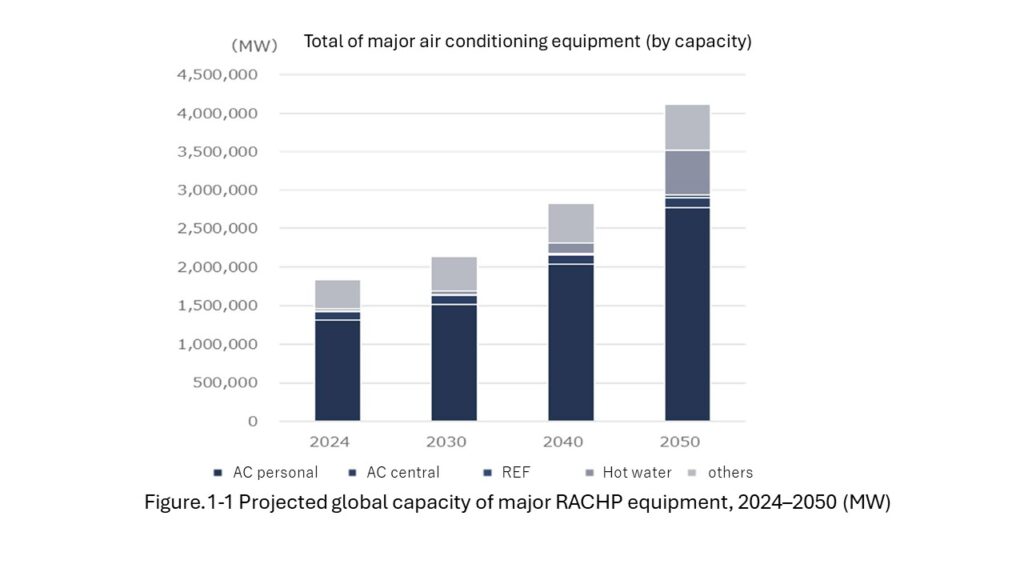
Demand for refrigeration and air conditioning equipment remains strong in Japan and globally. In Japan, residential air conditioners, commercial air conditioners, heat pump water heaters, chillers, ventilation units, refrigerated display cabinets and condensing units support daily life and business activity. Globally, air conditioner demand continues to grow, particularly in Asia and other warm regions where population growth, urbanization and higher living standards are increasing the need for reliable cooling.
This growth has two meanings. First, cooling is indispensable for modern society. It protects people from heat, keeps food and medicines safe, supports hospitals, schools, offices, shops and factories, and enables resilient urban life. Second, the industry’s responsibility is increasing. If growing demand is met by inefficient equipment or high-GWP refrigerants, the sector will become a larger source of greenhouse gas emissions.
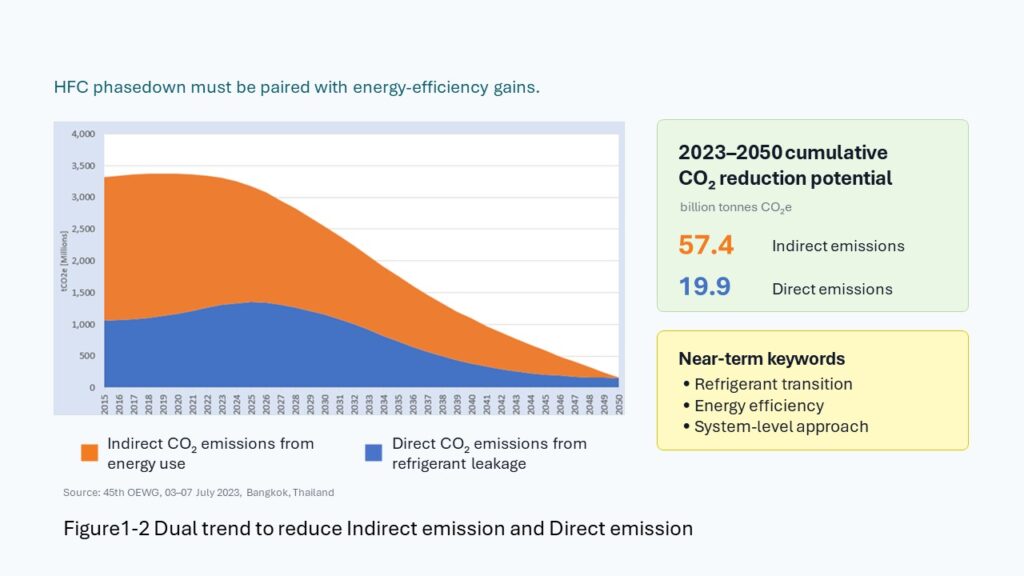
The challenge is therefore not to restrict cooling itself, but to make cooling sustainable. Sustainable cooling requires action on both direct and indirect emissions. Direct emissions come from refrigerant leakage during operation, servicing, repair and disposal. Indirect emissions come mainly from electricity consumption during equipment operation. Depending on the application, climate and electricity mix, indirect emissions can represent a large part of total climate impact. Therefore, refrigerant transition and energy efficiency improvement must be pursued together, as two sides of the same transition.
JAPAN’S POLICY CONTEXT AND THE S+3Es CONCEPT
Japan has committed to carbon neutrality by 2050. Recent national climate and energy policies emphasize steady greenhouse gas reduction, energy conservation, electrification and the use of non-fossil energy. For the refrigeration and air conditioning sector, several policy frameworks are relevant, including the Act on Rational Use and Proper Management of Fluorocarbons, the Ozone Layer Protection Act, the High Pressure Gas Safety Act and the Energy Conservation Act, including the Top Runner Program.
Each framework has a different purpose: refrigerant control, ozone layer protection, safety and energy efficiency. However, in actual product development and market implementation, these issues cannot be separated. This is why coordination among policies is important. A measure that is effective from one viewpoint may create difficulties from another viewpoint if the overall balance is not considered.
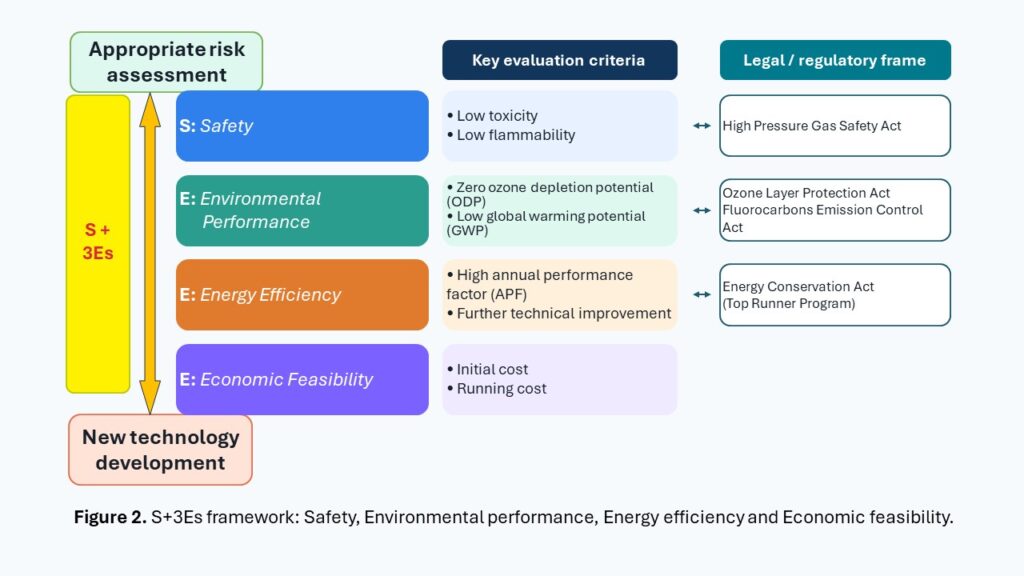
Japan’s industry often explains this balance through “S+3Es”: Safety, Environmental performance, Energy efficiency and Economic feasibility. Safety is non-negotiable, especially when mildly flammable or highly flammable refrigerants are considered. Environmental performance requires zero ozone depletion potential and lower global warming potential. Energy efficiency is essential because much of the lifecycle impact of equipment comes from operation. Economic feasibility is also necessary, because technologies must be accepted by users and spread widely in the market.
The S+3Es approach is not an excuse for delaying action. Rather, it is a framework for making climate action durable and scalable. A transition that ignores safety will not be accepted by users, installers or regulators. A transition that ignores efficiency may not reduce total emissions. A transition that ignores cost may not reach households, small shops and ordinary commercial users. All four elements must move together.
This point is particularly important for refrigerant selection. The GWP value of a refrigerant is very important, but it cannot be the only criterion. The best option may differ depending on product type, capacity, installation environment, servicing practice, user behavior and local regulation. For example, a refrigerant suitable for factory-built small equipment may not be suitable for large field-installed systems. A practical transition requires careful product-by-product and application-by-application evaluation.
PRACTICAL ACTIONS IN JAPAN
Japan’s industry is taking practical actions in several areas. The first is the development and evaluation of next-generation low-GWP refrigerants and compatible equipment. Research and development cover applications such as residential air conditioning, commercial air conditioning and refrigerated display cabinets. The key point is to evaluate not only refrigerant properties, but also equipment efficiency, reliability, safety, manufacturability and actual usability in the market. Refrigerant transition should be treated as a system design issue, not simply as replacement of one working fluid with another.
The second area is risk assessment for flammable refrigerants. A3 refrigerants, for example, may have excellent environmental characteristics, but their high flammability requires careful consideration. For chillers and residential air conditioners, risk assessment must cover refrigerant charge, leakage scenarios, ventilation, ignition sources, installation conditions, servicing procedures and end-of-life handling. Safety must be designed into the entire lifecycle of the product. It must also be supported by appropriate standards, training and communication with installers and service technicians.
The third area is leakage detection and monitoring. Continuous monitoring systems can help detect refrigerant leakage at an early stage, reduce emissions during use and improve maintenance practices. This kind of measure is sometimes less visible than the introduction of a new refrigerant, but it is highly practical. It is particularly important for existing equipment already installed in the market. In the future, digital monitoring may also contribute to predictive maintenance, better operation and lower lifecycle cost.
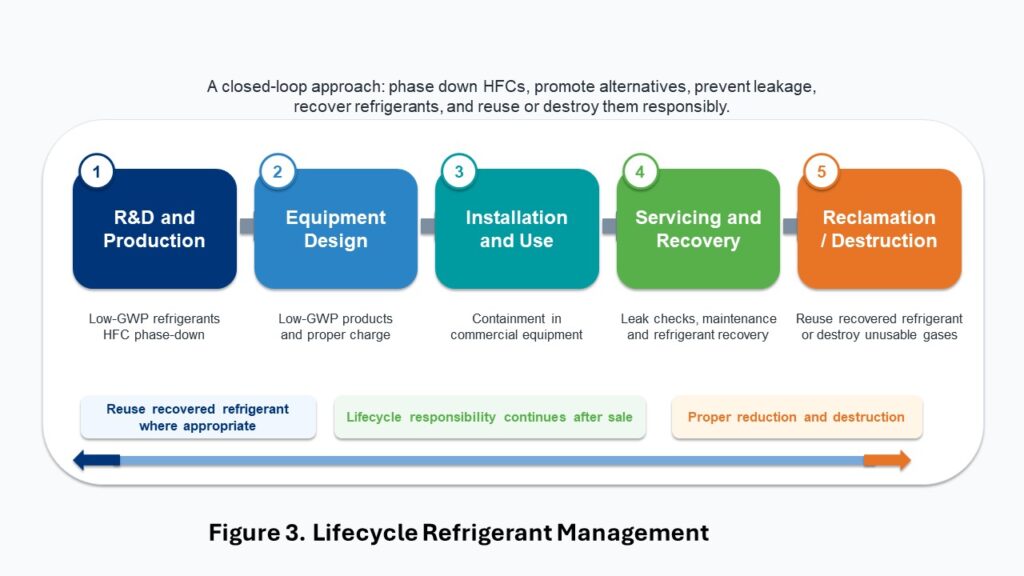
The fourth area is refrigerant recovery and reclamation. Even if new equipment shifts to lower-GWP refrigerants, existing equipment still contains a significant amount of HFCs. Proper recovery at servicing and disposal, followed by reclamation and reuse where appropriate, can reduce demand for virgin refrigerants and support a circular economy. Reclamation can serve as an important bridge measure during the transition period. It also sends an important message: refrigerant management does not end when equipment is sold. The responsibility continues throughout the lifecycle.
These actions show that refrigerant transition is not only an upstream technology issue. It also involves product design, field installation, servicing, leakage prevention, recovery infrastructure, recycling and user acceptance. The more ambitious the transition becomes, the more important these practical elements will be.
FROM EQUIPMENT TO SYSTEMS
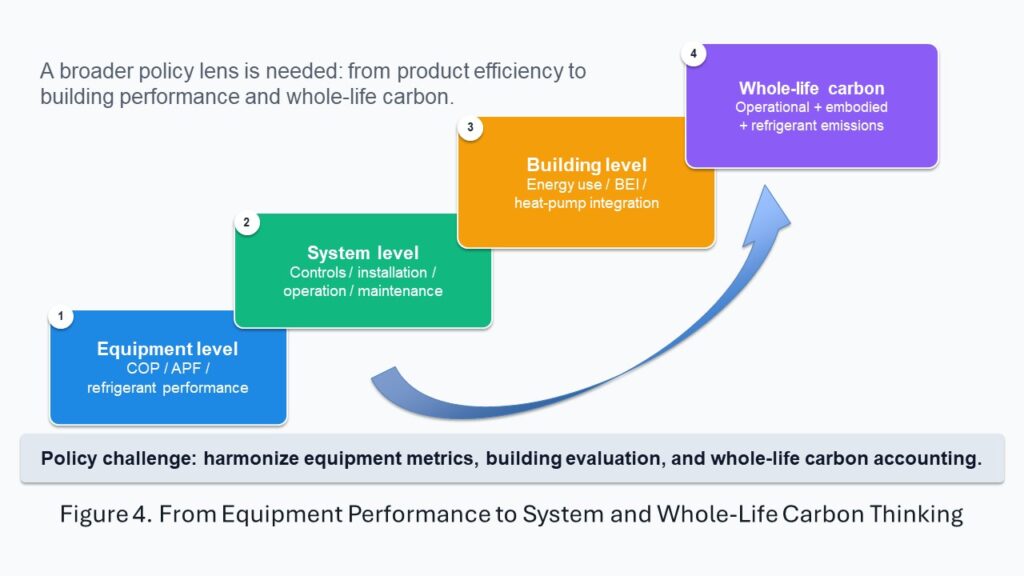
The next challenge is to move from equipment-level thinking to system-level and lifecycle thinking. Equipment efficiency and refrigerant characteristics remain essential, but carbon neutrality by 2050 requires a broader view.
In Japan, whole-life carbon assessment for buildings is becoming an important policy topic. Air conditioning, ventilation, refrigeration and heat pump systems are closely connected with building energy use. High-efficiency equipment and heat pump technologies can contribute greatly to reducing operational emissions. At the same time, embodied carbon, replacement cycles, refrigerant emissions and maintenance practices are becoming part of the wider discussion.
The important issue is harmonization. Equipment-level performance indicators, building energy evaluation, refrigerant management and whole-life carbon assessment should not develop independently without coordination. If each system uses different assumptions or incentives, manufacturers, designers, installers and users may face confusion. The goal should be to encourage real CO₂ reduction, not merely compliance with separate indicators.
Heat pumps also have an important role. As electricity becomes less carbon-intensive, efficient heat pump technologies can contribute to decarbonization of heating, cooling and hot water supply. Their contribution, however, should be evaluated in the broader context of system performance, building operation and lifecycle emissions. In this sense, the discussion on sustainable cooling is expanding beyond equipment itself to buildings, energy systems and society as a whole.
INTERNATIONAL COOPERATION
Refrigeration and air conditioning is a global industry. Refrigerants, components, products, standards and regulations move across borders. International cooperation is therefore essential. Japan has participated in international standardization and exchanges with industry associations and stakeholders in Asia, Europe, the United States and other regions. Such cooperation helps improve mutual understanding and supports more practical rule-making.
This cooperation is especially important for developing countries and high ambient temperature regions where cooling demand is expected to increase rapidly. These regions have an opportunity to avoid locking in inefficient equipment and high-GWP refrigerants. However, solutions must be practical and suited to local conditions, including climate, building types, electricity systems, safety rules, service infrastructure and economic capacity.
Japan’s experience may offer one useful lesson: ambition must be combined with implementability. Sustainable cooling requires not only products, but also standards, training, safety rules, recovery infrastructure, maintenance capacity and market support. Simply transferring a technology or regulation from one region to another may not be sufficient. Each country needs a pathway that reflects its own circumstances, while remaining aligned with global climate goals.
CONCLUSIONS
The refrigeration, air conditioning and heat pump sector is both part of the climate challenge and part of the climate solution. Cooling demand will continue to increase, and access to cooling is essential for health, food security, productivity and resilience. The task is not to reduce the importance of cooling, but to make cooling sustainable.
The main message of this article is that sustainable cooling requires balance. Lower-GWP refrigerants are indispensable, but GWP alone cannot determine the best pathway. Energy efficiency is essential, but it must be pursued together with refrigerant management. Safety is non-negotiable, especially when flammable refrigerants are used. Economic feasibility is also necessary, because technologies must spread widely in the real market to deliver environmental benefits.
Japan’s S+3Es approach provides a practical framework for this transition. Looking toward 2050, the industry must continue to develop low-GWP refrigerants and high-efficiency equipment, improve leakage detection, strengthen recovery and reclamation, assess whole-life carbon and contribute to international cooperation. Ten years after the Kigali Amendment, the global cooling sector should move from commitment to implementation through realistic, safe, affordable and scalable solutions. The challenge is complex, but the direction is clear: cooling must remain available, reliable and useful for society, while becoming compatible with a carbon-neutral future.

Tetsuji Okada