
2026 has been marked by record-breaking heatwaves and other extreme weather events such as intense summer wildfires in Australia and South America, alongside catastrophic heavy rainfall and displacement across southern Africa. Temperatures in the northern hemisphere have soared past historic highs, pushing power grids towards maximum capacity, straining household budgets and stretching health facilities.
As temperatures increase, cooling has become a matter of survival. Yet the very technologies that provide relief—air conditioners, refrigerators, and cold chains—can worsen the climate crisis as the vast majority of equipment still relies on hydrofluorocarbons (HFCs), greenhouse gases thousands of times more potent than carbon dioxide. This is the paradox the parties to the Montreal Protocol on Substances that Deplete the Ozone Layer were faced with more than a decade ago, and one they were determined to solve.
The Montreal Protocol, adopted in 1987, had already proven itself as one of the most successful environmental treaties in history. By phasing out ozone‑depleting substances, it has put the Earth’s protective shield on a clear path to recovery by
mid-century and prevented up to 1°C of warming.
In 2007, a scientific study quantified that the Protocol had already avoided 135 gigatonnes of CO₂‑equivalent emissions (equal to the greenhouse gas emissions of more than 28.5 billion cars driven in one year)[1] through the phase-out of 99 per cent of ozone-depleting substances under the Protocol. The remaining 1 per cent is largely hydrochlorofluorocarbons (HCFCs), which are expected to be phased out by 2030.
But as chlorofluorocarbons (CFCs) started to disappear, their replacements, HFCs, rose rapidly. While harmless to the ozone layer, they are powerful greenhouse gases. By 2009, another study projected that the use of HFCs and emissions from such use were set to surge in the coming decades in response to the regulations to phase out CFCs. Alarm bells started ringing!
Negotiating the Kigali Amendment
Diplomatic momentum began with small island states. In 2009, the Federated States of Micronesia and Mauritius tabled the first proposal to bring HFCs under the Montreal Protocol. A year later, the United States, Canada, and Mexico followed with a joint proposal.
Progress was slow. Many countries argued that HFCs were not ozone‑depleting and therefore outside the Protocol’s scope. In the early years of discussions, some parties could not even agree to formally negotiate on the possibility of HFCs being included in the list of controlled substance under the Protocol.
The turning point came in 2015, when a new study projected that HFCs alone could add 0.5 °C of warming by 2100. This evidence was described by negotiators as the “smoking gun.” At the Twenty‑Seventh Meeting of the Parties in Dubai, governments agreed to formally discuss a possible amendment to the Protocol relating to HFCs.
Negotiations were arduous and long. Every detail mattered: phase down schedules, financial support, technology pathways, and economic impacts. One negotiator described the process as “a chessboard limitlessly complex”.
By October 2016, after seven years of debate, the breakthrough came at the Twenty-Eighth Meeting of the Parties in Kigali, Rwanda when an amendment to phase down HFCs was adopted.
Since entering into force in 2019, the Kigali Amendment has driven over 170 nations to legally commit to an 80–85 per cent phase down of HFCs by the late 2040s. Full ratification and implementation of the Amendment could avoid up to 0.5 °C of warming by 2100—potentially double if paired with a transition to more efficient cooling technology.
Impacts of the Kigali Amendment
The Kigali Amendment’s design goes further than tackling the production and consumption of HFCs and the reduction of HFC-23 emissions. It promotes the transition to equipment using refrigerants with low or zero global warming potential (GWP) that are also being built to be more energy efficient. This means that air conditioners and refrigerators that move away from the use of HFCs generally consume less electricity. As a consequence, power grids face less stress, households save money, and emissions from fossil fuels decline.
The benefits go beyond emission reductions and energy efficiency. The transition is also creating jobs. Additional technicians are being trained worldwide. Manufacturing hubs are producing more equipment that use natural refrigerants, while companies are investing in research and development. Frameworks to integrate Kigali goals are helping to ensure that construction of new buildings use efficient cooling with low‑GWP refrigerants.
Safety standards have been rewritten to address flammability and toxicity risks of alternatives to HFCs, mandating improved ventilation, leak detection, and charge limits. Energy efficiency laws now complement refrigerant regulations, requiring better insulation, smarter thermostats, and passive‑cooling design.
For developing countries (Article 5 parties), ratification of the Kigali Amendment has opened access to financial and technical assistance, helping modernise industries and enhance the skills of workers in the refrigeration, air conditioning and heat pump (RACHP) sector. For developed countries (Article 2 parties), ratification provides a head start in deploying new technologies, securing export advantages in global markets.
Implementation of the Kigali Amendment and its impacts are gaining traction. Across regions, parties are advancing their Kigali implementation plans and HFC phase down strategies. Countries are pairing ratification with legislation mandating HFC reductions, unlocking investment and green jobs. In Asia, for example, governments are aligning national cooling action plans with Kigali timelines and investing in natural refrigerants and technician training, while in Africa, innovation coupled with performance standards has driven affordable access to efficient cooling through financing schemes and pilot schemes to support equipment replacement.
These short-term benefits are immediate, slowing near term warming while the longer-term benefits are transformative, preventing up to half a degree of warming by 2100.
A future worth building
The successes to date are noteworthy but can be accelerated with additional capacity and support to address transition challenges. While the economic benefits are clear, there are short-term costs for long-term financial gain. Replacing old systems is costly. Most companies cannot simply switch refrigerants and technologies; they must be replaced or heavily retrofitted with specialised components designed to handle high pressures or prevent explosions, especially in hot climates.
As is often the case, new ideas face market obstacles. Alternative refrigerants—natural options such as ammonia or propane, which are toxic or flammable, respectively—face technical challenges that need to be addressed if consumer trust is to be gained. Constraints on the supply of low- and zero-GWP refrigerants and lower production volumes keep market prices high. Regulatory reform and the corresponding institutional capacity to set change in motion requires time and can bring about higher consumer prices and industrial costs in the short term.
Despite some of these challenges, the Kigali Amendment’s impacts are measurable and demonstrable.
The Next Chapter
Ten years on, the Kigali Amendment is a triumph of collaboration and cooperation. Nations once more came together to solve a problem that impacts everyone. It is a story of intelligent cooling in a warming world. It shows that action can be pragmatic, equitable, and effective. It also proves that cooperation can deliver results even when headlines are dominated by division and multilateralism is under strain. Continued success will require political will, institutional participation, and support from science, industry, and business.
Together, the Montreal Protocol and its Kigali Amendment do far more than guide the transition to climate friendly refrigerants. They drive innovation in cooling technologies, strengthen regulatory frameworks, support improvements in servicing, and safeguard both ozone and climate integrity.
Implementation is everything. The Montreal Protocol reversed ozone depletion because it was universally ratified. The same must happen for the Kigali Amendment. As we face escalating heatwaves, wildfires and droughts coupled with rising cooling demand, the Amendment’s legacy is clear: sustainable cooling is not just possible, it is a necessity, is already underway and needs to maintain momentum.
Full implementation is key. If nations stay the course, the Kigali Amendment will be remembered not just as a quiet success, but as one of the greatest environmental achievements of our time.
[1] https://www.epa.gov/energy/greenhouse-gas-equivalencies-calculator.
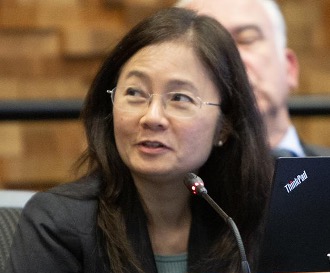
Maria Socorro Manguiat