
Abstract
The Kigali Amendment brings multiple new challenges, in particular for Article 5 countries that are simultaneously phasing out HCFCs. Experience from the phase-out of ozone-depleting substances (ODS) and Europe’s early action to phase out hydrofluorocarbons (HFCs), shows that as the phase-down progresses, robust policy measures will be needed to avoid large-scale illegal trade.
Since 2019, the Parties to the Montreal Protocol have held multiple discussions on ‘Further strengthening Montreal Protocol institutions’, most recently through an informal meeting on facilitating implementation of the Montreal Protocol ahead of the 37th Meeting of the Parties (MOP37). This paper discusses lessons from the illegal trade of HFCs in the EU, exploring a range of opportunities to advance a series of concrete actions to strengthen the effective implementation and enforcement of the Montreal Protocol.
Introduction
The Montreal Protocol is widely regarded as one of the world’s most successful environmental agreements. Since its adoption in 1987, it has driven the global phase-out of ozone-depleting substances (ODS), delivering major benefits for both the ozone layer and the climate. The 2016 Kigali Amendment expanded its remit to include hydrofluorocarbons (HFCs), which commits the world’s nations to significantly reduce consumption and production of HFCs.
As the Kigali Amendment enters early phases of implementation for Article 5 Parties, many face the dual challenge of completing the hydrochlorofluorocarbon (HCFC) phase-out while beginning to reduce HFC consumption. Experience from previous ODS phase-outs demonstrates that tightening supply controls, while environmentally essential, also creates strong financial incentives for illegal trade if regulatory systems and enforcement fail to keep pace. Europe provides an important case study. As the first region to introduce an HFC phase-down, it experienced widespread illegal trade within only a few years of implementation, prompting the introduction of some of the world’s most comprehensive measures to strengthen enforcement.
However, Europe’s experience also demonstrates that enforcement alone cannot solve the problem. Illegal trade is ultimately driven by continued demand for controlled substances. Where industries remain dependent on HFCs, criminal networks are presented with lucrative opportunities to supply cheaper illegal products. Conversely, where policies accelerate the uptake of non-fluorinated alternatives, demand for illegal HFCs falls.
Lessons from previous ODS phase-outs
Illegal trade has accompanied every major phase-out under the Montreal Protocol. During the 1990s, as developed countries rapidly phased out chlorofluorocarbons (CFCs), differences in production and consumption controls created opportunities for criminal networks to exploit price disparities between regulated and unregulated markets. EIA investigations uncovered Chinese exporters falsely declaring virgin CFCs as recycled refrigerants, while US authorities exposed transit regimes being used to divert illegal shipments onto domestic markets. [1] These experiences prompted Parties to adopt an Amendment the Protocol, introducing mandatory import and export licensing systems that remain a cornerstone of the Protocol today. [2]
Similar patterns emerged during the hydrochlorofluorocarbon (HCFC) phase-out. In Europe, UNEP estimated that up to ten shipments of illegal HCFCs entered southern Europe each day during the late 2000s.[3] Elsewhere, customs authorities in the Philippines and Thailand intercepted cylinders falsely labelled as HFC-134a that were found to contain mixtures of CFCs, HCFCs and hydrocarbons.[4] These cases demonstrated that illegal traders rapidly adapt to new controls, exploiting weaknesses in licensing systems, customs procedures and product identification.
Many of the methods first observed during ODS phase-outs continue to characterise illegal HFC trade today. These include false labelling, misdeclaration of customs codes, diversion of goods under transit procedures, fraudulent claims that virgin refrigerants are recycled or reclaimed, and the concealment of cylinders within legitimate cargo. As HFC controls tighten under the Kigali Amendment, these well-established trafficking methods are likely to remain attractive unless Parties strengthen both enforcement and regulatory oversight.
The European Union (EU) provides the first large-scale example of these challenges under an HFC phase-down. Since introducing its quota system in 2015, the EU has experienced significant illegal trade, providing valuable lessons for countries now implementing the Kigali Amendment.
Europe’s experience with illegal HFC trade
The EU became the first major jurisdiction to phase down HFC consumption when it introduced a quota system under the 2014 F-gas Regulation. Despite significant stockpiling before the Regulation entered into force, reports of illegal imports began emerging within a year. In 2019, EIA’s Doors Wide Open investigation demonstrated how easily HFCs could enter the EU without quota, and subsequent analysis suggested illegal imports accounted for as much as 20–30 per cent of the European market during the early years of the phase-down.[5]
The economic incentives driving this trade are clear. Between 2014 and 2025, HFC prices within the EU increased by almost tenfold as quotas tightened.[6] This created a substantial price differential between Europe and regions where HFC production remained unrestricted, allowing smugglers to generate significant profits even when selling refrigerants below legitimate market prices.
The trade has been particularly pronounced for very high global warming potential (GWP) refrigerants such as R404A. Because the EU quota is based on carbon dioxide equivalence (CO₂e) emissions, these gases consume a disproportionate share of available quota, making them increasingly expensive and difficult to obtain legally. While legitimate suppliers have gradually withdrawn from the market, illegal traders have met the continued demand. EIA investigations found traders openly offering banned refrigerants, while others marketed supposedly reclaimed gases that were suspected to be virgin imports. At the same time, counterfeit refrigerants have become increasingly common, with high-GWP gases being falsely sold as newer, lower-GWP blends.
Recognising these challenges, the EU significantly strengthened its regulatory framework in 2024. The revised F-Gas Regulation goes beyond simply reducing HFC supply by introducing measures designed to close many of the loopholes exploited during the first phase of implementation. Among the most important innovations is the integration of the EU Customs Single Window on ODS and F-gases, enabling customs authorities to verify real-time import quotas electronically before consignments enter the European market. The Regulation also requires Member States to designate specialist customs offices, strengthens penalties for illegal trade, tightens eligibility requirements for new quota applicants and introduces stricter controls on refillable cylinders and take-back schemes. Together, these measures represent one of the world’s most comprehensive regulatory responses to illegal HFC trade.
However, Europe’s experience also demonstrates that stronger enforcement alone is insufficient. Illegal trade persists because substantial demand for HFCs remains. Commercial refrigeration illustrates this challenge particularly well. Although the EU prohibited many new supermarket refrigeration systems using high-GWP refrigerants from 2022, existing systems can remain in operation for 10 to 20 years. As a result, only around 34 per cent of centralised supermarket refrigeration systems had transitioned to natural refrigerants by 2025, leaving a large installed base dependent on HFC servicing.[7] This continuing demand provides an attractive market for illegal imports.
The EU’s experience therefore highlights the importance of introducing demand-reduction measures early in the phase-down. Equipment bans, subsidies and policies promoting natural refrigerants reduce future dependence on controlled substances and, consequently, the profitability of illegal trade. Waiting until shortages emerge before encouraging alternatives risks locking countries into prolonged demand for increasingly scarce refrigerants.
Another emerging challenge is the rapid growth of online marketplaces. Digital platforms have transformed the way refrigerants are traded, providing sellers with direct access to large numbers of customers while making regulatory oversight more difficult. A 2026 EIA assessment of HFC advertisements on Poland’s Facebook Marketplace found widespread non-compliance with both the EU Digital Services Act and the F-gas Regulation.[8] Many advertisements lacked basic trader information, offered prohibited disposable cylinders or appeared to disguise illegal products through misleading descriptions and images. As refrigerant sales increasingly move online, effective enforcement will require much closer engagement with digital platforms alongside traditional customs inspections.
Financial investigations also represent an underused enforcement tool. Illegal HFC trade frequently involves organised criminal networks engaged not only in smuggling but also in VAT fraud, customs evasion and money laundering. EIA estimates suggest illegal HFC imports between 2018 and 2020 may have deprived European governments of around €77 million annually in unpaid taxes and customs duties. Recent prosecutions in Romania and Spain demonstrate that investigating financial crime alongside environmental offences can substantially strengthen enforcement outcomes and increase deterrence.[9]
Taken together, Europe’s experience demonstrates that successful implementation of the Kigali Amendment requires a balanced approach. Effective licensing systems, stronger customs controls and meaningful penalties remain essential, but they must be complemented by policies that reduce dependence on HFCs. Ultimately, enforcement can only limit illegal supply; lasting success depends on reducing the demand that makes illegal trade profitable in the first place.
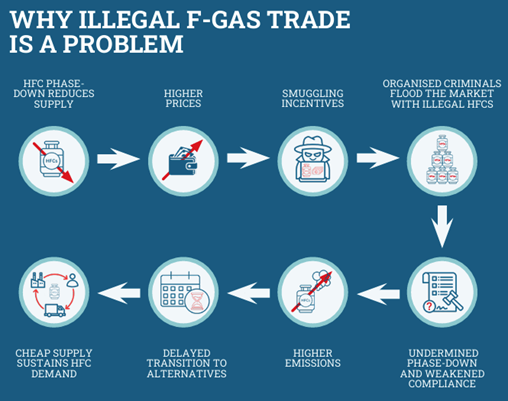
Figure 1. Flow chart showing how criminals capitalise on ongoing HFC demand and surging prices, undermining compliance and leading to additional emissions.
What the Kigali Amendment can learn from Europe
As all countries begin implementing the Kigali Amendment, Europe’s experience offers valuable lessons for strengthening the Montreal Protocol before illegal HFC trade becomes entrenched. Discussions among Parties ahead of the 37th Meeting of the Parties (MOP37) highlighted many of these priorities, including stronger licensing systems, better information sharing, improved customs cooperation and enhanced monitoring of domestic HFC markets. These discussions reflect growing recognition that implementation of the Kigali Amendment will require more than simply allocating quotas; it will need coordinated systems capable of preventing and detecting illegal trade throughout the supply chain.
One of the clearest lessons is the importance of introducing robust regulatory measures early. Europe demonstrates that waiting until quota reductions begin to constrain supply allows demand for HFCs to persist, creating profitable opportunities for criminal networks. Kigali Implementation Plans (KIPs) therefore provide a critical opportunity for Article 5 Parties to introduce targeted equipment restrictions in sectors where non-fluorinated alternatives are already commercially available, such as domestic refrigeration, commercial refrigeration and, increasingly, air conditioning. Reducing demand before supply shortages emerge is likely to be far more effective than relying solely on enforcement once illegal markets have become established.
The European experience also highlights opportunities to strengthen implementation mechanisms under the Montreal Protocol. Digital licensing systems that enable customs authorities to verify import authorisations in real time should become the norm, while closer integration between national ozone units and customs agencies would improve risk profiling and intelligence-led inspections. Similarly, greater consistency in reporting, investigation procedures and penalties would make it harder for criminal networks to exploit differences between national regulatory systems. Expanding and formalising tools such as the Informal Prior Informed Consent (iPIC) mechanism could further strengthen international cooperation by allowing authorities to verify traders and shipments before goods cross borders.
Europe’s experience also suggests that greater attention should be paid to areas that have traditionally received less focus under the Montreal Protocol. Online marketplaces are becoming increasingly important channels for refrigerant sales and should be incorporated into national enforcement strategies. Likewise, financial investigations should become a routine component of enforcement activity. Illegal HFC trade is often accompanied by tax evasion, customs fraud and money laundering, meaning that financial investigations can often impose penalties that are far more disruptive to organised criminal networks than environmental offences alone.
Finally, Parties should recognise that supply chain transparency will become increasingly important as HFC controls tighten. In many countries, proof of quota compliance is only required at the point of import, making illegally imported refrigerants difficult to distinguish from legitimate products once they enter domestic markets. Strengthening digital record-keeping and, ultimately, introducing traceability systems that follow refrigerants throughout the supply chain would significantly reduce opportunities for illegal products to be laundered into legitimate distribution networks. Similar approaches are already becoming standard practice in sectors ranging from food production to pharmaceuticals and should increasingly be considered for controlled refrigerants.
Conclusion
Nearly four decades after the adoption of the Montreal Protocol, illegal trade continues to evolve alongside each successive phase-out. The transition from ozone-depleting substances to HFCs has not fundamentally changed the incentives that drive criminal activity; rather, it has created new opportunities for organised networks to exploit differences in regulation, enforcement and market demand.
Europe’s experience demonstrates that strong enforcement is essential but cannot succeed in isolation. Even the world’s most comprehensive regulatory framework has struggled where demand for HFCs remains high. As the EU approaches its next major quota reduction in 2027, continued dependence on HFC-based equipment is likely to increase pressure on legal supply chains and further strengthen incentives for illegal imports.
The most important lesson for Parties implementing the Kigali Amendment is therefore that preventing illegal trade begins long before refrigerants reach the border. Effective customs controls, digital licensing systems, meaningful penalties and international cooperation are all critical components of a successful enforcement strategy. However, these measures must be accompanied by policies that accelerate the transition to non-fluorinated alternatives and reduce long-term dependence on HFCs. Without sustained demand reduction, enforcement efforts will remain reactive rather than preventative.
The Montreal Protocol has repeatedly demonstrated its ability to evolve in response to new environmental challenges. By applying the lessons emerging from Europe’s HFC phase-down; strengthening implementation institutions, improving international cooperation and accelerating the adoption of sustainable cooling technologies, Parties have an opportunity to prevent illegal HFC trade from reaching the scale previously seen during ODS phase-outs. Acting now will not only protect the integrity of the Kigali Amendment but also strengthen the Protocol’s reputation as the world’s most effective environmental treaty.
References
[1] EIA (1997) Chilling Facts About a Burning Issue: CFC Smuggling in the European Union
[2] Article 4B of the Protocol required Parties, by 1 January 2000, to establish and implement a system for licensing the import and export of new, used, recycled and reclaimed controlled substances. Decision IX/8 Licensing system outlined the basic requirements for the licensing system.
[3] UNEP (2008) OzonAction, HCFC Phase Out special issue
[4] EIA/UNEP (2011) Risk Assessment of Illegal Trade in HCFCs Available here
[5] EIA (2021) Europe’s Most Chilling Crime; The illegal trade in HFC refrigerant gases. Available here: https://eia-international.org/ report/europes-most-chilling-crime/
[6] European Commission (2025) Monitoring of Refrigerant Prices on the EU market. Results of Quarterly Survey: Quarter 1/2025. Available here: https://climate.ec.europa.eu/ document/download/f316472a-a893-4b0f-bbb8-b988fbee8fff_ en?filename=Price%20monitoring%20Q1_2025.pdf
[7] ATMO (2025) Refrigeration: Commercial and Industrial Refrigeration with Natural Refrigerants. Available here: https://atmosphere.cool/refrigeration-commercial-and-industrial-refrigeration-with-natural-refrigerants-2025/
[8] This is fakes frauds and F-gases which isn’t available online, so perhaps we don’t reference it?
[9] Profit.ro (2025) “Ghost companies: Damage of almost 11 million lei caused by two companies in Bucharest that sold freon gas” Press release 28 March 2025 https://www.profit.ro/taxe-si-consultanta/ firme-fantoma-prejudiciu-de-aproape-11-milioane-lei-cauzat de-doua-firme-din-bucuresti-care-au-comercializat-gaz freon-21982281 85 and Cooling Post (2025) Spanish tax agents seize 53 tonnes of illegal refrigerant. News 28th October 2025. Available here: https://www. coolingpost.com/world-news/spanish-tax-agents-seize-53 tonnes-of-illegal-refrigerant/

Fionnuala Walravens