
Introduction
Cooling is a major energy and climate challenge for small island developing states (SIDS). Rising temperatures, tourism growth, urbanization, and increasing demand for thermal comfort are driving rapid growth in air-conditioning demand. In most SIDS, cooling depends on conventional, energy-intensive vapor-compression systems using electricity generated by imported fossil fuels subject to high prices and volatility and resulting in high emissions. Seawater Air Conditioning (SWAC) is a promising not-in-kind cooling solution that offers lower costs, high reliability, energy reduction up to 90% and near elimination of refrigerant use.
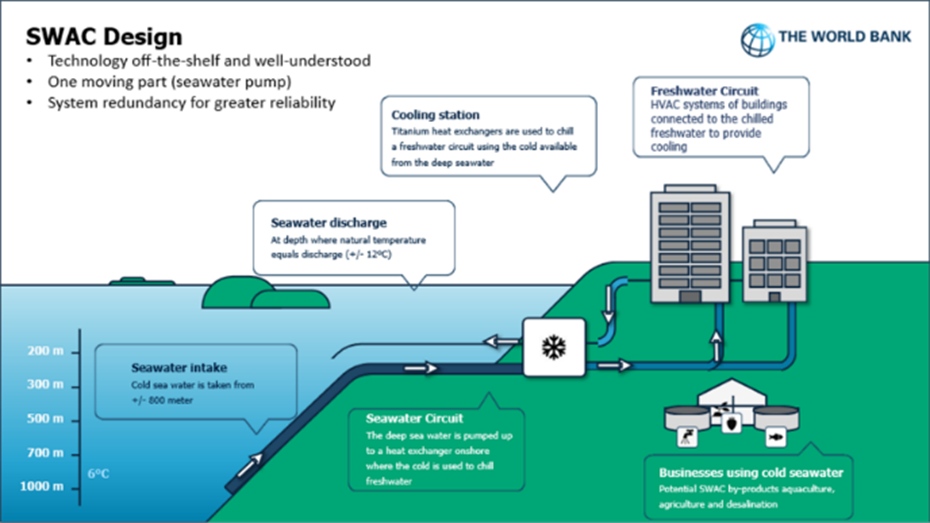
Figure 1: Design of Seawater Air-Conditioning System
How SWAC Works
SWAC systems draw cold seawater from ocean depths of 600 – 900 m where water temperatures are low and stable to shore via offshore high-density polyethylene (HDPE) pipes where it is passed through onshore titanium counter-flow heat exchangers to cool separate closed-loop freshwater systems. This chilled freshwater is then distributed to buildings through either a district cooling network or directly to individual customers. The seawater and freshwater circuits remain separated by the heat exchanger to prevent mixing of the fluids. All materials exposed to seawater (e.g., HDPE and titanium) are selected for seawater corrosion resistance
The only energy consumption of a SWAC system are standard seawater pumps to overcome drag through the pipelines and heat exchanger. In most conditions, SWAC saves up to 80-90% of the energy used by conventional air conditioning systems.
Why SWAC Matters for SIDS
SIDS face high and growing cooling needs, high electricity tariffs, limited electricity generation capacity, and heavy dependence on imported fuel. Tourism sector is the cornerstone for sustainable economic growth of most SIDS and cooling often accounts for more than 50% of electricity consumption at tropical hotels. This cost would be significantly lowered by using a locally available natural cooling resource rather than imported fuels and refrigerants.
SWAC supports both climate change mitigation and adaptation anchored around the objectives of the Montreal Protocol and the Kigali Amendment and often comes with co-benefits in the blue economy realm. It can also complement SIDS’ clean energy transition, together with renewable energy deployment thereby easing pressure on island power grids. In SIDS, SWAC can form part of a wider sustainable cooling action plans that include energy efficient ACs, passive building design, district cooling, renewable energy, and climate-resilient infrastructure.
SWAC Deployment to Date
While not yet widespread in use, SWAC – and variants using cold lake water – have been deployed and used around the world for many years as shown in Figure 2. The track record of these systems is reliability, low costs and high sustainability, all of which are particularly relevant for SIDS.
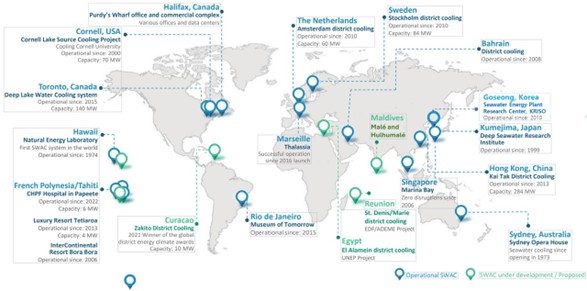
Figure 2: Deployment of SWAC Systems
Implementation Methodology and Site Selection
SWAC projects can be developed through a staged methodology, involving multiple stakeholders in both the public and private domain.
- Screening locations for accessible cold deep seawater that is not too far from the shore to the target intake depth.
- Screening for cooling demand. SWAC works best where cooling load is sufficiently large and dense to justify the cost of the marine pipeline.
- Technical and financial assessments, examining pipeline length and cost of deployment, pumping energy, heat exchanger design, discharge location, and integration into customers’ current systems. This also includes financial analysis to assess SWAC cost versus status quo and competing cooling options.
- Environmental and social assessment. The two primary environmental risks are: (i) disturbance of seabed habitats during pipeline installation, and (ii) localized effects from discharge of the warmed seawater. Existing SWAC facilities show these risks can be managed but must be assessed for each SWAC project based on local conditions.
Caribbean Experience and Grenada SWAC Case Study
This cooling challenge is particularly acute across Caribbean SIDS, where heat stress is intensifying, and where cooling is a frontline climate adaptation need. Their heavy dependence on imported fossil fuels along with inefficient cooling compounds their fiscal vulnerability in addition to generating emissions. Recent work in the region illustrates the potential for SWAC to be a sustainable cooling solution. Studies supported by the World Bank identified Jamaica, Grenada, the Dominican Republic and Dominica as the most promising SWAC sites in the Caribbean. Subsequent pre-feasibility studies found most of those sites feasible and attractive for SWAC
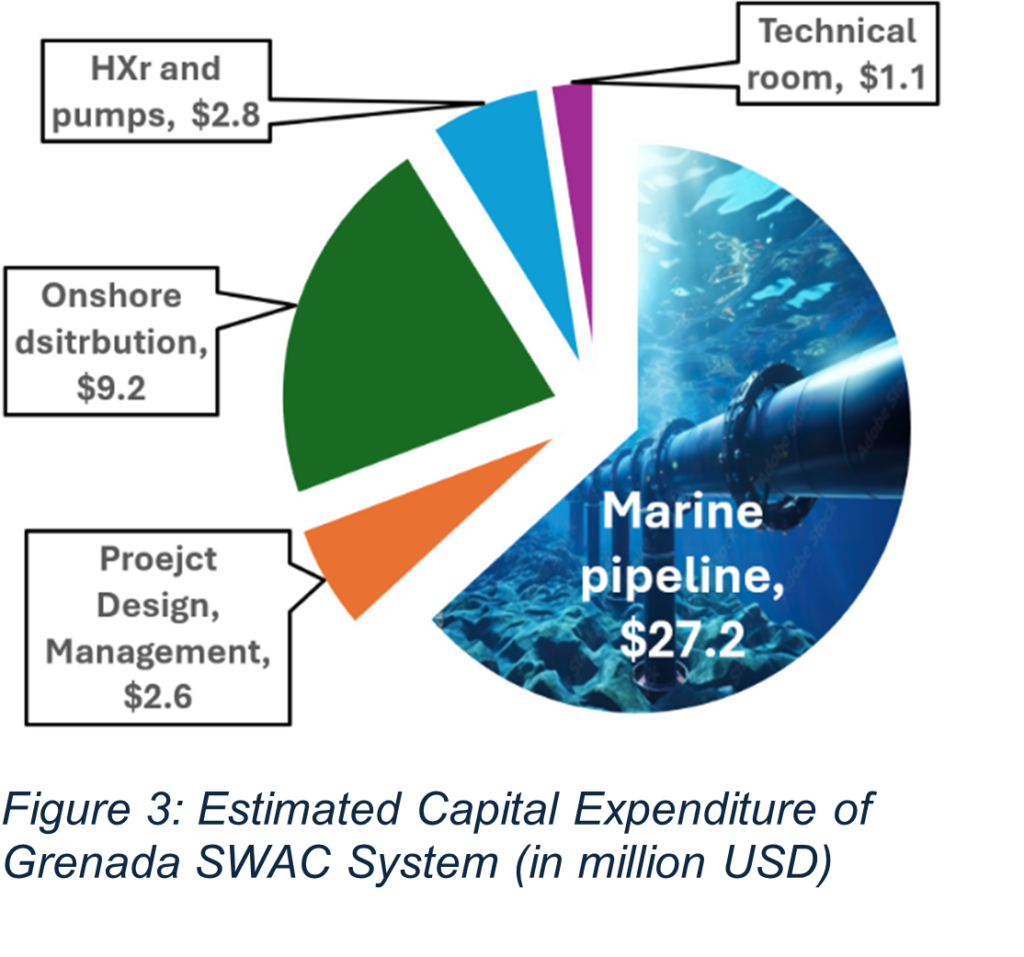
Grenada is emerging as one of the most advanced SWAC opportunities in the Caribbean. The proposed system, being developed with World Bank support, would initially supply 2,360 refrigeration tonnes (RT) cooling to four anchor customers: the Maurice Bishop International Airport (MBIA), St George’s University, and two private coastal resorts. The project, with an estimated capital expenditure of $43.1 million (Figure 3), would be structured as a public-private partnership (PPP) blending lower-cost public funding with commercial investment, with practically no initial capital investment by end-user, customers and beneficiaries of the cooling service.
Despite the higher capital costs of the SWAC system, the reduction in electricity use of 86% – combined with the relatively high cost of electricity in Grenada – means that the all-in cost of the SWAC system woud be up to 30% less than that of conventional air-conditioning serving the same cooling needs. In addition, SWAC would provide numerous other environmental, economic and other broader co-benefits in the blue economy domain. Figure 4 compares the annual costs and benefits of Grenada SWAC system against conventional chillers with the same cooling capacity.
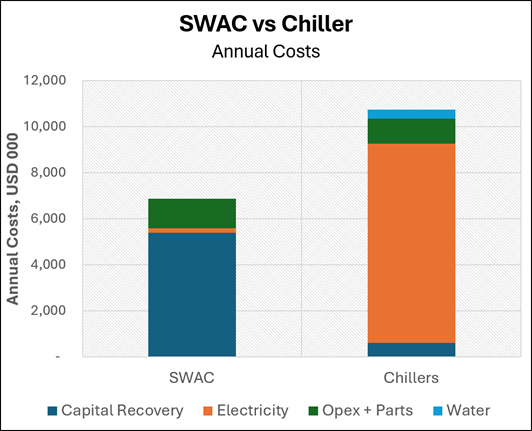
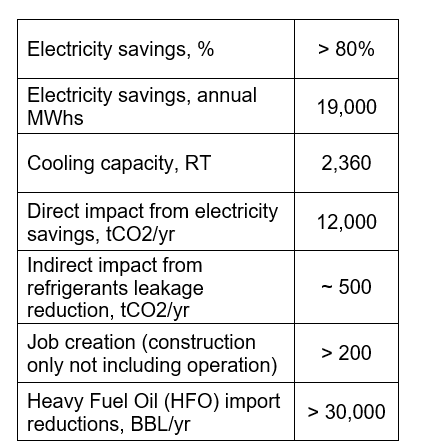
Figure 4: Benefits of Grenada SWAC over Conventional Chillers
Mauritius SWAC project
The World Bank Group is also supporting development of a SWAC project in Mauritius in the Indian Ocean to serve major hotels on the coast. To date, two major hotels have signed letters of intent (LOIs) to pursue SWAC and others are currently negotiating their one LOIs. The first two sites would encompass 6,500 refrigeration tonnes (RT) and have a capital cost of approximately EUR 83 million.
Going Forward
SWAC has the potential to lower costs for cooling while also greatly lowering energy use and direct and indirect emissions. This is particularly valuable in island power systems where electricity is expensive, and its supply is often constrained. SWAC also has refrigerant-related benefits because it replaces conventional chillers and their use of high-GWP refrigerants. SWAC improves competitiveness for end-users, eliminates noise and heat rejection from conventional cooling and supports broader blue economy strategies by using the cold, deep seawater for aquaculture, desalination and marine research.
However, SWAC also faces barriers to wider deployment, including high upfront costs for offshore and onshore infrastructure. Its viability is highly site-specific, depending on access to deep cold water nearby and sufficient cooling demand. It also requires specialized engineering and maintenance capacity, which may need to be brought in for some locations.
While SWAC is not a substitute for all other cooling measures, where conditions are favorable, it can become a cornerstone of a sustainable cooling strategy for SIDS. Combined with energy efficiency, passive design, renewable power, resilient infrastructure, and strong marine stewardship, SWAC can help islands in their path towards clean energy transition while meeting the rising cooling needs without deepening their dependence on high-carbon and high-GWP refrigerant based cooling pathways.

Jonathan Coony

Thanavat Junchaya

Ashok Sarkar