
Abstract
The transition to clean cooling using natural working fluids is gaining momentum and represents a critical pathway towards the necessary defluorination of the refrigeration and heat pumping sectors. A decade after the adoption of the Kigali Amendment to the Montreal Protocol, notable progress has been achieved in reducing high-global-warming-potential (GWP) refrigerants. However, fluorinated gases (F-gases), including substances that fall under the broader category of per- and polyfluoroalkyl substances (PFAS), continue to pose significant and growing environmental and public health concerns. PFAS contamination has emerged as a pressing local and global issue, with documented impacts on ecosystems and drinking water supplies across Europe and wherever measured.
Natural working fluids, such as ammonia, carbon dioxide, hydrocarbons, and others, offer proven, energy-efficient, and environmentally benign alternatives for the HVAC&R sector. These technologies are already mature and widely deployed across a broad range of refrigeration and heat pump applications. Despite their availability, the continued installation of F-gas-based systems persists, often without adequate consideration of long-term environmental and health implications.
This contribution emphasizes the urgency of accelerating the transition away from F-gases by presenting practical, safe and economic examples of systems utilizing natural working fluids across the refrigeration and heat pumping sectors. It demonstrates that the ongoing reliance on F-gas technologies is increasingly unjustified given the technical maturity and market readiness of natural refrigerant based solutions. Furthermore, insufficient information is provided to end users, who are often not explicitly informed about the environmental and health risks associated with refrigerant choices. As a potential policy measure, the introduction of a mandatory declaration, to be signed by system owners to acknowledge these risks, could enhance transparency, support informed decision-making, and help drive market transformation toward sustainable and fluorine-free alternatives.
Keywords: Clean cooling and heat pumping; defluorination; natural refrigerants
1. Introduction
Lorentzen [1, 2], Ciconkov [3], and Kauffeld & Dudita [4] have emphasized earlier that achieving a sustainable refrigeration sector ultimately requires the elimination of synthetic refrigerants and the prevention of their emissions. Natural refrigerants have been used successfully in refrigeration and heat pump applications since the nineteenth century and provide nowadays again proven alternatives to fluorinated substances. Many synthetic refrigerants contribute to environmental burdens through their atmospheric degradation products, including PFAS-related compounds such as trifluoroacetic acid (TFA), which is highly persistent in the environment. Therefore, alongside the revised EU F-gas Regulation and the Kigali Amendment to the Montreal Protocol, the proposed ECHA PFAS restriction is expected to further accelerate the phase-out of most synthetic refrigerants [5].
As highlighted by Arp et al. [6], trifluoroacetic acid (TFA) has become the dominant PFAS in the environment, originating primarily from the atmospheric degradation of fluorinated gases and certain pesticides, Palm [7] and Hart et al. [8] similarly identify F-gases as a major source of TFA formation. Arp et al. further warn that TFA may represent a ‘planetary boundary threat for novel entities’ because of its rapidly increasing global exposure. The societal costs of PFAS contamination are substantial, with water pollution recognized as a major concern by Ricardo and Trinomics [9]. These concerns are supported by EU assessments [10], which identifies chemical contamination of surface water and groundwater as a significant risk to both human health and aquatic ecosystems due to acute and chronic toxic effects. Data from River Basin Management Plans show that 46% of EU surface waters and 24% of groundwater bodies fail to meet existing environmental quality standards. In response, the Drinking Water Directive (DWD[1]) strengthens protection against emerging contaminants and chemical mixtures, including PFAS-related substances [11].
Therefore, the well-intentioned proposed EU PFAS restriction should be seen as the enabler for the required and possible transition away from F-gasses within the refrigeration and heat pumping sector. The availability of natural-refrigerant technologies allows the entire HVAC&R sector to deploy future-proof, energy-efficient systems with long-term regulatory compliance. Existing installations should be properly maintained and responsibly decommissioned to minimize environmental and health impacts.
A significant challenge in the transition to sustainable & clean refrigeration and heat pump technologies is the limited information provided to end-users regarding the environmental and potential health implications of fluorinated refrigerants and their degradation products. As a result, purchasing decisions are often based primarily on current regulatory compliance, equipment cost, and low GWP values, without a full understanding of the broader impacts associated with PFAS-related substances. Consequently, many owners have invested and still invest in systems using so-called low-GWP F-gases that were promoted as long-term environmentally friendly solutions, only to face the prospect of replacement within a relatively short period due to emerging PFAS restrictions in the European Union. This lack of transparent information by the designers and vendors can lead to avoidable economic costs for end-users while prolonging emissions of persistent fluorinated substances to the local and global environment. Providing clear, mandatory, and balanced information on long-term environmental, health, and regulatory risks is therefore essential to support informed investment decisions and to avoid technology choices that may soon become obsolete and difficult to maintain.
In the following chapter a brief overview of currently available clean technologies for the different application areas is provided. The intention is to support decision makers to get offers for such technologies, whenever a new installation or a replacement must be ordered and become the asset and responsibility of the owner.
2. Defluorintated System Alternatives
The system solutions described are a representative selection to cover the largest high-value and the largest volume segments within the HVAV & R sector, as well as some heat pump options.
2.1. Industrial & commercial chillers
There is a large capacity range of chillers in the market applying hydrocarbons as the working fluid. R290 (propane) became the preferred natural refrigerant for commercial and industrial chillers in Europe, due to the EU F-Gas phase-out and decarbonization policies. The market is still fragmented, but a handful of manufacturers are emerging as leaders in medium and large-capacity R290 chiller applications. R290 chillers are primarily used in industrial process cooling, commercial building HVAC systems, and increasingly in data centres cooling units. The largest capacity applications include food and beverage processing, plastics and chemical manufacturing, pharmaceutical facilities, shopping malls, office buildings, hospitals, hotels, and public infrastructure. Their popularity is driven by the high energy efficiency of R290, its ultra-low global warming potential (GWP), and compliance with increasingly stringent EU F-Gas regulations. In recent years, adoption has grown particularly quickly in Germany, the Nordic countries, the Netherlands, France, and Italy, with data centres emerging as one of the fastest-growing markets for large-capacity chillers.
There are also alternative solutions available for lower volume markets, as an example shown by De Zan et al. [12], demonstrating a commercial type of an Air-to-Air rooftop unit for buildings like cinemas, applying R744.
2.2. Heat pump chillers
R744 (CO₂ – carbon dioxide) heat pump chillers applying carbon dioxide as a natural refrigerant often in a transcritical cycle. Compared with R290, R744 is non-flammable, and is particularly attractive where high hot water temperatures supplies (70-90°C+) are required or where strict safety requirements limit the use of hydrocarbons. While R290 units are preferred in many commercial and industrial chiller installations, R744 heat pump chillers are increasingly selected for projects, designed with a low heat sink return temperature, as only R744 systems can provide an efficient high temperature lift, necessary when producing hot water in high performance buildings like hotels or gyms. These double usage units are often applied in local and district energy systems, hotels, hospitals, and industrial sites, where safety, sustainability, and simultaneous heating/cooling are major drivers.
The global availability and implementation of R744 heat pump chillers is not limited to Europe, America, and Fare East. There are also several suppliers delivering these units successfully across India[2], in accordance with the local policy ‘make in India’.
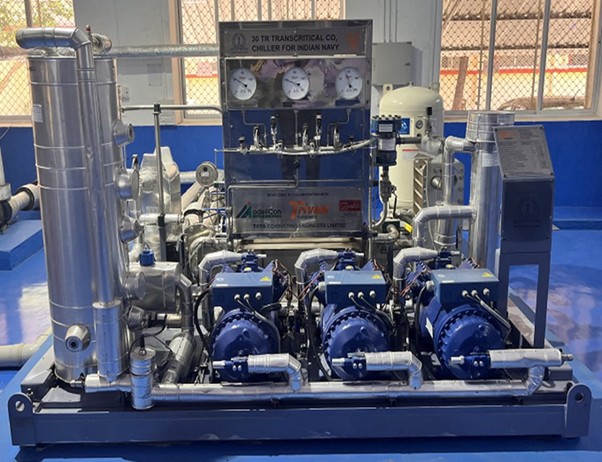
Fig.1 R744 Chiller for ship cooling application, Qo=100 kW, Chilled water 12°C to 7°C, seawater temperatures up to 36°C. Picture reference: Indian Institute of Science, Bangalore.
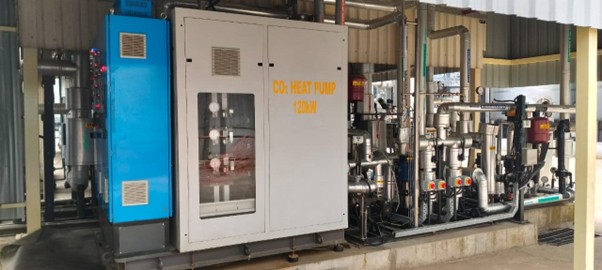
Fig. 2 R744 Industrial heat pump chiller unit. 120 kW hot water production, lifting from 27°C to 90°C. Chilled water 12°C to 7°C. Picture Ref: Koshyma Engineering.
2.3. Variable Refrigerant Flow systems
These systems are characterized by a single outdoor unit connected to multiple indoor units, with the refrigerant flow continuously adjusted to each zone according to heating or cooling demand.
Several defluorinated alternative systems are emerging for these applications, particularly in larger commercial buildings. One leading OEM[3] has already developed and deployed a R744 VRV system in several buildings and is able to prepare for broader market adoption as regulatory requirements and customer demand evolve.
Another alternative is a water-based distribution loop within the building, connected to a central heat pump-chiller using either R744, R290, or even R717 (ammonia) as the refrigerant. Given the growing shortage of qualified refrigeration technicians able to install all required units, closer cooperation with the hydronic / plumber sector could help overcome this bottleneck. Such an approach may also accelerate the transition from fossil fuel-based heating systems to heat pump technologies by leveraging existing competencies in the plumbing and hydronic installation trades.
2.4. Split Air Conditioning units
The market share of R290 split air-conditioning units is still in the low single-digit percentage range, but it is expanding. Most commercially available units are in the range of 2.5 – 5 kW residential and light-commercial segment, where the required refrigerant charge is typically limited to only a few hundred grams per unit. Commercial products are already available from the main global manufacturers, while other major OEMs, are now introducing propane-based air-conditioning products. Although R290 systems currently account for only a small share of global split AC sales, their adoption is expected to accelerate, particularly in Europe, driven by the shortage of R32 because of the F-Gas regulations and repeating heat waves.
Also in this business section, the availability of qualified personnel is increasingly becoming one of the main barriers to the rapid deployment of R290-based air conditioning and heat pump systems. While the technology is commercially available and has already been deployed in millions of units worldwide, R290 is classified as a flammable refrigerant and therefore requires additional competencies related to installation, commissioning, leak testing, servicing, and risk assessments. Similar challenges have already been observed during the transition from R410A to R32 systems, where shortages of trained technicians slowed market adoption in several regions. As the market must defluorinate, the need for training and certification is expected to grow faster than the available workforce. Consequently, workforce development[4] may become a more significant constraint than technology availability or manufacturing capacity.
2.5. Supermarket refrigeration
New commercial supermarket refrigeration systems are increasingly based on R744, provided that local suppliers and service organizations have the expertise required for installation and maintenance. For medium and large stores, centralized R744 systems offer the highest energy efficiency while eliminating the need for numerous stand-alone cabinets that release heat directly into the sales area. Through effective heat recovery, these systems can provide space heating, domestic hot water, and in some cases even air conditioning, significantly reducing or eliminating the need for auxiliary heating & AC equipment. Modern R744 supermarket systems are therefore evolving into integrated energy centers that combine refrigeration, heating, cooling, and thermal storage within a single platform. In regions with suitable infrastructure, surplus heat can even be exported to neighboring buildings or district heating networks, enabling supermarkets to become net suppliers of thermal energy. Continued advances in ejector technology and heat recovery have further improved system efficiency, making R744 refrigeration one of the most mature, total cost efficient, and successful natural refrigerant technologies in commercial applications. For smaller stores, stand-alone or water-loop systems using R290 are often an attractive and cost efficient alternative due to their simpler installation as store lifetime is often limited.
2.6. Mobile- & Transport refrigeration
Mobile and transport applications are an important growth area for applying natural refrigerants. In the automotive sector, a leading German car manufacture has announced its intention to convert all battery-electric vehicle heat pumps and air-conditioning systems to R744 by 2030 and has experience with more than 1 million vehicles equipped with R744 heat pumps in operation. In railway applications, propane (R290) has proven to be a technically and economically viable alternative to conventional refrigerants. Deutsche Bahn is deploying R290 HVAC systems in both regional and high-speed trains and expecting wider adoption across Europe. In transport refrigeration, natural refrigerants are also present, with R744 applied in refrigerated containers and specialized transport systems, while innovative truck and trailer refrigeration solutions are based on CO₂ (as an indirect working fluid) and hydrocarbons such as R1270 (propylene) are on the road [13]. Together, these examples demonstrate that natural refrigerants are no longer limited to stationary refrigeration and heat pump systems but are rapidly expanding into mobile air-conditioning, thermal management, and transport refrigeration applications.
2.7. Hot water heat pump
One of the most successful examples of natural refrigerant technology so far is Japan’s Eco Cute program, which uses R744 heat pumps for domestic hot water production. Introduced in 2001, the technology has been adopted by all major Japanese manufacturers and surpassed 10 million cumulative domestic shipments [14] in March 2025. Eco Cute systems demonstrate that R744 heat pumps can be deployed at large scale while delivering high energy efficiency and long-term regulatory compliance. In addition to providing domestic hot water, these systems increasingly support renewable electricity integration through thermal energy storage and demand-response operation.
2.8. Light commercial units
One of the earliest large-scale deployments of natural refrigerants was achieved through the Refrigerants, Naturally! initiative, led by Coca-Cola, PepsiCo, Unilever, Red Bull, and other global consumer brands. The initiative focused on beverage coolers, vending machines, ice cream freezers, and other point-of-sale refrigeration equipment. By the end of 2017, more than 7.25 million natural refrigerant units [15] had been installed worldwide, avoided by that time already 43.5 million tonnes of CO₂-equivalent emissions. Since then, major beverage and food companies have continued replacing HFC-based equipment with predominantly R290-based systems. While a consolidated global figure is not publicly available, the installed base is widely believed to have exceeded 10 million units worldwide, making light-commercial refrigeration, beside the Japanese Eco Cutes, a significant market for natural refrigerant units.
2.9. Medical- and Pharma Refrigeration
Medical and pharmaceutical ultra-low-temperature refrigeration has historically relied on high-GWP refrigerants such as R23 to achieve storage temperatures down to -80°C and below. However, the revised EU F-Gas Regulation will effectively phase out the use of these refrigerants in many applications after 2030, accelerating the transition towards natural refrigerant alternatives. Current developments focus on hydrocarbon cascade systems using R170 (ethane), R290, R1150 (ethylene), and R1270, as well as air-cycle refrigeration technologies. Studies indicate that R170/R290 cascade systems can efficiently achieve storage temperatures between -70°C and -86°C, making them suitable for pharmaceutical products, vaccines, biological samples, blood products, cells, and gene therapies.
Air-cycle refrigeration is also widely applied for pharmaceutical and medical ultra-low-temperature applications. Several OEMs of air compressors and entire units are suppling the market. These systems apply reverse Brayton cycle technology using air as the only working fluid, thereby eliminating concerns related to refrigerant phase-down regulations, PFAS, toxicity, and flammability. Air-cycle refrigeration is increasingly considered a viable option for freeze-drying, vaccine storage, plasma freezing, and other biomedical applications requiring temperatures between approximately -40°C to -80°C and below.
In addition to hydrocarbon- and air-cycle-based ultra-low-temperature technologies, R784 (krypton) has recently been investigated as a natural refrigerant for applications requiring temperatures below the operating range of CO₂ systems. Contiero et al. [16] proposed ejector-supported krypton refrigeration cycles for future CERN detector cooling systems, demonstrating the potential of R784 as a non-flammable natural refrigerant for specialized ultra-low-temperature applications below −60°C, also applicable for medical- and pharma refrigeration units.
3. Conclusion
The refrigeration, AC, and heat pump sectors are entering a decisive phase in the transition away from fluorinated refrigerants. While the Kigali Amendment and the revised EU F-Gas Regulation have already accelerated the reduction of high-GWP refrigerants, growing concerns regarding PFAS emissions and the formation of persistent degradation products such as trifluoroacetic acid (TFA) further strengthen the case for a complete defluorination of the sector. The environmental and societal costs associated with PFAS contamination increasingly challenge the continued use of fluorinated working fluids, even where their direct climate impact has been reduced through lower-GWP alternatives.
The examples presented in this contribution demonstrate that natural refrigerants are no longer niche technologies. Proven and commercially available solutions based on R290, R744, R717, hydrocarbons, air, and other natural working fluids are already deployed successfully across virtually all major application areas, including industrial chillers, heat pumps, air conditioning, supermarket refrigeration, transport cooling, domestic hot water production, light-commercial refrigeration, and ultra-low-temperature medical applications. Several of these sectors have achieved deployment volumes measured in millions of installations worldwide, confirming both technical maturity and market acceptance.
The main obstacles to broader implementation are therefore no longer related to technology readiness. Instead, barriers increasingly arise from insufficient awareness among end-users, limited availability of trained personnel, fragmented procurement practices, and continued market acceptance of fluorinated technologies that may soon face additional regulatory restrictions. The shortage of qualified HVAC&R technicians capable of designing, installing, and maintaining systems is emerging as one of the most significant challenges for the coming decade. Expanding vocational training, continuing education, and recruitment of young professionals into the sector should therefore be viewed as an essential component of climate and energy policy.
To support informed investment decisions, greater transparency regarding refrigerant-related environmental, health, and regulatory risks is needed. System owners should be provided with clear information on the long-term implications of refrigerant choices, enabling them to evaluate not only current compliance but also future regulatory and environmental liabilities. A mandatory declaration acknowledging refrigerant-related risks could be one mechanism to strengthen transparency and accelerate market transformation.
Ultimately, the evidence suggests that a future-proof HVAC&R sector can be built entirely on natural working fluids. The required technologies exist, their performance has been proven, and successful deployment is already taking place at global scale. The remaining question is therefore no longer whether defluorination is technically possible, but how quickly industry, policymakers, and end-users are willing to implement solutions that are already available today.
References
[1] G. Lorentzen, “Revival of carbon dioxide as a refrigerant,” Int J Refrig, vol. 17, no. 5, pp. 292-301, 1994.
[2] G. Lorentzen, “The use of natural refrigerants: a complete solution to the CFC/HCFC predicament,” Int J Refrig, vol. 18, no. 3, pp. 190-197, 1995.
[3] R. Ciconkov, “Refrigerants: There is still no vision for sustainable solutions,” Int J Refrig, vol. 86, pp. 441-448, 2018.
[4] M. Kauffeld, and M. Dudita. “Environmental impact of HFO refrigerants & alternatives for the future https://www.openaccessgovernment.org/hfo-refrigerants/112698/.”
[5] PFAS. “The PFAS Restriction Proposal https://echa.europa.eu/documents/10162/2082415/2023-02-07_pfas+media+briefing_en.pdf/1661579d-353a-2fb0-1062-38fc3eb4bd78?t=1675849038730.”
[6] Hans Peter H. Arp, Andrea Gredelj, Juliane Glüge, Martin Scheringer, Ian T. Cousins. The Global Threat from the Irreversible Accumulation of Trifluoroacetic Acid (TFA), In Special Collection: 60 Years of Persistence Science: Impactful ES&T Papers From 1967 to 2026, Environ. Sci. Technol. (2024) 58 (45): 19925–19935. https://doi.org/10.1021/acs.est.4c06189
[7] Palm B. 2025, Refrigerant Column: PFAS, TFA and the Hidden Risks of Synthetic Refrigerants
[8] Hart, L., Hossaini, R., Wild, O., Mazzeo, A., Halsall, C., Hou, X., et al. (2026). Growth in production and environmental deposition of Trifluoroacetic acid due to long‐lived CFC replacements and anesthetics. Geophysical Research Letters, 53, e2025GL119216. https://doi.org/10. 1029/2025GL119216
[9] Ricardo and Trinomics (2026) European Commission: Directorate-General for Environment, WSP, Ricardo and Trinomics, [Directorate-General for Environment, WSP, Ricardo, Trinomics], The cost of PFAS pollution for our society – Final report, Publications Office of the European Union, 2026, https://data.europa.eu/doi/10.2779/9590509
[10] EU_Feb_2026 Safeguarding water: https://www.consilium.europa.eu/en/press/press-releases/2026/02/17/safeguarding-water-quality-council-signs-off-on-stricter-protection-rules-for-surface-water-and-groundwater/
[11] PAN Europe 2024 https://www.pan-europe.info/resources/reports/2024/07/tfa-forever-chemical-water-we-drink
[12] De Zan, F., Hazarika, M.M., Piovesan, S., Hafner, A., Banasiak, K., and Bordignon S., (2026). Design and performance evaluation of a novel CO2 rooftop prototype. Proceedings of the 15th IEA Heat Pump Conference, Vienna, May 2026.
[13] ENOUGH Project, Smart CO2 (R744) refrigeration and heat pumping systems, Factsheet No. 8, May 2023 (https://enough-emissions.eu/publications-2/)
[14] https://www.hptcj.or.jp/en/information/10million/
[15] https://www.refrigerantsnaturally.com/about-us/achievements/
[16] Contiero et al. https://cds.cern.ch/record/2938952/files/1-s2.0-S0140700725002555-main.pdf
[1] The EU Directive 2020/2184 (DWD) on the quality of water intended for human consumption, introduced parameters and parametric values for PFAS. These values are 0,50 μg/l (500 ng/l) for the ‘PFAS Total’ parameter and 0,10 μg/l (100 ng/l) for the ‘Sum of PFAS’ parameter.
[2] INDEE3 – https://www.sintef.no/en/projects/2025/indee3-sustainable-cooling-and-heating-in-india/
[3] OEM: Original Equipment Manufacture
[4] Reskilling and upskilling the existing boiler technicians to support heat pump deployment is one solution.

Armin Hafner