
ABSTRACT
The 2016 Kigali Amendment is a legally binding international agreement signed by 173 countries to phase down HFCs, thereby reducing greenhouse gas emissions. The implementation of “Kigali” is projected to reduce the temperature impact of HFC emissions to < 0.05 °C by 2100, still contributing to the Paris Agreement targets. Since 80% of global HFC consumption is tied to electricity-powered RACHP equipment, energy efficiency improvements in HFC conversions is important to significantly reduce emissions from fossil-fuel-based electricity generation. Recent efforts have primarily focused on achieving net-zero emissions by 2050 through cuts in fossil fuel use and large-scale replacement by renewable energy. As global energy consumption patterns evolve, new factors continue to influence the transition from fossil fuels to renewable energy. The USA-Israel vs Iran conflict convinced many countries to “renew” expansion of renewable energy capacity for energy security reasons. This likely expansion during 2026–2036 will coincide with the second decade of Kigali implementation of HFC phase-down projects, while continued improvements in energy efficiency will remain important. However, reducing RACHP demand is also critical to lowering fossil fuel dependence and matching energy use with growing renewable and battery storage capacity. The RACHP sector also needs to address how to avoid PFAS and TFA-producing refrigerants when transitioning to non-fluorinated alternatives and/or by adopting novel, high-efficient non-vapor compression technologies, thereby reducing demand. Supply-side measures should be complemented by demand-side policies. Reducing demand requires addressing both active and passive measures, with passive strategies expected to play an increasingly important role. Investment costs per kW installed for both active and passive measures, relative to the cost per kW of renewable energy capacity, will be a key determining factor.
1. The Kigali Amendment and related actions
The 38th Meeting of the Parties (MOP-38) to the Montreal Protocol, likely to be held in Kigali in November 2026, will mark the 10th anniversary of the Kigali Amendment, a legally binding amendment to the Montreal Protocol. As of April 2026, 173 countries ratified the Amendment, which implies that 25 countries have not yet ratified (UNEP, 2026). The Kigali Amendment mandates a phased reduction in HFC production and consumption, thereby reducing HFC emissions.
Implementation of the Kigali Amendment is projected to limit the temperature impact of HFC emissions from up to 4 °C –in case of unrestricted growth– down to <0.05 °C by 2100 (Fig. 1), thereby contributing to the achievement of the Paris Agreement temperature goals (see below).
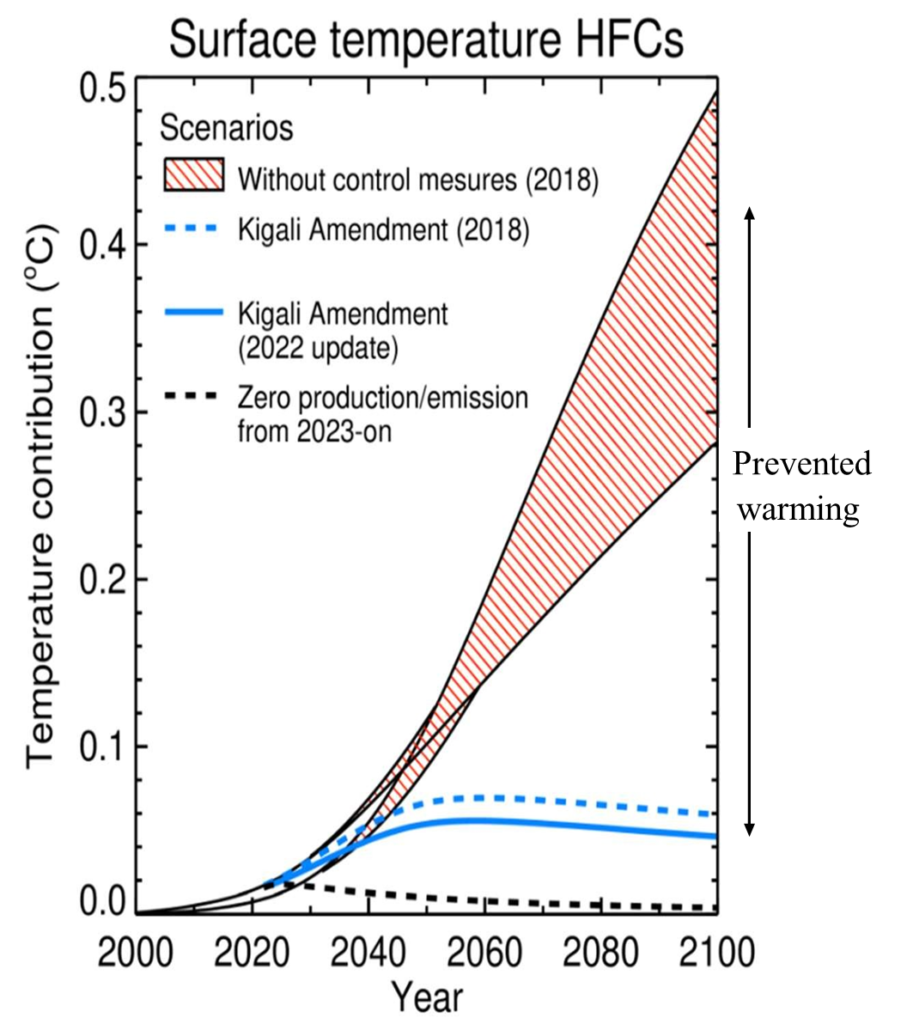
Fig. 1. Temperature contribution with, and without the Kigali Amendment (2018). The Kigali Amendment limits warming in 2100 to <0.05 °C (SAP, 2022); zero production from 2023 on brings the warming in 2100 back to virtually zero.
Paragraph 22 of the Kigali Decision XXVIII/2 emphasizes maintaining or improving energy efficiency during the transition from HFCs to alternative refrigerants. Following the Amendment’s adoption, energy efficiency became a key focus, as improvements in equipment efficiency could reduce greenhouse gas emissions even more than the HFC phase-down alone. Since about 80% of global HFC consumption is linked to electricity-powered RACHP equipment, improving energy efficiency during refrigerant transitions can significantly reduce emissions from electricity generation. The magnitude of these reductions depends on the carbon intensity of the electricity supply, as well as equipment operation, refrigerant leakage, and energy consumption. It is therefore virtually impossible to relate the HFC temperature contribution shown in Figure 1 directly to CO₂ emissions from electricity generation because future electricity generation mixes and equipment energy efficiency cannot be projected accurately over the period 2020–2100.
In response to various Montreal Protocol decisions, TEAP and its Energy Efficiency Task Forces published numerous reports during 2017-2022 on this issue (TEAP, 2023). The reports did not refer to the overall GHG reductions as recommended by the IPCC in the 1.5 °C report (IPCC, 2018), although such an assessment might have been expected. These developments led to efforts to fund HFC reduction and energy efficiency projects through the Montreal Protocol Multilateral Fund.
With some delays (mainly due to COVID-19), guidelines for addressing HFC reductions and energy efficiency in Kigali Implementation Plans (KIPs) have become standard practice, so the whole approach became more or less Business-As-Usual in the years 2025-26. This is a significant outcome, ten years after the adoption of the Kigali Amendment, now ratified by all major producing and consuming countries.
2. What about net-zero?
Following the 2015 Paris Agreement – which mentions 2 °C (and preferably 1.5 °C) as targets for the global temperature increase by 2100 – the IPCC 1.5 °C Special Report (IPCC, 2018) outlines pathways for the mitigation of climate change to keep long-term warming below 1.5 °C as the long-term temperature average. The report also states (1) reductions in net emissions can be achieved through consistent portfolios of mitigation measures (i.e., NDCs, Nationally Determined Contributions), and (2) future radiative forcing resulting from cumulative greenhouse gas emissions determine the probability of limiting warming to 1.5 °C. To achieve net zero, global greenhouse gas emissions (Fig. 2A/B) would need to decline by about 45% from 2010 levels by 2030 and reaching net zero around 2050, consistent with the net-zero pathway.
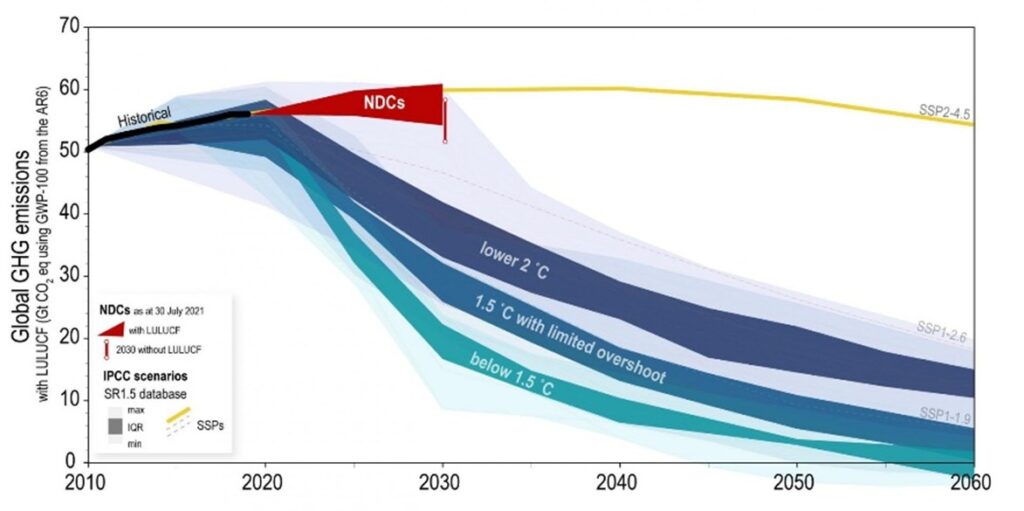
Fig. 2A. Emission reductions required for 2 °C and 1.5 °C targets (2022–2050) compared with current, insufficient NDC projections (UNFCCC, 2021).
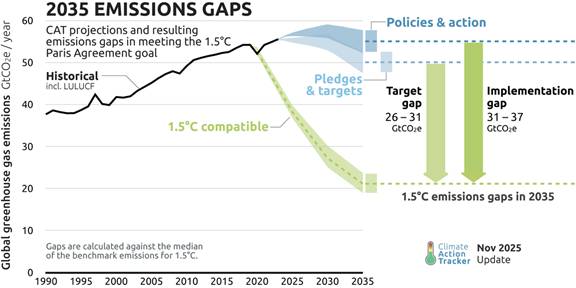
Fig. 2B. 2025 clarification of Figure 2A, where it concerns emissions gaps. Emissions continue to rise under current policies, leaving a 31–37 Gt CO₂-eq gap to the 1.5 °C pathway by 2035 and resulting in projected warming of 2.5–3.1 °C by 2100 (CAT, 2025).
Under the Paris Agreement, countries committed to reducing emissions through voluntary Nationally Determined Contributions (NDCs). Approaches to emission reductions differ between Annex I (developed) and non-Annex I (developing) countries, for which further information can be found in Kuijpers et al. (2022-24). Many governments initially adopted long-term NDC visions, but these have had limited short-term impact, as near-term measures rely on policies and projections that are increasingly affected by geopolitical developments. Figure 2 illustrates the gap between current NDC trajectories and the net-zero pathway. During 2023-2026, many stated that not enough was done to transform society to “net zero”: “Current global climate action is starkly insufficient”, and “We are not on track” (summary by Stiell (2026)). Current projections indicate that emissions during 2026–2050 are likely to result in 2.7–3.2 °C of warming by 2100. The net-zero target and limiting warming to 1.5 °C by 2050 are now widely viewed as unlikely. This shift was reflected in studies published during 2024–2026 (Nature, 2025; Climate Analytics, 2025; Nature, 2026), whichreport sustained periods of global temperatures above 1.5 °C and increasing risks of climate tipping points, regional climate shifts, more frequent heat waves, and accelerated polar ice loss.
Achieving net zero depends largely on the transition to renewable energy. This was also the major issue for the forecast of emissions reductions by (IPCC, 2018). However, since 2024-2025 many global supply and economic issues have changed, resulting in:
(1) The rise of climate-sceptic policies in some countries has slowed or reversed fossil-fuel phase-down efforts and, in some cases, encouraged renewed fossil-fuel use.
(2) In 2025, the United States promoted expanded oil drilling and hydraulic fracturing, with similar initiatives emerging elsewhere (edie, 2026). However, fossil-fuel production growth has been driven mainly by natural gas.
(3) Where COP30 was not able to address fossil fuel phase-downs, a separate conference in Santa Marta, Colombia addressed it in April 2026 (IISD, 2026), but it is not yet clear whether and how this will impact future conferences such as the next COP31 in 2026.
(4) The evolving conflict involving the United States and Iran has renewed emphasis on fossil fuels, while also strengthening energy security arguments for expanding renewable energy, as well as greater reliance on natural gas and nuclear power for baseload electricity.
(5) The IEA projects that global fossil fuel consumption will peak around 2030 after which renewables are expected to gain further market share, supported by advances in energy storage. The rapid development of sodium-ion batteries could significantly reshape electricity storage (see also Nature, 2026a).
Recently, the Montreal Action Plan, launched by the IEA (IEA, 2026), emphasized the dual priorities of long-term energy efficiency improvements and short-term energy security, particularly regarding oil and gas. As IEA Executive Director Fatih Birol stated, “The world will need oil and gas for years to come, based on trust and predictability”. As mentioned, current projections indicate that the trajectory to 2100 will lead to temperature increases in the range of 2.7–3.2 °C. In this context, to what extent can the Kigali Amendment be considered a climate action measure with a meaningful influence on the expected global temperature rise by 2100?
3. THE NEXT DECADE: THE COMBINED IMPACT OF TWO KEY DRIVERS
The temperature impact of the Kigali Amendment by 2100 is small compared with the projected global temperature increase of >2.7 °C (2.7–3.2 °C), even when accounting for potential emissions from fossil fuel-based electricity used by HFC equipment.
The Amendment is progressing, and Parties are expected to meet phase-down schedules. During 2026–2036, HFC phase-down and RACHP energy efficiency improvements will remain critical, through low-GWP alternatives, more efficient equipment, and potentially advanced non-vapor-compression technologies, although the time required for these technologies to mature and their investment costs remain uncertain.
However, reducing RACHP demand is also very much related to lowering fossil fuel dependence and matching energy use with growing renewable and battery storage capacity (see under the “demand” section below). Particularly, the conversion to sodium-ion batteries is very promising (Nature, 2026a).
4. RACHP BEYOND KIGALI: THE NEXT DECADE OF ACTION
The RACHP sector may need to avoid PFAS- and TFA-forming refrigerants (see for an artist’ impression Fig. 3) by adopting non-fluorinated alternatives or advanced non-vapor-compression technologies; HFO conversions may also face regulatory limits.
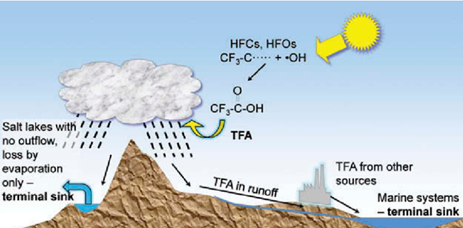
Fig. 3. Trifluoracetic acid (TFA) formed from HFCs and HFOs transfers rapidly from the atmosphere to water, accumulating in soils, salt lakes, and oceans. TFA from HFCs and HFOs is quantifiable, unlike natural and other anthropogenic sources (EEAP, 2018).
This raises questions regarding the future regulatory treatment of large-scale HFO-1234yf use in mobile air conditioning.
It implies two questions (1) will all countries be able to comply with Kigali using low GWP alternatives, and would it necessitate the use of HFOs, (2) will HAT countries be ready to rapidly phase-down HFCs, and would they be prepared to use non-fluorinated refrigerants.
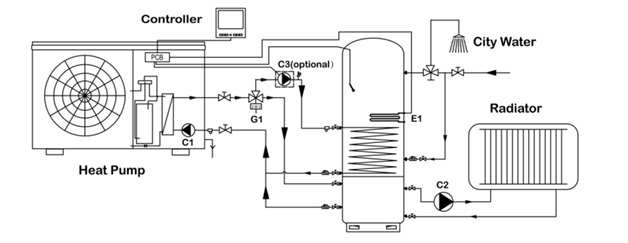
Fig. 4. Air-to-water R290 heat pump (Nobel, 2022)
More robust evidence will be needed to guide the selection of low- or near-zero-GWP alternatives. The transition may increasingly favor non-fluorinated refrigerants and refrigerant-free technologies with very high energy efficiency. Ideally, low-GWP options in highly efficient, renewable-powered equipment, such as propane heat pumps (see Fig. 4) and potentially room air conditioners will dominate the next decade. A key challenge is reducing refrigeration demand to avoid capacity constraints from continued RACHP growth.
Demand minimization requires measures beyond low-GWP alternatives and high energy efficiency, which are the main Kigali Amendment focus areas (where energy efficiency is an added parameter not subject to compliance with the Amendment, given in Kigali Decision XXVIII/2, para 22 (MP Handbook, 2020))
5. Actions AFFECTING DEMAND
The supply-side actions must be complemented by demand-side measures, including both active and passive strategies, with passive approaches expected to become increasingly important.
Improving efficiency and reducing heating and cooling demand will remain essential. However, additional demand-side measures should also be considered, including: (1) significant behavior changes (2) the use of different (lower) temperature differences in operating refrigeration, AC, and heat pumps than used so far, (3) combining electricity from renewables and electricity and heat storage on a large and small scale, and lastly, but important (4) a wide range of passive measures, including site selection, architectural design, urban planning, and increased use of vegetation and trees in cities (Cooling Watch, 2023).
The first decade after Kigali (2016-2026) focused primarily on HFC phase-down and RACHP efficiency. The next decade will require broader approaches for demand reduction, including lifestyle measures, advanced building cooling materials (Nature,2026b), passive strategies, and improved building design. Although beyond the the Kigali Amendment’s formal scope, integrating these measures with HFC phase-down strategies would further reduce refrigerant use, emissions, and energy consumption.
6. CONCLUSIONS
Over the last 10 years, Kigali has well-deserved its place in the transitioning of HFCs to low GWP and near-zero GWP refrigerants. Some of the main conclusions include the following (but not limited to):
- Energy efficiency and demand reduction will be critical for Kigali progress (2026–2036), alongside HFC phase-down.
- Improving equipment efficiency and reducing energy demand can lower fossil-fuel-related emissions and limit the need for additional renewable generation capacity.
- A key question is whether demand-reduction measures should be integrated into Kigali strategies or addressed through broader CO₂ reduction frameworks.
- Future discussions will need to assess the cost-effectiveness of demand-side measures compared with expanding electricity generation capacity.
- Rapid RACHP growth will increase demand for materials, refrigerants, manufacturing capacity, electricity generation, grid infrastructure, and critical minerals, creating supply-chain pressures and emission risks unless addressed through demand reduction, efficient designs, and alternative technologies.
- Rising incomes, urbanization, and increasing heat waves are expected to accelerate cooling demand and RACHP growth, increasing pressure on energy, materials, and manufacturing resources while making efficient design and passive demand-reduction measures increasingly important.
- As electricity grids may not be prepared for rapidly increasing RACHP demand, locally generated power and cost-effective demand-side solutions will become increasingly important; investment costs per kW for active and passive measures compared with renewable energy capacity will be a key determining factor.
7. REFERENCES
CAT, 2025. Climate Action Tracker, November2025, https://climateactiontracker.org/global/emissions-pathways/
Climate Analytics, 2025. World can still rescue 1.5 °C, says new analysis mapping the highest-ambition path. 6 November 2025. https://climateanalytics.org/press-releases/world-can-still-rescue-1-5-c-says-new-analysis-mapping-the-highest-ambition-path
Cooling Watch, 2023. Report by UNEP’s Cool Coalition. Keeping it Chill: How to meet cooling demands while cutting emissions. 5 December 2023. https://www.unep.org/resources/global-cooling-watch-2023
edie, 2026. Oil and gas giants to grow production despite climate goals, study finds. 17 June 2026. https://www.edie.net/oil-and-gas-giants-to-grow-production-despite-climate-goals-study-finds/
IEA, 2026. Newsletter of the IEA, IEA News. Outcome Statement of the IEA’s 11th Annual Conference on Energy Efficiency. 29 June 2026. https://www.iea.org/news/outcome-statement-of-the-iea-s-11th-annual-conference-on-energy-efficiency
IISD, 2026. Summary Report 28-29 April 2026, High-level Segment of the First Conference on Transitioning Away from Fossil Fuels, Santa Marta (CO). https://enb.iisd.org/sites/default/files/2026-05/enb12890e.pdf
IPCC, 2018. The IPCC Special Report on Global Warming of 1.5 ºC. https://www.ipcc.ch/sr15/, Summary for Policymakers, https://www.ipcc.ch/sr15/chapter/spm/ (chapters are all separate on the IPCC website)
Kuijpers, L.J.M., Kochova, N., Vonsild, A.L. (2022–24). Series of IIR conference papers on net-zero RACHP pathways, including renewables, natural refrigerants, and key transition parameters. presented at IIR Conferences Trondheim (2022), Ohrid (2023) and Bratislava (2024).
MP Handbook, 2020. Montreal Protocol Handbook, The Kigali Amendment, pp. 926-936. https://ozone.unep.org/sites/default/files/Handbooks/MP-Handbook-2020-English.pdf
Nature, 2025. A year above 1.5 °C signals that Earth is most probably within the 20-year period that will reach the Paris Agreement limit. Nature Climate Change, 10 February 2025. https://www.nature.com/articles/s41558-025-02246-9
Nature, 2026. What does the future hold for the thawing Arctic? 20 April 2026. https://www.nature.com/articles/d41586-026-01258-5
Nature, 2026a. Beyond lithium: how sodium-ion batteries could change the world. 15 July 2026. https://www.nature.com/articles/d41586-026-02150-y
Nature, 2026b. Air conditioning is not enough to keep people cool — can scientists find an alternative? 22 July 2026. https://www.nature.com/articles/d41586-026-02273-2
Nobel, 2022. Nobel Technical Manual, 2022. 60 pages, with the specific NBL-HPM-HT-AC006-V1 propane heat pump design. https://nobel.bg/wp-content/uploads/2023/01/Heat-Pump-R290_Nobel_Technical-manual_A_ENG_07-12-2022.pdf
SAP-WMO, 2022. Science Assessment Panel report, 2022. Chapter 2, p. 145. https://ozone.unep.org/sites/default/files/2019-04/EEAP_assessment-report-2018%20%282%29.pdf
Stiell, 2026. Stiell, S. 19 June 2026. In: “Remarks of the Executive Secretary during Introduction to the High-Level Informal Consultative Roundtable”, Bonn. https://unfccc.int/news/transcript-of-remarks-of-executive-secretary-during-introduction-to-the-high-level-informal
TEAP, 2023. Decision XXXIV/3 Energy Efficiency Working Group Report, May 2023 (latest TEAP energy efficiency report, with references to earlier ones). https://ozone.unep.org/system/files/documents/TEAP-May2023-Progress-Report-Supplementary.pdf
UNEP, 2026. Country data (for the ratification status of all MP Amendments etc., by countries). https://ozone.unep.org/all-ratifications
UNFCCC, 2021. FCCC/PA/CMA/2021/8/Rev.1. Nationally determined contributions under the Paris Agreement. Revised synthesis report by the secretariat, 25 October 2021. https://unfccc.int/sites/default/files/resource/cma2021_08r01_E.pdf

Lambert Kuijpers

Natasha Kochova

Asbjorn Vonsild