
Abstract
Activities under the Sustainable Cooling and Cold-Chain Solutions Programme (SCCCS) have created a systems-scale approach to deliver efficient, inclusive and climate-friendly cooling and cold-chain solutions and a comprehensive suite of services delivered through specialised Centres of Excellence (COE).
Designed to provide technical and policy support at the national and regional level to optimise the implementation of the Kigali Amendment to the UN Montreal Protocol, work has led to the first physical CoE in Rwanda, The Africa Centre of Excellence for Sustainable Cooling and Cold-Chain (ACES).
To extend its impact, ACES was designed through the “Hub and SPOKE” approach, with the “Hub” acting as the research, testing and development Centre and SPOKEs then developed in strategic country locations across the continent to flow knowledge, training and support for rollout to other markets. Specifically, these SPOKEs house the local/near to market training and community technical and business support to put into practice and demonstrate real world inclusive and sustainable cold chain solutions.
The establishment of SPOKEs is an integrated part of meeting the ambition of the SCCCS Programme objectives as SPOKEs are the extended vehicle to enable dissemination, testing and validation of the knowledge and tools developed between the Hub and the SPOKEs.
For ACES, the first SPOKE is in Kenya serving as the reference SPOKE, for the SCCCS programme, and delivered in country by the African Centre for Technology Studies (ACTS). Since March 2025, tools developed under the SCCCS Programme are being refined, deployed and tested through the reference SPOKE in Kenya where the first SPOKE Community recently celebrated a key milestone a year after being establishing.
Over 200 smallholder farmers are already registered, and many are already earning over 50% higher returns on their produce, thanks to improved quality, extended shelf life, and access to premium markets. Building on the work to date, a second community engagement programme was recently launched within the Kenya reference SPOKE.
This case study sets out the key achievements and learnings from the development of the CoE approach under the SCCCS Programme and its implementation and testing through the Kenya SPOKE to date. It also looks forward to how this model is now being further validated and scaled through replication and new partner funding across a wider range of Communities in Kenya over the next three years.
Introduction
The Africa Centre of Excellence for Sustainable Cooling and Cold-chain (ACES) was conceived in 2020 as the flagship workstream under the Sustainable Cooling and Cold-Chains (SCCCS) Programme, built and co-created through a collaborative partnership between UNEP, the Governments of the UK and Rwanda and a consortium of UK Universities led by the University of Birmingham.
Supported with UK Defra funding of over $35m, and with further support from the Government of Rwanda, grants and cold chain industry, the SCCCS Programme aim has been to increase and accelerate the adoption and uptake of resilient, efficient, inclusive and climate-friendly cooling and cold-chain. A core focus of activities has been to facilitate and enable an optimised implementation of the Kigali Amendment to the UN Montreal Protocol, providing valuable support to developing countries for technical capacity and insights on global best practice to rapidly decrease or avoid HFC use as they transition from ozone depleting substances in cooling and cold chains.
The work since 2020 has built the tools to support the foundational and readiness levels in countries that enable leapfrogging to more sustainable cooling and cold-chain infrastructure and the conditions to bring to market accessible and available climate-friendly, energy efficient cooling solutions, accelerating the transition in Africa and other developing markets to sustainable refrigeration reducing food loss and improving vaccine supply chains.
The role of these specialised CoE is to support the development of policies and tools and offer technical assistance through undertaking and sharing research, demonstrations and knowledge transfer to rural communities through:
- Upgrading training content and infrastructure that can be coordinated through specialised Centre of Excellence (CoE) (including through a cross-sharing network of physical and thematic CoE and through their SPOKES).
- Driving technology change through in-market testing and demonstration.
- Technical support for adopting energy efficient technologies including product design, manufacturing and assembly.
- Developing the local skills and training so that equipment is specifically designed for the local markets and can be installed operated and maintained by local people to a high standard. For ACES, this means “developed and tested in Africa for Africa” through the state-of-the-art Environmental Test Chamber which has been built.
- Assessing and designing national systems to meet strategically important national and international priorities and objectives.
These reference materials have been built out of years of detailed needs assessments, dedicated research, development of bespoke training programmes and business models and other products that can now support adoption through CoE and a hub and SPOKEs model deployed through a hybrid online and physical approach.
At ACES, this “hub and SPOKE” model represents an Africa-centric programme which is “Born in Rwanda, pan-Africa and global in vision” with the ACES “Hub” acting as the African research, testing and knowledge development Centre which then interacts through country-led “SPOKEs” (Specialised Outreach and Knowledge Establishments) which are developed to share and implement the research, innovation and knowledge in different African countries, test validate and localise the approaches in actual market conditions and build capacity in countries.
Progress to Date – Moving ACES to become a Centre of Reference and Blueprint for others
The SCCCS Programme has been developed through two main phases. The first has been the design and development stage to deliver foundational build support that has led to the first physical specialized CoE in Rwanda – ACES.
Through the CoE activities under the SCCCS Programme, the reference materials, blueprints and process maps have all been developed and are now ready for refining, deploying and testing in other markets, setting the stage for the next phase of the Programme through enhanced implementation and deployment. A core component in this next phase is to validate how these materials can be made available, used and deployed through specialised CoE and SPOKEs to deliver sustained operations.
Through further Defra funding provided in mid-2025, work has focussed on actively developing an environment for stakeholder collaboration to explore enhanced opportunities for co-financing, cost-recovery and partnerships to help the Programme and activities at ACES to become self-sustaining. This additional funding continues to provide transitional support as the programme moves from demonstration to proof-of-concept stage and to provide more confidence for third-party donors to fund expansion of ACES and its SPOKE network.
During this period, the focus is on how to ensure ACES can move from being a specialised CoE to become a Centre of Reference which others can learn from, and which can be adapted to meet local needs and circumstances. Defra support during this period will therefore help to ensure the development of a sound operational business model with a co-financing plan for ongoing sustained operations, based on its technical and policy assistance and services. These can continue to position ACES as a knowledge and innovation centre, providing a global collaborative platform for networking with industry and service providers for better outreach on technologies and ensuring continued support for training and technical support to technicians and to local stakeholders on technical and policy issues including product design and local adaptation of technologies and approaches in a cost-effective manner.
Implementation through the ACES Reference SPOKE in Kenya
Through its “Hub and SPOKE” approach, SPOKE activities are now being scaled supporting operations in Kenya, which serves as the reference SPOKE, and evolving and validating the approach which can then be rolled out for different African countries to deploy the solutions tailored for local markets and communities.
Through a close relationship between the hub in Kigali and activities for the first SPOKE communities in Kenya, the knowledge, training and support is now being disseminated to deliver local/near to market training and community support and put into practice and demonstrate real world solutions.
The establishment of SPOKEs is an integral part of meeting the ambition of the SCCCS Programme objectives as SPOKEs are the extended vehicle to enable dissemination of the knowledge and tools developed.
The African Centre for Technology Studies (ACTS) as the lead in-country delivery partner in Kenya, supported by the ACES hub and the wider SCCCS Programme partners, has been developing the delivery and implementation of the reference SPOKE. Since March 2025, the tools developed under the SCCCS Programme are now being refined, deployed and tested through the first SPOKE Community in Kenya, and the establishment of a new farmer co-operative (Lari Horticulture Co-operative Ltd.) as the pilot community. A key activity is to develop new financeable community-based business models and approaches for testing cold-chain integration in actual market conditions and assess how value is brought back to the community and to the smallholder farmers. This enables farmers and cooperatives to build financeable and investment-ready proposals to invest in their own fit-for-purpose cold-chain infrastructure.
The SPOKE Reference Approach
Activities are delivered through two phases:
- Phase 1 – Engagement, selection and business model development
- Phase 2 – Business model with technology integration testing and validation
Phase 1 through a series of diagnostic and desk-based assessments led by ACTS and supported where needed by the ACES Hub expertise, candidate communities are selected through a detailed mapping process which considers the existing co-operatives, farmer groups, SMEs and other actors in the chain, the markets and value-chain opportunities and community technical and Infrastructure readiness levels.
Through an EOI process, community groups are then shortlisted and invited to a series of introductory sessions and training activities. These engagements provide an opportunity to further explore their cold-chain needs and opportunities, while fostering a more detailed dialogue on their current business models and the potential benefits of integrating cooling solutions and cold-chain systems to assess community readiness.
Most ready communities are then selected from the wider group to move through to the next stage where the SPOKE in-country team deliver the support, governance and operational systems and targeted training necessary to support community leaders and the wider community establish a grassroots, community cold-chain ecosystem and refine their business models ready for testing.
Ongoing engagement and support continue to be provided to the wider group linked to training and capacity building programmes and these communities can re-engage at future calls.
Phase 2 then enables one selected community to fully test and validate their developed business model through a basic package of cold-chain equipment which is loaned and deployed to the community free of charge for a set period. This includes pre-cooling, cold storage, processing equipment, integrated with telemetrics and ongoing mentoring and support across this period to refine, test and evaluate performance and impacts in their own communities and connect to new markets before making a decision to purchase their own cold-chain equipment and finalise their validated investment ready business cases.
Enabling such testing and validation prior to investment removes the upfront risk for communities and also builds confidence amongst investors and financial institutions to provide financing given the availability and evidence of economic viability and return on investment.
Furthermore, communities who are able to benefit from such a proof of concept approach can then act as “model communities” and themselves become demonstration and learning sites, providing the evidence and knowledge to other communities underpinned by the SPOKE teams as a local facilitator.
The approach and results from the Lari Horticulture Co-operative Ltd pilot
The Lari Horticulture Co-operative Ltd recently celebrated a key milestone a year after being established. Over 200 smallholder farmers are already registered and many are already earning over 50% higher returns on their produce, thanks to improved quality, extended shelf life, and access to premium markets.
The loaned equipment at Lari has enabled trial and testing of a cold-chain that extends from the field to the marketplace.
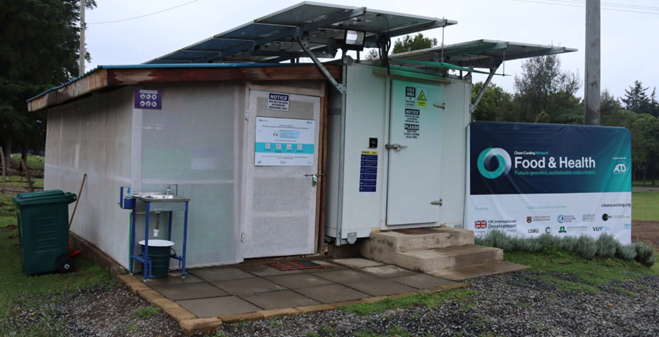
In the field, the first step towards the market is a quality control stage and at this point, the farmer is provided with a “goods-received form” for the accepted produce. Based on this paperwork, the farmer will be paid within a maximum of a week and orders by end markets are fulfilled by the cooperative’s sorter staff through the use of a single cabin pickup truck. The vehicle has a 20mm sandwich panel insulated body to prevent temperature related spoilage of the produce during transit.
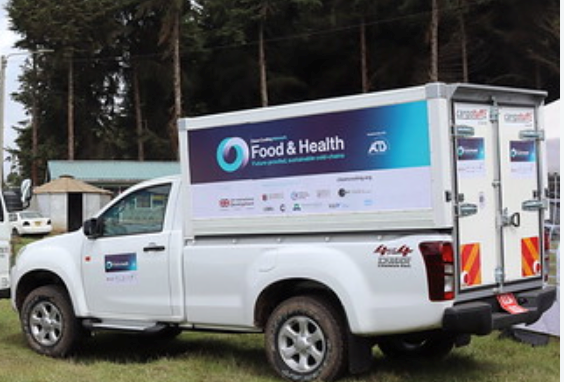
Fast-spoiling products, such as herbs, are immediately packed into cooler boxes with Phase Change Material (PCM) packs to reduce their stored temperature during transit. Less sensitive products are simply stacked in ventilated crates for the journey.
The crops are taken to the aggregation facility, where they are graded according to the specific buyer’s specifications. A pre-cooling unit, which is integrated into the 5-tonne solar-powered cold room removes field heat from the fresh produce.
The aggregated and graded produce is then transported from the aggregation centre to wholesale or retail buyers using a 5-tonne refrigerated truck. Both the truck and the cold room contain their own remote monitoring system, which enables traceability of temperature control throughout the journey, thereby ensuring the integrity of the cold-chain from farm to market.
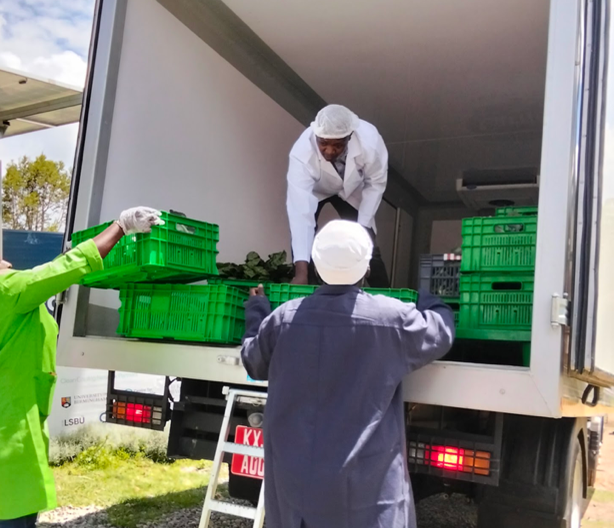
Integrity of the cold-chain is essential to maintain the quality and freshness of the produce all the way to the market, without it the value-add of cooling is lost. The Lari pilot as part of the wider Kenya SPOKE activities therefore trains all stakeholders in best practice and best handling of produce, enabling the highest standards to be achieved and guaranteed for the end markets.
Learning from Lari and refining the approach
A comprehensive technical review of the Lari Cooperative pilot has been conducted, assessing facility uptime, energy consumption, utilization, operational efficiency, maintenance, and business performance. Building on these lessons, a Technical and Infrastructure Readiness Assessment Framework has been developed and is now being integrated into the next community due diligence processes currently being assessed and implemented.
Other elements of the Kenya SPOKE programme have also been refined to reflect the operational experience, emerging diagnostic evidence and lessons from the Lari Cooperative and which are now being further contextualized and applied to Kenya’s horticultural systems, county-level implementation realities and smallholder aggregation challenges. These specific lessons from the Lari pilot are informing the minimum institutional, technical, operational, and financial requirements needed to establish commercially viable, investment-ready, and scalable Community cooling and cold-chain approaches.
Building on the work to date at the Lari Cooperative, a second community engagement programme working with Ustawi Afrika, a social enterprise, was recently launched within the Kenya reference SPOKE.
Scaling the Kenya SPOKE model
Earmarked funding from a new partner has been secured to support the SCCCS Programme in Kenya over the next three years, complementing the existing and ongoing Defra support at the wider SCCCS Programme level and aimed at supporting the SPOKE activities in Kenya. Funding will support delivery and impact through validation and scaling of the SPOKE and community engagement model through replication.
The project will secure impact through scaling up outreach to more smallholder farmers in Kenya, aiming to expand to three new SPOKE regions in Kenya and increase the numbers of smallholder farmers and communities that can develop, test and validate their inclusive business models through project support, and prepare for sustainable cold chain investment enhancing the ambition level that has currently been delivered through Defra funding and building on the lessons to date and refinement of the overall replicability and scaling of the approach.

Stephen Cowperthwaite