
International cooperation as an enabler of technological transition
The refrigeration, air conditioning and heat pumps (RACHP) sector has significantly evolved. Its infrastructure has become fundamental for modern societies. They preserve food and medicines, maintain safe and productive indoor environments, enable industrial processes and technological development, and increasingly provide an efficient route for the electrification of heating. The scale of the sector illustrates both its importance and the magnitude of the transition ahead. According to IIR[1], more than 5.4 billion refrigeration, air-conditioning and heat-pump systems are estimated to be in operation worldwide. The sector generates more than USD 300 billion in annual sales and employs approximately 12 million people. At the same time, refrigeration represents about 20% of global electricity consumption and contributes an estimated 7.5% of global CO₂ emissions, through the combined effects of energy use and refrigerant emissions1.
Looking at these figures, one may note why technological development in RACHP can no longer be considered solely from an engineering perspective. Decisions concerning refrigerants, equipment efficiency, system architecture, standards, training, energy infrastructure and access to refrigeration increasingly interfere with climate policy, food security, health, industrial competitiveness and energy-system planning. In this context, one may raise the following question: should we be dealing with a purely technological challenge, or should we adopt a much broader and structured systems transition? The first option has shown that isolated actions and a narrow focus can lead to successive changes, each requiring additional effort to adapt. It is time to move from a finite mindset to an infinite mindset. The latter would adopt a broader approach which anticipates continuous change, builds long-term resilience and more importantly, recognises that no country or actor can address this transition alone. This is where international cooperation becomes essential. In many ways, international cooperation is already embedded in this sector. Our equipment, components, refrigerants and cold-chain systems are designed, manufactured, traded and operated across borders. The same applies to food and health supply chains that depend on these systems. In many respects, cooperation is already embedded in the way the sector functions..
The next step now is to bring the same level of cooperation to the way we think, plan and make decisions: sharing evidence, aligning approaches, learning from different regional experiences and anticipating transitions together. This is how we can accelerate progress and avoid repeatedly reinventing solutions in isolation. The reader here should be careful not to confuse learning from one another with adopting a cookie-cutter approach. A technology that delivers substantial energy savings in one country may not perform in the same way elsewhere. Its performance depends on ambient temperatures, humidity, controls system, operating practices and importantly the skills available to install, commission, operate and maintain it. In addition, technology should not be promoted in isolation from the capacity required to support it. Training must come first, and it must be sustained over time so that local professionals can progressively build the expertise needed to operate, maintain and adapt these systems autonomously.
The perfect refrigerant doesn’t’ exist, the perfect system design doesn’t exist, the compromise? Yes. We may operate a system using a refrigerant with zero ODP and very low or even ultra-low GWP, but this has limited value if the system itself is inefficient. We should stop thinking that energy efficiency is only about selecting high efficient components. This also includes an appropriate system design to cope with extreme conditions. Even where the necessary skills and technology are available, systems must be properly commissioned and subsequently operated and maintained within the conditions and performance range for which they were designed. Otherwise, the expected efficiency gains may not be realised in practice. This takes me to conclude that achieving the sector transition would definitely require combination of efforts on reducing both direct (from refrigerant use) and indirect emissions (from energy use). I would go one step further: even a highly efficient system using a low GWP refrigerant, may still have a significant climate impact if the electricity supply originates from a high carbon factor energy source. This is why refrigerant choice, system efficiency and the carbon intensity of the energy supply must be considered together. This is another dimension of the infinite mindest, cited earlier in the text, that we should start adopting to achieve a real transition.
Another aspect about the mindset transition. An excellent talk by Andy Pearson regarding Risks in refrigeration was delivered during the 17th edition of the IIR Gustav Lorentzen conference on natural refrigerants in Hamilton, New Zealand (August 2026), has challenged the common understanding about the risks perception in our sector. While the common understanding often focuses on issues such as flammability and toxicity, Pearson presented a much broader, system-level perspective, looking beyond these immediate health and safety concerns to the wider implications of threats related to the supply chain, utility costs, employee relations, reputational damage, recruitment, retention, AI, cyber security, legislation, litigation and the economical aspect. More information will be soon available in the conference proceedings in FRIDOC.
This broader perspective about the refrigeration sector gives international cooperation a different role, which IIR has secured for our sector more than a century ago. Its contribution is not limited to documenting scientific progress. By bringing together scientific expertise, engineering practice and policy considerations, the IIR provides an independent technical assessment which governments, industry, researchers and international organisations can use to evaluate technological options. The recent IIR publications considered in the following section illustrate this function particularly clearly. The information provided below ranges from global modelling of air-conditioning emissions and assessments of heat-pump and dehumidification technologies to application-specific analyses of supermarkets, domestic appliances, fishing vessels, walk-in cold rooms and refrigerated transport. The joint IIR–UNEP OzonAction technology briefs about cold chain technologies in warm climates, published late 2025, further demonstrate how international scientific cooperation can translate the objectives of the Montreal Protocol and its Kigali Amendment into practical technological pathways adapted to different economic and climatic conditions.
The central conclusion emerging from these recent publications is that the transformation of RACHP is no longer driven by a single technological substitution. The sector is moving simultaneously towards lower-GWP and natural refrigerants, higher energy efficiency, greater electrification, variable-capacity operation, thermal energy storage, renewable-energy integration, heat recovery and increasingly sophisticated monitoring and control. The role of AI and Internet of things has become increasingly preeminent the last decade and offer great opportunities for control and predictions[2].
Air conditioning: addressing both direct and indirect emissions with larger perspectives
Air conditioning is perhaps the clearest illustration of the need for a system-level approach. The IIR estimates that air conditioning already accounts for more than 12% of global electricity consumption and approximately 5% of energy-related CO₂ emissions. Of the emissions attributed to air conditioning, approximately 77% are indirect emissions associated with electricity consumption, while 23% result directly from refrigerant emissions during operation and at end of life[3].
In this work, the IIR model considers a scenario combining a significant acceleration in equipment efficiency with a rapid reduction in refrigerant impacts, which could reduce global air-conditioning emissions by around one third by 2050, despite an estimated 2.5 fold increase in the global stock of air-conditioning equipment. Yet this projected growth raises a broader and equally important question: are our electricity grids and energy infrastructures ready to accommodate such a rapid expansion in cooling demand? The transition cannot therefore be considered at equipment and refrigerant level alone; it must be accompanied by adequate grid capacity, greater system flexibility, renewable-energy integration, energy storage, and strategies to manage increasingly significant cooling related peak loads.
Technological development is consequently progressing at several levels. At equipment level, higher efficiency, low-GWP refrigerants and improved refrigerant containment remain fundamental. At building level, passive measures such as improved design, solar shading, green roofs and phase-change materials can reduce the cooling load before mechanical cooling is required. At system level, district cooling can exploit economies of scale and potentially integrate natural heat sinks, renewable energy or waste-energy sources. Photovoltaic powered cooling is particularly relevant in regions where peak solar availability coincides with peak cooling demand. Personal or localised cooling concepts, including radiative systems, represent another direction by conditioning the occupied environment rather than cooling an entire space uniformly. The reader is directed to IIR publication on passive cooling technologies for further information[4].
This evolution from equipment centred to a system centred approach is likely to be one of the defining characteristics of future air conditioning.
Dehumidification: separating temperature and moisture control
A related development is the increasing recognition that temperature and humidity should not necessarily be controlled through the same thermodynamic process. This is especially important in tropical and subtropical climates, where latent loads may be very high. The IIR’s 2026 technical brief on the topic[5], reports that dehumidification can account for more than half of HVAC energy demand, while HVAC itself may represent more than half of total building energy consumption in hot and humid regions. Humidity control is also critical in industrial applications including pharmaceutical production, electronics, lithium-battery manufacturing, food processing and optical manufacturing. Conventional condensation using vapour-compression refrigeration (VCR) remains dominant, accounting for more than 70% of the dehumidification market, and VCR dehumidifiers can achieve electrical COP values of approximately 2.5-4.0. Solid-desiccant systems are also commercially mature and are particularly suitable for deep dehumidification. Liquid-desiccant systems, assessed as proven technologies, provide the additional advantage of allowing temperature and humidity to be controlled more independently and are increasingly relevant to hospitals, large fresh-air systems and industrial processes. Membrane-based dehumidification remains at an earlier stage of commercialisation but offers potential for compact and highly localised moisture control.
The likely development pathway is therefore not wholesale replacement of established technologies but their optimisation and combination. Hybridisation of vapour compression, solid or liquid desiccants and membrane technologies can match the process more closely to the required humidity level and available energy source. As it can be seen in figure 1, solid desiccant dehumidification is particularly effective for deep dehumidification, whereas vapour-compression systems dehumidifiers offer high moisture-removal capacity under humid conditions. Regeneration of desiccants using heat pumps, waste heat or renewable thermal energy is particularly promising. A cited industrial application in Xiamen reported energy savings of 20–30% or more for a liquid-desiccant system relative to conventional vapour-compression air conditioning. Digitalisation is also entering this field: sensor-based control and artificial intelligence can dynamically regulate humidity and reduce unnecessary over-dehumidification.
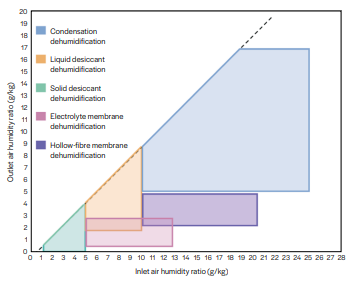
Figure 1 Typical inlet and outlet air humidity ratio ranges for various dehumidification technologies 5
Data centres: cooling the rapidly expanding digital infrastructure
The rapid expansion of data centres is creating a major new source of cooling demand. According to IIR[6], Global data centres consumed an estimated 240–340 TWh of electricity in 2022, around 1-1.3% of global electricity demand, with cooling accounting for about 40% of their energy use. It can be depicted from Figure 2, that the transmission and distribution stage plays a key role in improving energy efficiency and reducing emissions in data centres.
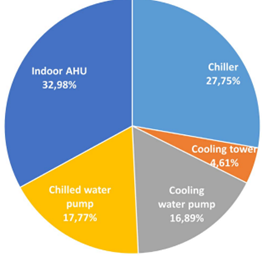
Figure 2 Breakdown of the consumption of cooling energy in a data centre 6
Technological development is moving towards liquid cooling for high-density computing, together with natural and hybrid cooling, waste-heat recovery, and AI-based optimisation and digital twins.
This application reinforces a broader challenge for the RACHP sector: cooling technologies cannot be considered independently from the energy system. As data centres, buildings and other cooling applications expand, greater attention will be needed to grid capacity, renewable-energy integration, heat recovery and intelligent energy management.
Heat pumps: expansion of the temperature and refrigerant envelope
Heat pump development is occurring simultaneously at residential and industrial scales. In domestic applications, the transition towards natural refrigerants is already well advanced in parts of Europe. R290 is attracting particular interest because of its favourable thermodynamic and transport properties, very low climate impact and ability to achieve efficiencies comparable with or higher than many synthetic refrigerants. The main technical constraint remains flammability, making refrigerant charge reduction, leak prevention, elimination of ignition sources, ventilation and appropriate installation practices integral elements of system design. Revised standards, including IEC 60335-2-40:2022 and EN 378, are perceived by some as technological enablers and as simply regulatory requirements, by others.
The market evidence indicates that the heating sector transition has moved beyond the demonstration phase. The IIR reports that R290 heat pumps already represented approximately 20% of the German domestic heat-pump market at the time of the assessment. Air-to-water heat pumps, particularly outdoor packaged units, are becoming a major alternative to gas boilers for space heating and domestic hot water. Current research[7] is expected to concentrate on reducing refrigerant charge, improving flexibility and efficiency, and managing the refrigerant throughout the equipment life cycle[8].
At the opposite end of the temperature range, high temperature heat pumps (HTHPs) are extending electrification into industrial process heat. The 100-200°C range is of particular importance for food processing, chemicals, textiles, papermaking, brewing, plastics and metals. Recent systems demonstrate that heat pumps are no longer confined to low-temperature space heating: commercially available HTHPs now cover approximately 100-300°C and capacities extending to around 100 MW.
Several thermodynamic architectures are developing in parallel. Vapour-compression systems remain the most widely deployed, with cascade cycles, multi-stage compression, vapour or liquid injection, new compressor concepts and alternative working fluids extending achievable supply temperatures beyond 200°C. Absorption systems can exploit industrial waste heat directly when suitable heat sources are available, while hybrid absorption-compression cycles offer another route to high temperatures while limiting operating pressures. Particularly important is the integration of heat pumps into the wider process rather than treating them as stand alone boiler replacements. Simultaneous heating and cooling, also referred to as thermal integration, can substantially improve effective system performance, while thermal energy storage allows heat production to be shifted in time and aligned with electricity prices or renewable energy availability.
The technology is already commercially credible and its technical feasibility is proved, although economics remain site-specific. A brewery steam-supply example operating at 120°C and a COP of 1.85 achieved a reported 46% reduction in electricity consumption relative to an electric boiler, with a payback period of 2.4 years. The remaining barriers are increasingly associated with electricity-to-fuel price ratios, grid carbon intensity, investment cost and specialist skills. At temperatures above approximately 200°C, compressor reliability, lubrication and materials nevertheless remain active areas of research6.
Commercial, professional and domestic refrigeration: mature technology undergoing rapid optimisation
The cold chain demonstrates how incremental improvements to mature vapour-compression technology can produce substantial system benefits. In supermarkets, professional kitchens and domestic refrigeration, technological development is concentrating on temperature stability, energy efficiency, refrigerant containment and low-GWP working fluids.
In commercial refrigeration, temperature management remains a significant practical weakness. Field studies reviewed by the IIR-UNEP technology brief[9] indicate that 7–35% of retail establishments assessed failed to maintain appropriate refrigerated or frozen-food temperatures. Enclosed display cabinets generally maintain more uniform product temperatures than open cabinets. This apparently simple design change can therefore improve food safety while reducing infiltration loads and energy consumption.
Supermarket refrigeration is particularly important because it frequently accounts for 40-60% of store electricity consumption. Technologies being deployed or evaluated include doors and efficient lighting on medium-temperature cabinets, improved evaporator configurations, parallel compression, CO₂ systems with heat recovery, and integration of renewable electricity with thermal storage.
The refrigerant transition is also increasingly visible. Food service cabinets have moved from R134a towards R290, facilitated by revisions to IEC 60335-2-89 that increased permissible A3 refrigerant charges from 150 g to 500 g for relevant equipment. Supermarkets are progressively adopting R744, R290 and lower-GWP blends, while around 75% of newly sold domestic refrigerators reported in the source assessment were already using R600a. the table below lists current high GWP Vs alternative low GWP refrigerants for commercial, professional and domestic refrigeration.
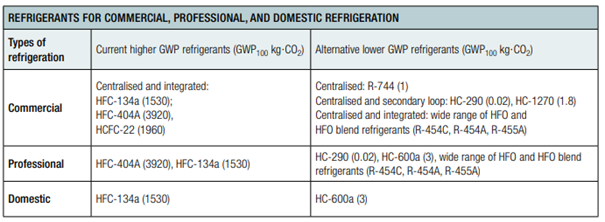
Figure 3 commercial, professional and domestic refrigeration: Current high GWP Vs. Alternative lower GWP9
Beyond conventional vapour compression, the same technology brief identifies solid-state refrigeration as an important longer-term research frontier. Magnetocaloric, electrocaloric, mechanocaloric, ionocaloric and multicaloric systems, together with thermoelectric, spintronic, radiative and laser-cooling approaches, are being explored for applications ranging from compact refrigeration and electronic thermal management to high temperature heat pumping and cryogenic cooling. Their attraction lies in the possibility of compact and low-noise systems, the absence of conventional fluid refrigerant leakage in caloric devices, and access to temperature ranges or scales that can be difficult for vapour compression. Most remain far from broad commercial deployment because performance, material cost, manufacturability and scalability still require substantial research, which IIR is supporting, particularly through the IIR Thermag conference series on solid-state cooling, heating and energy harvesting[10].
Walk-in cold rooms: technology adapted to energy access and food-system needs
Walk-in cold rooms (WICR) illustrate another dimension of technological development: innovation must be judged not only by thermodynamic performance but by accessibility, reliability and compatibility with the surrounding food system. In many Article 5 countries, standard electrically driven direct-expansion systems remain the principal technology, generally using compact monobloc or split units. Increasingly, these systems are being combined with solar photovoltaics and thermal energy storage to operate where grid supply is unreliable or absent.
Thermal storage can range from simple water containers to ice banks and phase change material panels. It reduces peak cooling capacity as mentioned earlier, provides resilience during power interruptions which represents a major issue in many developing countries, mainly during extreme heat conditions, and can reduce the size of electrical battery storage required in solar-powered installations. As for buildings, passive measures can also be valuable for this application: shading and evaporative pre-cooling may lower product temperatures by approximately 5-15°C below ambient before mechanical refrigeration is applied. The reader is directed to IIR publication on evaporative cooling technologies for more information[11].
The refrigerant transition is technically achievable in WICR. Virtually all suppliers assessed in the brief offer low- or ultra-low-GWP options using R290 or R600a, and many monobloc units operate with approximately 150 g of propane. Life cycle analysis of a solar-powered WICR showed the importance of looking beyond operational electricity alone: manufacturing accounted for more than four fifths of the life cycle impact in the example studied, whereas the use phase represented less than 2% because of solar electricity. Replacing an HFC with a hydrocarbon refrigerant reduced refrigerant related life cycle GHG emissions by approximately 99% in the comparison presented.
Beyond electricity-driven systems, emerging autonomous refrigeration technologies also illustrate how cooling can be decoupled from continuous electrical supply. One innovative approach[1] is based on a reversible chemical sorption process between a reactive salt and ammonia (R717), as natural refrigerant with zero GWP. The process is simple, thermal energy is stored in chemical form and converted into cooling on demand. The system can be driven by low-temperature heat sources, including solar thermal energy and recovered waste heat, thereby reducing reliance on electricity and providing flexible and resilient cooling. Such technology developed by the French company[13] is particularly relevant to remote or weak-grid areas exposed to hot climates and can be applied to autonomous walk-in cold rooms for post-harvest preservation, vaccine storage and decentralised food and pharmaceutical cold chains. The same principle can also support refrigerated transport and cold-chain logistics by providing autonomous cooling for temperature-sensitive products during transportation and distribution. These developments point towards a broader role for renewable-heat-driven refrigeration alongside photovoltaic-powered conventional systems, particularly where reliable electricity supply cannot be guaranteed.
The principal obstacles are increasingly economic and institutional. Solar WICRs are expanding. More than 1,400 units were reported in India by February 2025, while installations are also growing in Africa, but smallholder affordability remains difficult. Cooling-as-a-service, shared cold rooms, rental models and integration into complete farm-to-market cold chains are therefore as important as equipment innovation. For larger deployment, technical performance standards, independent testing, repairability and training in the safe use of hydrocarbon refrigerants are essential. More details can be found in the UNEP-IIR brief[14].
Refrigerated road transport in hot climates: electrification, storage and natural refrigerants
Refrigerated transport faces a different set of boundary conditions: vibration, limited space and weight, frequent door opening, changing engine speeds and high ambient temperatures. The IIR estimated a global refrigerated road fleet of approximately 5.7 million vehicles in 2024, with substantial expansion expected as cold-chain coverage increases, particularly in the Global South[15]. All information below is originated from the same reference.
Improving insulation is the first technological lever because every reduction in thermal load reduces both required capacity and operating energy. Reinforced insulation has been shown to reduce thermal loads by approximately 22% in long distance applications under southern European conditions. Vacuum-insulated panels can provide exceptionally low thermal conductivity but still face cost, manufacturing and repair constraints. Door infiltration is equally important for distribution vehicles: experiments under hot conditions found that appropriately designed air curtains could reduce infiltration loads substantially.
The refrigeration unit itself is increasingly being decoupled from the vehicle engine. Conventional mechanically driven compressors operate at speeds determined by vehicle operation rather than cooling demand. Electrification enables variable-speed compressors, batteries, photovoltaics and regenerative e-axles. In one door-to-door delivery analysis, separating refrigeration from the driveline and regulating compressor speed according to cooling demand reduced refrigeration energy use by 26%.
Cold thermal energy storage offers another route, particularly for short distance distribution. Eutectic plates (see Figure 4) and other phase change systems can be charged at a depot, shifting refrigeration equipment away from the vehicle and simplifying maintenance. Natural refrigerants are also progressing. R290 systems tested at ambient temperatures up to 50°C achieved COP improvements of 15-25% for medium temperature operation and 10-30% for low-temperature operation compared with R404A in the studies reviewed, together with reductions in diesel use and emissions. CO₂ transport refrigeration is less mature in very hot climates because of space, mass and heat-rejection constraints, but modelling of a developing CO₂ unit indicated a seasonal COP 27% higher than an R134a reference and a 32% reduction in overall life-cycle emissions.
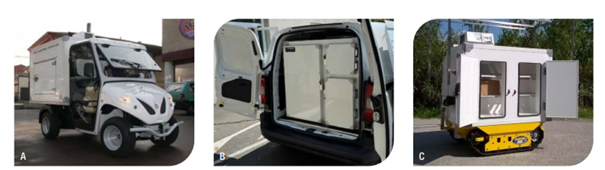
Figure 4 Eutectic solutions: (A) full electric last-mile delivery light vehicle; (B) multi-temperature transport in a van; (C) full electric 13
Renewable integration is also increasingly practical. Photovoltaics installed on refrigerated vehicles have demonstrated the potential to cover more than 40% of refrigeration energy demand in some semi-trailer applications, while studies of last-mile delivery under Athens climatic conditions found annual solar production equivalent to 65-112% of refrigeration requirements, depending on configuration. As for the other applications, IoT and AI-based logistics optimisation provide an additional efficiency layer by improving routing, temperature transparency and operational decisions.
Fishing vessels: refrigeration technology under demanding marine constraints
Refrigeration on fishing vessels is technologically diverse, ranging from shore produced ice on small artisanal craft to refrigerated seawater (RSW), plate freezers, blast freezers, ice slurry systems and complete processing plants on industrial vessels. This diversity is important because small-scale vessels represent approximately 89% of the global fishing fleet, and access to adequate onboard chilling remains highly uneven[16].
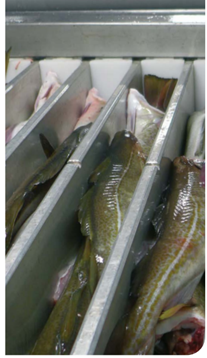
Figure 5 Cod frozen in vertical plate freezers, Photo: Guro M. Tveit, SINTEF Ocean. 14
For large catches, RSW systems cool seawater to approximately -1.5 to +0.5°C. Ammonia remains highly efficient for large-capacity systems, while compact CO₂ systems are gaining interest where space and safety considerations favour them. In warm waters, ammonia remains particularly attractive for RSW duty, whereas R717/R744 cascade systems can combine efficient heat rejection with CO₂ stages capable of reaching around -50°C for deep freezing.
Innovation is also happening at smaller scale. An R290 flake-ice system under development for Indian fishing vessels was modelled at 30 kW capacity with a COP of 1.76 at an evaporation temperature of -25°C and condensation temperature of +40°C, demonstrating the potential for propane even under demanding tropical conditions. Heat-driven absorption systems offer the theoretical possibility of exploiting engine waste heat but remain constrained on smaller vessels by weight, volume, complexity and insufficient recoverable heat.
Marine refrigeration is also becoming digital. Integration of refrigeration data with vessel monitoring systems, automation systems, weather information and catch records creates opportunities for predictive maintenance, better system sizing and optimisation of fishing routes. In parallel, electrified or hybrid propulsion, thermal storage and waste-heat recovery are creating opportunities to integrate previously separate heating, cooling and propulsion systems.
Refrigerant containment is particularly important at sea because vibration and mechanical movement make low leakage rates difficult to maintain. The reviewed data indicate continued use of R22 in parts of the global fleet and significant refrigerant losses. The transition towards ammonia, CO₂ and hydrocarbons therefore has both climate and operational significance, but it must be accompanied by appropriate materials, leak detection, ventilation, risk assessment and crew training.
An outlook
The direction of RACHP travel is increasingly clear. The future RACHP system should be more efficient, more integrated with the energy system, less dependent on high-GWP working fluids and more responsive to real operating conditions. It will also need to be adapted much more carefully to climate, application and local capacity. Achieving this transition at global scale requires continued scientific progress, but equally requires the international exchange of evidence, harmonised approaches to safety and performance, investment in skills, and sustained cooperation between governments, research organisations and industry and this is precisely where international organisations such as the IIR have their greatest value.
[1] The Role of Refrigeration in the Global Economy, 3rd Edition. 60th Informatory Note on Refrigeration Technologies. International Institute of Refrigeration. April 2025.
[2] Use of Internet of Things and Artificial Intelligence in Refrigeration and Air Conditioning. 55th Informatory Note on Refrigeration Technologies. International Institute of Refrigeration. August 2023.
[3] CO₂ Emissions from Air Conditioning. 57th Informatory Note on Refrigeration Technologies. International Institute of Refrigeration. July 2024.
[4] Passive cooling technologies. 47th Informatory Note on Refrigeration Technologies. International Institute of Refrigeration. August 2023.
[5] Dehumidification in Air Conditioning. Dehumidification in Air Conditioning. 62nd Technical Brief on Refrigeration Technologies. International Institute of Refrigeration. July 2026.
[6] Cooling technologies for sustainable data centres. 59th IIR Technical Brief on Refrigeration Technologies. International Institute of Refrigeration. January 2025.
[7] Hydrocarbon heat pumps – a European perspective. Bjorn Palm. 6th IIR-Gustav Lorentzen Conference on Natural Refrigerants (GL2024).
[8] High-Temperature Heat Pumps for Industrial Decarbonisation. 61st Technical Brief on Refrigeration Technologies. International Institute of Refrigeration. April 2026.
[9] Cold Chain Technology Brief: Commercial, Professional, and Domestic Refrigeration. UNEP OzonAction and International Institute of Refrigeration. November 2025.
[10] https://iifiir.org/en/iir-conferences-series
[11] Evaporative cooling. 52nd Informatory Note on Refrigeration Technologies. International Institute of Refrigeration. May 2023.
[12] Cold Chain Technology Brief: Walk-in Cold Rooms in Article 5 Countries. UNEP OzonAction and International Institute of Refrigeration. November 2025.
[13] Sofrigam https://sofrigam.com/en/
[14] Cold Chain Technology Brief: Walk-in Cold Rooms in Article 5 Countries. UNEP OzonAction and International Institute of Refrigeration. November 2025.
[15] Cold Chain Technology Brief: Road Refrigerated Transport in Hot Climates. UNEP OzonAction and International Institute of Refrigeration. December 2025.
[16] Cold Chain Technology Brief: Fishing Vessel Applications. UNEP OzonAction and International Institute of Refrigeration. December 2025.

Yosr Allouche