
1. Introduction
India is rapidly transforming into a global digital infrastructure powerhouse. The convergence of cloud adoption, Artificial Intelligence (AI) emerging across all businesses and services, the telecom sector’s transition from 4G to 5G, the Digital Personal Data Protection (DPDP) Act and its data localization requirements, the growth of digital public infrastructure, expansion of fintech, Industry 4.0, and other forces are driving unprecedented growth in Data Centers (DCs). Unlike previous growth cycles dominated by storage and cloud computing, the next decade will be defined by AI factories and High-Performance Computing (HPC), fundamentally altering the thermal and energy profile of DCs.
Today, DCs have evolved from being IT assets into energy-intensive industrial infrastructure, where cooling systems have become mission-critical. The HVAC&R fraternity is no longer a supporting stakeholder, but a strong strategic enabler responsible for ensuring the efficiency, sustainability, reliability, and resilience (R&R) that are a key focus for all DCs. The load profile and load density of IT equipment in DCs has undergone a radical shift. Going forward, the industry’s success will increasingly depend on how effectively it manages four resources simultaneously: Power, Cooling, Water, and Carbon.
ISHRAE (Indian Society of Heating, Refrigerating and Air-Conditioning Engineers) envisioned the growth of data centers many years ago, and has been working continuously to empower the DC community in a holistic manner by offering sustainable, reliable, and highly effective cooling solutions. ISHRAE has formed a Technical Group (TG: H-104 – Data Centre) under the ISHRAE Technical Committee (ITC). This diverse group comprises industry experts, academia, OEMs, designers, and leading consultants.
2. India’s Data Center Landscape
India has emerged as one of the fastest-growing DC markets globally, led by Mumbai, Chennai, Hyderabad, Bengaluru, Pune, and Delhi/NCR. Hyperscalers, colocation/enterprise operators, edge data centres, and AI infrastructure providers are aggressively expanding capacity. In 2016 (a decade ago), India had only a few MW of IT capacity; today, designed IT capacity stands at 1.5-1.6 GW, and is projected to cross 8 GW or more by 2030. Figure 1 illustrates the projected growth in IT capacity starting from 2025 until 2028.
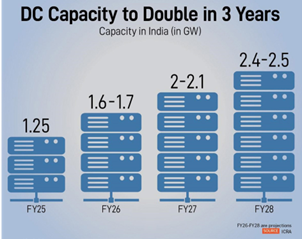
India’s Data Center IT Capacity Growth, FY25-FY28 (Source: ICRA)
The Indian DC market is simultaneously experiencing three structural shifts, supported by a city-wise distribution of capacity as shown in Figure 2.
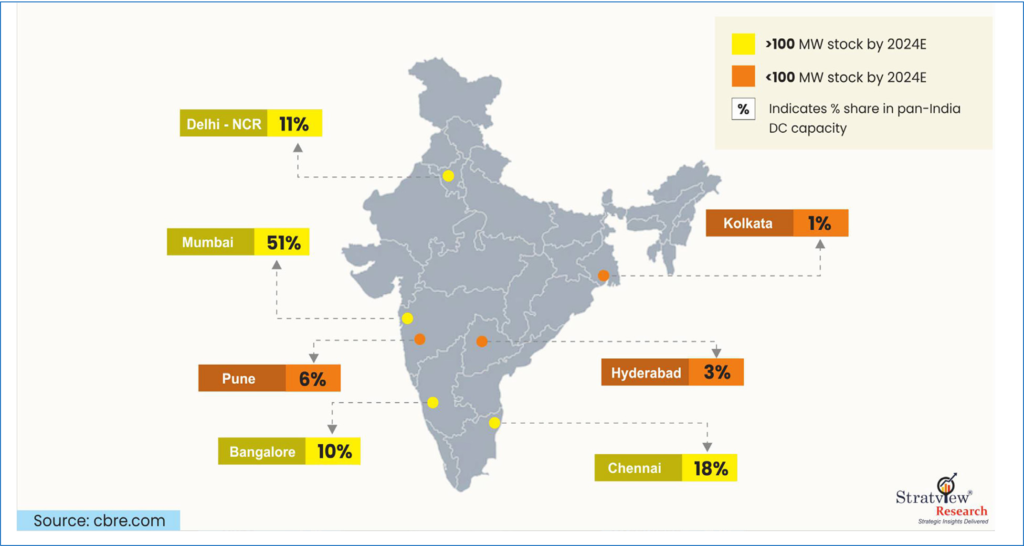
City-Wise Share of Data Centre Capacity in India (Source: CBRE)
2.1 AI-Driven Densification
Traditional enterprise workloads operated at 3–8 kW/rack, while hyperscale facilities typically range between 10–20 kW/rack. AI clusters are now pushing rack densities toward 30–80 kW/rack or even more, with some GPU deployments exceeding 100 kW/rack. This fundamentally challenges conventional air- cooling architectures.
2.2 Energy as a Key Resource
Power consumption has become primary constraint, rather than land availability. Large campuses now require 100–500 MW of dedicated power, transforming DCs into major industrial electricity consumers Central and state Governments have made grid capacity a key focus area in recent years. The DC market presents a major opportunity for India to attract investment and strengthen the economy. Energy will remain a critical constraint going forward, and new cooling solutions will be essential to reduce consumption significantly.
2.3 Sustainability as a Business Imperative
National and International end-users and operators increasingly demand low-carbon infrastructure. Consequently, operators are actively pursuing a Power Usage Effectiveness (PUE) below 1.3, a significant reduction in Water Usage Effectiveness (WUE) though today’s DCs are not operated by water cooled chiller unfortunately owing to several reasons and challenges, and an increase in the share of renewable energy to as much as 50–80% of total energy use. Some DC operators have already set target to become carbon neutral by 2035/2040/2045.
Consequently, HVAC&R decisions now directly influence Green Data Centre Certifications, ESG performance, operating expenditure, and investment attractiveness. New and emerging cooling technologies are becoming the new norm across all categories of data centres – colocation, enterprise, edge, and hyperscale.
3. Cooling Status in Indian Data Centres
Data Centres require robust cooling to process loads through servers, CPUs, and GPUs, which generate significant heat. Inadequate cooling reduces the performance, reliability, and life of IT equipment; hence cooling can never be compromised in DCs. Traditional air-cooling (CRAC/CRAH, hot-aisle/cold-aisle design) remains common for conventional IT loads; however, it is reaching its limits with modern IT equipment running very high-density AI workloads. Recent advancements include Direct-to-Chip Liquid Cooling (DCLC) and Liquid Immersion Cooling (LIC), which remove heat much more efficiently and support high-density AI workloads. The industry is increasingly adopting hybrid air-plus-liquid cooling systems, with liquid cooling becoming essential for next-generation AI and HPC DCs due to its higher efficiency and lower energy consumption.
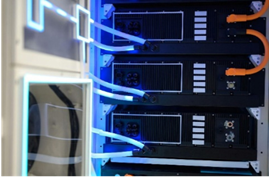
Direct Liquid-Cooled Hardware in a Modern Data Centre
India today has 1.5 GW of IT load, which translates into 0.75 million TR of cooling demand. With IT load expected to grow to 8 GW by 2030, cooling demand will rise sharply, and integrated cooling systems will become the new norm for AI workloads. Advanced cooling systems will be more efficient; however the share/magnitude of cooling required will be extraordinarily high. It is therefore important to factor in the carbon footprint of cooling infrastructure while planning to meet sustainability goals.
Supplying chilled water at higher temperatures has now become the baseline across the industry. Under this approach cooling performance (kW/TR) can reach as low as 0.28–0.35 kW/TR for a chilled water supply temperature of 20°C, as summarized below.
Indicative Cooling Performance (kW/TR) at Varying Chilled Water Supply Temperatures
| Chilled Water Supply Temp. | Cooling Performance (kW/TR) |
| 7°C | 0.50 – 0.60 |
| 12°C | 0.42 – 0.50 |
| 16°C | 0.35 – 0.42 |
| 20°C | 0.28 – 0.35 |
4. Challenges in Indian Data Centres
While the DC sector which does not yet have formal industry status, the Installation of Data Centres in India is growing rapidly, and several challenges must be addressed to harness this growth and help India in becoming a global Data Centre hub.
Emerging Challenges in Indian Data Centres
| Challenge | Description |
| Thermal Management of AI Workloads | AI has become the single largest engineering challenge for DC designers. Traditional Computer-Room-Air-Conditioning (CRAC) and Computer-Room-Air-Handler (CRAH) systems encounter limitations beyond 20-30 kW/rack due to: • Increased fan energy consumption • Airflow recirculation and hotspot formation • Reduced cooling effectiveness • Higher pressure-drop requirements The industry is transitioning from air as the primary heat-transfer medium toward liquid-based thermal management. India needs to build greater capacity to manage this transition. |
| Power Availability and Grid Constraints | Power availability has become the biggest bottleneck in hyperscale expansion. Challenges include: • Long utility connection timelines • Transmission infrastructure limitations, and location of Green Power Sab-Stations • Peak summer grid stress • High electricity tariffs DCs are shifting from being power consumers toward becoming “power ecosystem participants,” requiring integration with renewable energy (RE), Battery Energy Storage Systems (BESS), and grid-interactive operations. Small Modular Reactors (SMRs) could emerge as a new baseline power source. |
| Water Sustainability | India is a water-stressed nation, making water-intensive cooling solutions increasingly unsustainable. Conventional cooling towers pose challenges such as: • High water consumption • Evaporative losses • Water treatment requirements • Blowdown disposal Water availability may eventually become a site-selection criterion equivalent to power availability. Future facilities should prioritize closed-loop cooling systems, water reuse and recycling, alternative heat-rejection technologies, and water-positive campus strategies. |
| Refrigerant Transition and Environmental Regulations | The HVAC&R industry is simultaneously navigating refrigerant transitions driven by Kigali Amendment obligations. Key challenges include: • Migration from high-GWP refrigerants • Adoption of low-GWP alternatives • Flammability management (A2L refrigerants) • Workforce training and safety compliance Future-proofing refrigerant choices has become essential to avoid stranded assets over 20-30 year facility lifecycles. |
| Talent and Skill Gap | Data center engineering requires multidisciplinary expertise spanning mechanical & electrical engineering, thermal sciences, power systems, controls engineering, sustainability, and digital technologies. India currently faces shortages in specialized competencies related to: • Cooling Technologies (DCLC, LIC etc.) • Use of CFD modelling in air-flow optimization, UHI Mitigation, etc. • AI workload planning • Digital twin deployment • Energy optimization The industry has already taken initiatives, including those by CII (DCAP for skill development, capacity building, certification, and accreditation of Data Center Professionals) and Telecom Sector Skill Councils such as TSSC. |
5. Opportunities for the HVAC&R Fraternity
The evolving data center ecosystem presents a significant opportunity for HVAC&R professionals, summarized across six focus areas in Table 3.
Two cooling technologies stand out as especially relevant to the opportunities above: rear-door heat exchangers, which extend the life of air-cooled architectures, and immersion cooling, which is fast emerging as the platform of choice for the highest-density AI racks.
HVAC&R Strategies
| Opportunity Area | Key Focus Areas |
| Air Cooling Optimization | • Indirect evaporative cooling • Rear-door heat exchangers • Containment systems • Adiabatic cooling |
| Liquid Cooling Technologies | • Direct-to-chip liquid cooling (DCLC) • Liquid Immersion cooling (LIC) • Hybrid cooling systems Liquid cooling may become mainstream for AI workloads above 50 kW/rack. |
| Digital Engineering and Smart Operations | Digitalization presents immense opportunities through: • Digital twins • AI-based controls • Predictive maintenance and IoT-enabled sensing • Continuous commissioning (Cx) Real-time optimization can significantly reduce energy consumption without compromising uptime. Several companies have already developed AI-based tools to optimize DC operations. |
| Energy Efficiency Leadership | HVAC&R professionals can become energy strategists by optimizing: • Chiller plant performance and partial-load efficiency • Heat recovery systems and thermal energy storage • Dynamic setpoint optimization Every 0.1 improvement in PUE translates into substantial energy and carbon savings over the facility’s life. |
| Renewable Energy Integration | Future DCs will increasingly operate as integrated energy ecosystems comprising: • Solar photovoltaic (SPV) systems • Wind power procurement and hybrid systems • Battery energy storage systems • Green open-access arrangements • Microgrids |
| Water-Positive Infrastructure | • Hybrid cooling systems • Air-assisted liquid cooling • Wastewater utilization • Zero liquid discharge systems Water-neutral Green Campus designs that meets and exceed sustainability goals. |
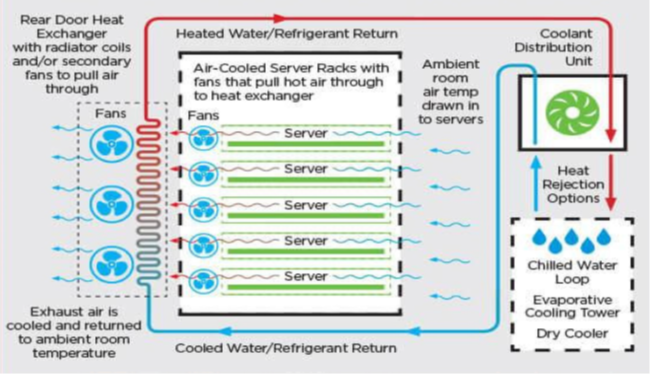
Rear-Door Heat Exchanger Cooling Schematic
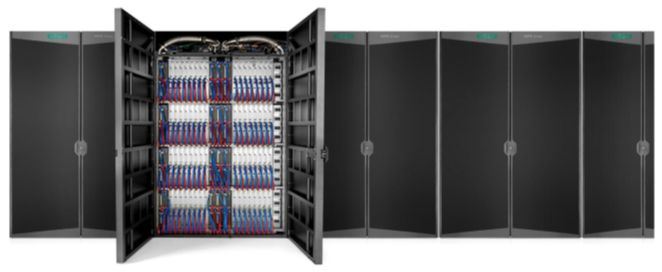
High-Density Liquid-Cooled Server Rack Infrastructure
6. Conclusion and Way Forward
India’s Data Centre growth story is no longer just an IT story; it is fundamentally an energy, cooling, and sustainability story. The future competitiveness of Indian data centres will depend on successfully balancing performance across power, cooling, water, and carbon. The HVAC&R fraternity must evolve from an equipment-centric mindset to becoming infrastructure strategists responsible for lifecycle performance optimization.
The way forward requires coordinated action in five priority areas:
1) Accelerate adoption of liquid cooling technologies for AI infrastructure.
2) Follow National benchmarks for PUE WUE, and carbon intensity, as practised in the industry through various sustainability initiatives.
3) Integrate renewable energy, battery energy storage, and smart grids for Green Data Centres.
4) Develop a National DCcooling competency framework to address skill shortages.
5) Prioritize low-GWP refrigerants and sustainable thermal management practices.
India has a unique opportunity to build the world’s most sustainable next-generation DC ecosystem. The HVAC&R fraternity will play a decisive role in determining whether this growth becomes energy-intensive or energy-intelligent.
This position document presents the collective perspective of the ISHRAE Technical Group on Data Centres (TG: H-104), constituted under the ISHRAE Technical Committee (ITC). It is intended to inform industry stakeholders, policymakers, designers, and built-environment professionals on the evolving Data Centre (DC) landscape in India.

Vikram Murthy