
Abstract:
This subject is present in the media in general and has taken up a good part of the technical publications, generating articles about the doubts that hover in the job market.
Will AI take my job?
As president of international relations at ABRAVA, I have participated in several international meetings, and the concern is the same around the world, but although everyone understands that this is a global issue, everyone agrees that the solution needs to be local.
No one knows yet what the impact of AI will be on the labor market; economists have not yet reached an agreement, and they are still divided into at least three camps.
In this article, we will talk about a work published in April 2026 by the Carnegie Endowment for International Peace.
1.0 – FUTURE OF WORK
- The magnitude and direction of AI’s impact on the future of work
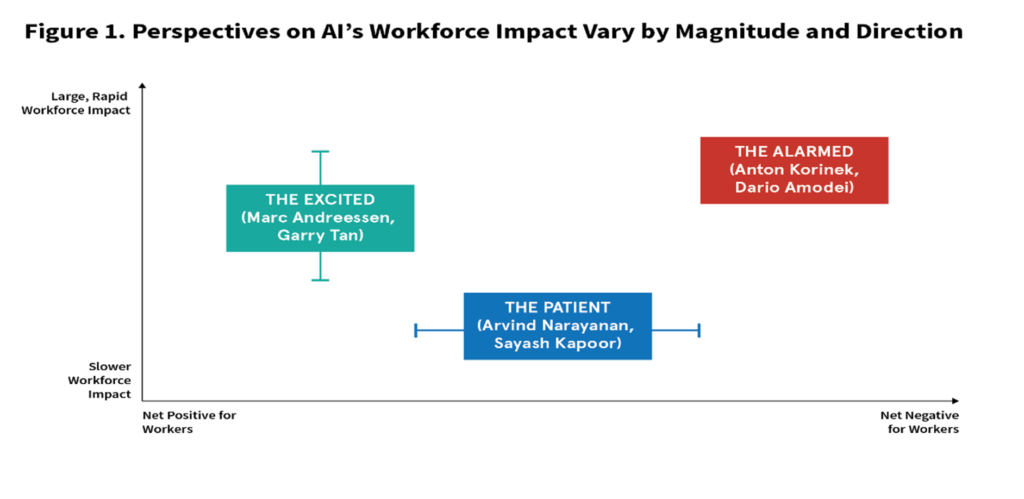
The study, “Three Views on the Future of Work,” published in April 2026 by the Carnegie Endowment for International Peace, mapped the three dominant currents among researchers and policymakers. The figure 1 of the published work demonstrates that perspectives on the impact of AI in the workplace vary in magnitude and direction.
By mapping the three streams, the study graphically presented the distances between them and classified the most likely views of job disruption caused by AI into three groups: Excited, Patient, and Alarmed.
Source: Carnegie Endowment for International Peace
b. Three visions on the future of work.
- Enthusiastic, a group of those who argue that AI will create more opportunities than it eliminates.
- Patients, those who argue that the replacement will be gradual and will occur over decades.
- Alarmed are those who believe that AI will replace a large portion of office work in the next decade.
This is not a dispute between optimists and pessimists; each view bases its position on some facts, and the distance between them demonstrates how much uncertainty there is still on this subject
The enthusiasts insist that this movie has already been seen, that the great technological waves have destroyed categories of jobs and created others that no one imagined. The argument is not that the transition will not take place without sacrifices and adaptations, but that the result will be positive.
They argue that new technologies have always reshaped work. About sixty percent of jobs in 2018 were in professions that did not exist in 1940, and there was no disruption in the labor market during that period. Enthusiasts believe that AI will generate such great economic growth that it will increase the demand for human labor in new areas, offsetting losses in automated categories.
Let’s believe that this is possible!
Patients recognize the transformative potential of AI but disagree with the speed at which it will act because they believe that current technical limitations, coupled with practical barriers to adoption in enterprises, will slow the pace of replacement.
The argument here is about the difference between what AI does well and what it can’t do when it comes to complex tasks of the kind that a human worker is capable of doing.
According to them, there is a structural gap between what AI does well in standardized tasks and what it cannot do when the actual work requires interpretation of context, adaptability, relationship, etc.
These factors will influence the pace of implementation in companies that will have to overcome barriers such as regulation, implementation costs, etc.
The alarmed believe that the replacement will be quick. They start from three premises:
- Over the next decade or sooner, AI systems will be able to solve most office workers’ tasks.
- Employers will prefer to use AI and fire human workers.
- New jobs will not be enough to compensate for those laid off by the automation made by AI leading to an increase in unemployment.
It is important to note that this group, of those alarmed, is not without its reasons about the exchange of humans for AI, because in the real labor market, we have seen that in mergers and acquisitions, layoffs or the slowdown in hiring affect more workers with little practical experience and those in sectors considered easier to be replaced by AI, such as human resources, administration, law, accounting and IT. It remains to be seen how many new jobs have been or will be generated in new functions to compensate for these layoffs.
c. Consensus
Despite the disagreement between these three groups, there is at least a consensus among them; the debate is not yet fully resolved, and, therefore, it is necessary to act now.
AI can reduce jobs, redesign them over time, create completely new ones, or do all three at once, but we need to act now, because the argument for starting to act doesn’t depend on which scenario will happen.
The labor market rarely moves in a straight line. He alternates between advance and waiting, short, medium, and long-term vision, conviction and doubt, trial and error, etc., always trying to find balance.
Governments that wait for certainty before investing in data centers, requalification programs, and new regulatory frameworks will be too late. This also applies to large corporations and our companies.
For Brazilian workers and companies, the risk is not only unemployment; there is also the risk of obsolescence of the function, the one in which the function continues to exist, but the professional who has not learned to work with AI, despite continuing with his job, may be worth less than those who have learned.
Therefore, let’s stay tuned and follow the evolution of this new era that is certainly here to stay.
2.0) Technological Cycles
To delve a little deeper into the previous considerations about the impact of AI on the labor market, let’s take a look at what has occurred in previous cycles of technological advances.
The stages of evolution from the pre-industrial era to the present day can be divided at least into six stages, or “waves”.
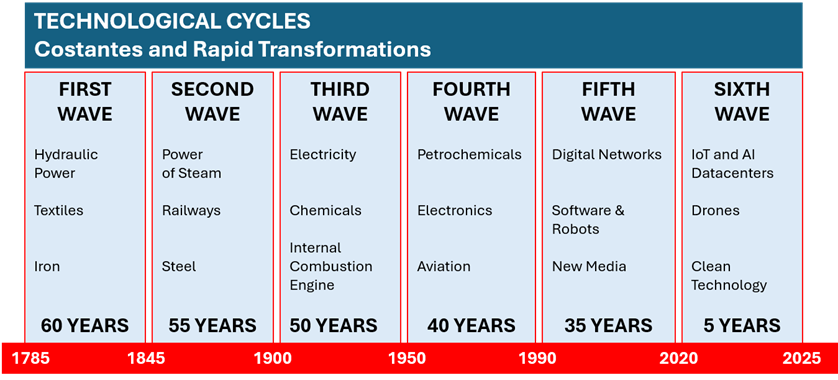
Table 1 Technological Cycles
The summary presented in Table 1 gives us an idea of the duration and the technological evolution that occurred in each stage. We can see that the duration of each wave has been becoming shorter. Each of them brought us extremely important points for the evolution of industry and society.
2.1) The Third Wave
Although the first and second waves were fundamental for the start of modernization, let’s start by commenting on two points of the Third Wave:
a) Electricity:
Electricity is one of the greatest forces of transformation in our history. The mastery of this invisible force exceeded all expectations of the time. It went far beyond replacing candles with lamps in the windows of homes; It went to industries and powered engines that replaced human and animal physical strength with constant force, something unimaginable at the time.
The assembly lines gained an uninterrupted rhythm, and the scale of manufacturing reached unprecedented levels.
In addition to the revolution in industry, electricity has shortened distances by giving life to telegraphs and telephony; communication that used to take weeks now happens in minutes or seconds.
These advances led to others; hospital medicine moved from the old mercury thermometers to safe treatment environments, clean rooms, etc., equipped with continuous monitoring devices. The rhythm of social development accelerated, shaping the modern era that emerged quickly.
In short, electricity was disruptive, and this did not bring any unemployment; on the contrary, it brought new jobs in areas that did not even exist.
b) Internal Combustion Engines:
The first internal combustion engine was invented by Nikolaus August Otto in Germany in the mid-nineteenth century to replace steam engines. Among other advantages, it was lighter, more efficient, and capable of producing more power than the steam engines of the time.
Even after more than a century since this invention, they are part of many people’s daily lives. From automobiles, generators, and large machines such as aircraft and ships, they continue to use this technology.
But now, in the latest wave, combustion engine cars have begun to find a strong competitor, which is precisely the electric-powered vehicles.
2.2) The Fifth and Sixth Waves
Returning to our topic on the impact of artificial intelligence on the labor market, the automotive industry is a good example of change.
a. Battery Electric Vehicle
What is happening before our eyes is one technological, industrial, and perhaps geopolitical disruption of rare proportions in modern history.
The automotive cycle, shaped for more than a hundred years by mechanical engineering, is being displaced by a new productive logic. It’s not just about switching from gasoline to electricity or battery. The change is more profound: the automobile of the 21st century is moving from being essentially a thermodynamic machine to becoming a digital, electric, connected, and permanently upgradeable platform.
The modern electric vehicle is not a conventional car retrofitted with a battery. It is, increasingly, a high-performance computer on wheels. The expression “software-defined vehicle” translates this turning point well. The car becomes an integrated platform of sensors, artificial intelligence, connectivity, entertainment, navigation, energy management, driving assistance, remote updating, and permanent interaction with the user and the surrounding infrastructure.
The most interesting thing is that, even with all this paraphernalia, electric vehicles are more economical in operation and, probably, in maintenance.
Are we close to the end of the combustion engine cycle?
Maybe for automobiles, yes, but as mentioned above, they have other applications that will continue to require their application, whether for logistical needs, power, or for strategic reasons; time will tell us:
b. HVACR Market
What to think about our HVACR market?
The impact of electricity in the automotive area, where the automobile is being displaced by a new production logic, is also being observed in HVACR products and systems.
This phenomenon started way back when pneumatic controls were replaced by electric ones, then by analog electronics, and quickly digital controls appeared.
The famous DDC (Direct Digital Controls) with their microcontrollers that read data from sensors and make automatic decisions to control equipment in real time opened the doors to the Internet of Things (IoT), and from there, in a leap, the application of Artificial Intelligence is rapidly being applied to products and facilities.
But at least for now, here in Brazil, both in the automotive industry and in the refrigeration and air conditioning industry, these real disruptions are not causing consistent job losses but have required professional qualification and even contributed to the lack of a skilled labor force.
So, analyzing what happened in the past with electricity and now in these two sectors, we’re on the middle way; that is, probably the Patients are right.
Souce: Three Views on the Future of Work – https://carnegieendowment.org/

Samoel Vieira de Souza