
ASHRAE has a long history of improving the quality of life. The Society has made important contributions to improving energy efficiency and decarbonizing buildings—and, through the development of industry standards, research into refrigerant properties and applications, and education and training, ASHRAE has helped lead global efforts to eliminate ozone-depleting refrigerants and transition to environmentally preferable alternatives.
As the refrigeration and air-conditioning industry recognizes the 10-year anniversary of the adoption of the Kigali Amendment to the Montreal Protocol, ASHRAE remains fully committed to supporting its vision and implementation.
The Kigali Amendment established a global schedule for reducing the production and consumption of hydrofluorocarbons (HFCs), powerful greenhouse gases widely used as refrigerants. Full implementation is expected to avoid up to approximately 0.3–0.5°C of global warming by 2100.
But Kigali’s impact extends well beyond the refrigerant itself. It affects the equipment we manufacture, the buildings we design, the systems we install and operate, the technicians who service them, and the policies and standards that govern their use. That is why Kigali implementation requires more than replacing one refrigerant with another. The transition must also be safe and energy efficient.
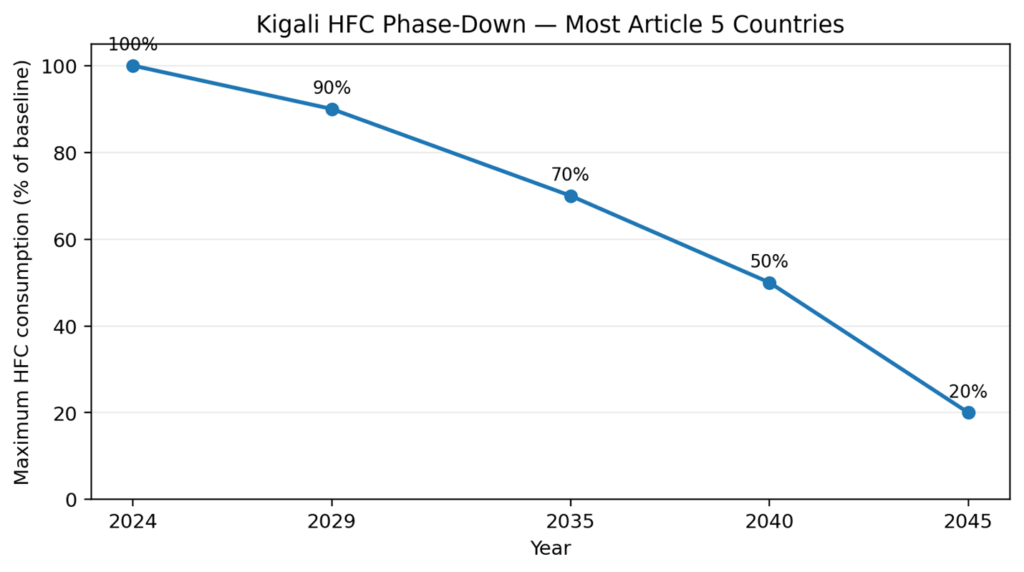
Figure 1. Kigali HFC phase-down for most Article 5 countries. Consumption froze at the baseline level in 2024 and is progressively reduced to 20% of baseline by 2045.
Source: UNEP Ozone Secretariat.
Why Energy Efficiency Matters
Cooling demand continues to grow, particularly in developing economies. HFCs do not deplete the ozone layer, but many have global warming potentials hundreds or thousands of times greater than carbon dioxide. Lower-GWP alternatives have therefore been developed and introduced, some with different safety characteristics, including increased flammability.
At the same time, refrigerant choice alone does not determine the climate impact of a cooling system. If equipment is inefficient, increased electricity consumption—and the associated CO₂ emissions from electricity generation—can offset part of the climate benefit achieved by switching refrigerants.
The Kigali transition therefore presents an opportunity to address both direct emissions from refrigerants and indirect emissions associated with energy consumption. High-efficiency cooling equipment, better building design, proper system sizing and optimization, energy-efficient servicing practices and responsible refrigerant management all contribute to the solution.
ASHRAE’s role is particularly important at the point where international environmental commitments must be translated into engineering requirements and everyday practice.
Turning Kigali Commitments into Practice
The Kigali Amendment establishes the direction and timetable for reducing HFC consumption. Implementation ultimately takes place in equipment, buildings and the refrigeration and air-conditioning workforce. This is where ASHRAE makes a distinctive contribution.
ASHRAE helps provide the technical infrastructure needed to make the transition possible. The Society translates scientific and engineering knowledge into standards, guidance, research, education and practical tools that can be used by designers, manufacturers, engineers, building owners, operators and service technicians.
That support can be viewed as four interconnected activities: research and technical knowledge, standards, education and workforce development, and life-cycle refrigerant management.
Research and Technical Knowledge
A successful refrigerant transition begins with understanding the alternatives and understanding how they can be used safely and effectively in real-world applications. ASHRAE-sponsored research and the ASHRAE Handbook contribute technical information needed to understand refrigerant properties, system performance, safety and application requirements.
As the industry prepared for the transition to lower-GWP refrigerants, ASHRAE also played an important role in assessing the risks associated with these alternatives. Through the ASHRAE Low GWP Refrigerants Modeling and Simulation Technical Committee (Low GWP MTG), the Society supported significant risk-assessment research to better understand how lower-GWP refrigerants could be used safely and effectively.
This work was part of a broader industry effort. ASHRAE collaborated with the U.S. Department of Energy and its national laboratories, AHRI and companies across the industry to conduct research, evaluate technical challenges and develop the information needed to support the transition. The work brought together expertise from across the refrigeration and air-conditioning community and helped address the practical questions involved in moving from one generation of refrigerants to the next.
That collaborative effort helped bridge the gap between identifying lower-GWP alternatives and putting them into practical use. It provided important technical information to support standards, codes, equipment design and safe application, helping to make the transition both practical and possible.
Standards for a Safe Transition
Safety is fundamental to Kigali implementation because some lower-GWP alternatives have different flammability or toxicity characteristics than the refrigerants they replace.
ANSI/ASHRAE Standard 34, Designation and Safety Classification of Refrigerants, establishes a uniform system for assigning refrigerant numbers, safety classifications and refrigerant concentration limits. ANSI/ASHRAE Standard 15, Safety Standard for Refrigeration Systems, establishes requirements for the safe design, construction, installation and operation of refrigeration systems.
Together, Standards 15 and 34 help turn the introduction of new refrigerants into engineering requirements that protect people and property. They also reflect the research, risk assessment and industry experience that have informed the transition to lower-GWP refrigerants.
These standards provide a technical basis that can be incorporated into national and regional codes and regulations as countries implement their refrigerant transitions.
Education and Workforce Development
Standards alone are not enough. The engineers who design systems and the technicians who install, operate, maintain and repair them must understand how refrigerants differ and how those differences affect their work.
This becomes particularly important as technicians encounter mildly flammable A2L refrigerants and, in some applications, highly flammable A3 refrigerants. Safe practices may require different tools, leak-detection procedures, ventilation, refrigerant recovery practices and precautions against potential ignition sources.
ASHRAE supports the transition through publications, technical guidance, eLearning and other educational resources. Through its partnership with the United Nations Environment Programme’s OzonAction programme, these resources can also support capacity building in developing countries, where much of the future growth in refrigeration and air conditioning will occur.
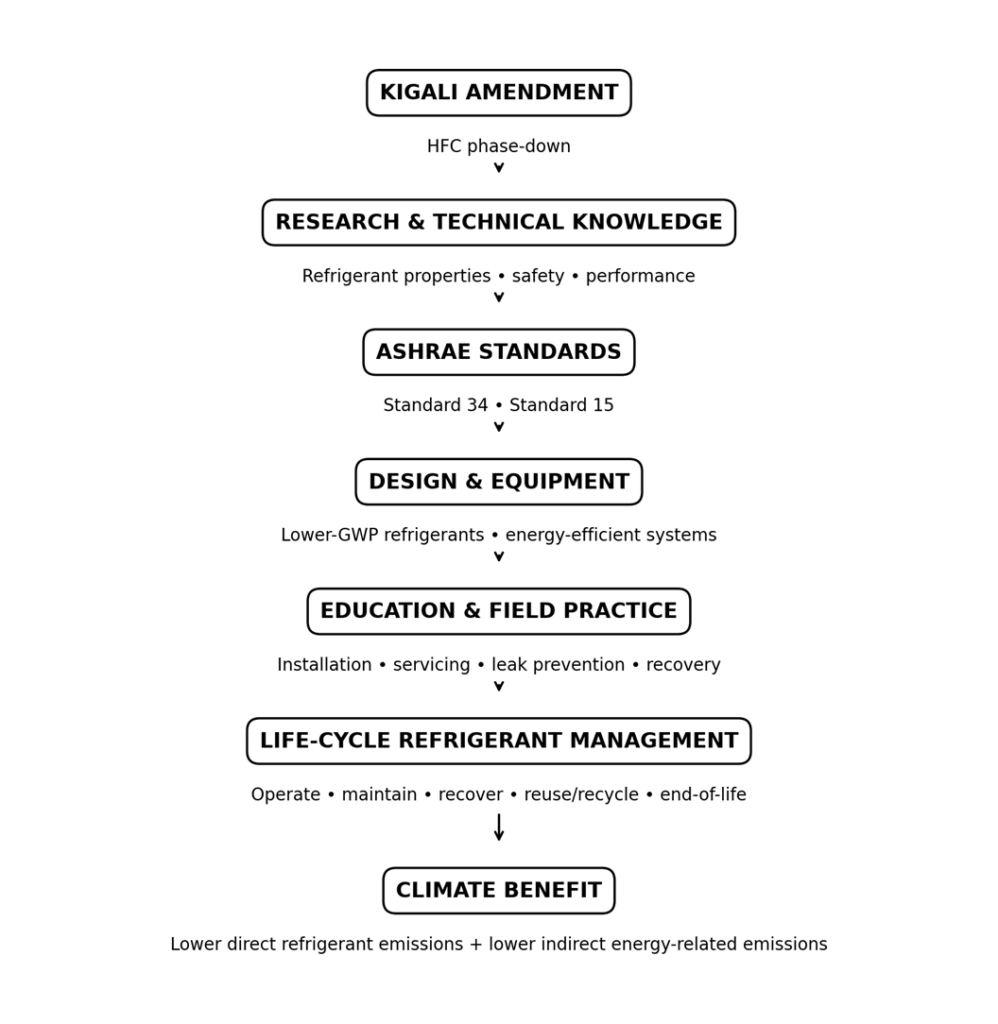
Figure 2. From Kigali commitment to climate benefit. ASHRAE helps bridge international environmental commitments and implementation through research, standards, education and field practice.
A Global Partnership for Implementation
Developing countries face particular challenges in making this transition. Equipment must change, standards and regulations must evolve, and large numbers of technicians and engineers need access to appropriate information and training.
ASHRAE and the United Nations Environment Programme have worked together since 2007 to help meet that need. The partnership combines UNEP OzonAction’s role in assisting developing countries with their Montreal Protocol obligations with ASHRAE’s technical expertise, standards and international network of HVAC&R professionals.
In 2026, ASHRAE and UNEP adopted a new two-year work plan focused on Life Cycle Refrigerant Management (LCRM). The work plan looks beyond refrigerant selection to consider the refrigerant throughout its useful life—from production and installation through operation, servicing, recovery, reuse and eventual disposal.
The 2026–2027 program includes development and expansion of practical tools and educational products, including a multilingual technician field companion, fact sheets, eLearning, university materials, RAC Plant Sustainability resources, refrigerant information and case studies demonstrating successful lower-GWP applications.
Managing Refrigerants from Cradle to Grave
One of the lessons of earlier refrigerant transitions is that refrigerant management cannot end when equipment is installed. A refrigerant may remain in a system for years or decades. During that period, emissions can occur through leaks, servicing, improper charging and equipment failure. Additional emissions can occur when equipment reaches the end of its useful life if the remaining refrigerant is not properly recovered.
Preventing leaks provides a double benefit. It prevents direct emissions of refrigerant while also helping equipment maintain its intended efficiency. Recovery and responsible end-of-life management are equally important. This is why ASHRAE’s approach increasingly brings refrigerant management, energy efficiency and safety together rather than treating them as separate objectives.
Putting Life-Cycle Management into Practice
A good example is the ASHRAE–UNEP Assessing RAC Plant Sustainability technical guidance. The resource provides practical checklists that operators can use to assess whether refrigeration and air-conditioning plants are being operated in ways that are safe, energy efficient and environmentally sustainable.
Safe storage and proper handling of refrigerants
Periodic leak checking and proper documentation
Preventive maintenance of equipment
Preventive maintenance of automatic controls
Energy-efficient operation
Proper commissioning and recommissioning practices
Proper disposal of equipment and refrigerant
Competencies of operating and service personnel, including requirements for tools and servicing
This is an example of how the Kigali transition moves from policy to practice: an international commitment becomes an engineering standard, a training program, a maintenance procedure or a technician’s checklist. The Assessing RAC Plant Sustainability technical guide is available for free download at ashrae.org/UNEP-RACchecklists.
ASHRAE’s Kigali Implementation Toolbox
| Implementation Need | ASHRAE Contribution |
| Understand alternative refrigerants | Research, ASHRAE Handbook and technical information |
| Identify and classify refrigerants | ASHRAE Standard 34 |
| Apply refrigerants safely | ASHRAE Standard 15 |
| Improve system efficiency | Standards, guidance, research and training |
| Develop workforce capability | eLearning, publications, university and technician resources |
| Reduce leaks and refrigerant emissions | Life-Cycle Refrigerant Management guidance |
| Improve operation and servicing | RAC Plant Sustainability checklists and guidance sheets |
| Demonstrate successful transitions | Lower-GWP case studies |
| Support developing countries | ASHRAE–UNEP OzonAction partnership and National Ozone Unit engagement |
Figure 3. ASHRAE’s Kigali implementation toolbox. Kigali implementation requires more than selecting a replacement refrigerant; ASHRAE resources support the full technical chain.
Kigali’s Broader Legacy
Ten years after the Kigali Amendment was adopted, its legacy is becoming clearer. Kigali established a pathway for reducing the climate impact of HFC refrigerants. But its implementation is also accelerating changes throughout the refrigeration and air-conditioning industry—in refrigerants, equipment, system design, standards, training, servicing and refrigerant management.
Those changes come at a time when the need for cooling is increasing around the world. The challenge is therefore not simply to provide more cooling, but to provide it without unnecessarily increasing energy demand, greenhouse gas emissions or safety risks.
ASHRAE’s goal is to help ensure that this transition occurs with minimum disruption to end users and as safely and efficiently as possible. Refrigerant choice cannot be separated from equipment efficiency; equipment efficiency cannot be separated from building design and operation; and environmental performance cannot be separated from the health, comfort and safety of occupants.
The challenges are substantial, but they are not insurmountable. Our industry has already developed much of the equipment, standards, knowledge, tools and workforce needed to meet them. The work now is to build on that foundation and apply it consistently around the world.
The Kigali Amendment gave the world a direction. The task now is implementation. For ASHRAE, that means continuing to connect environmental protection, energy efficiency and safety and helping translate global environmental commitments into practical engineering solutions that work in buildings and communities around the world.
Sources for Figures and Supporting Data
UNEP Ozone Secretariat, Kigali Amendment HFC phase-down schedules.
United Nations Environment Programme, information on the expected climate benefit of Kigali implementation.
ASHRAE, 2026–2027 ASHRAE–UNEP Work Plan focused on Life Cycle Refrigerant Management.
ANSI/ASHRAE Standard 15, Safety Standard for Refrigeration Systems.
ANSI/ASHRAE Standard 34, Designation and Safety Classification of Refrigerants.

Bill McQuade