
The ongoing, global transition to lower-global warming potential (GWP) refrigerants has been one of the most significant environmental and technological transformations in the history of the HVACR and water heating industry. In the United States, this transition has been driven in large part by a combination of innovation, investment, and a carefully constructed regulatory framework established through the American Innovation and Manufacturing (AIM) Act, which implements the objectives of the Kigali Amendment to the Montreal Protocol.
For manufacturers, distributors, contractors, and other industry stakeholders, the transition has required substantial planning and investment. Companies have redesigned products, retooled manufacturing facilities, trained employees, and educated customers. These investments were made with the expectation that the regulatory framework governing the transition would remain predictable and consistent – an expectation that has recently been tested by the U.S. Environmental Protection Agency’s (EPA) rollback of the compliance requirements and deadlines of the Technology Transitions (TT) Program.
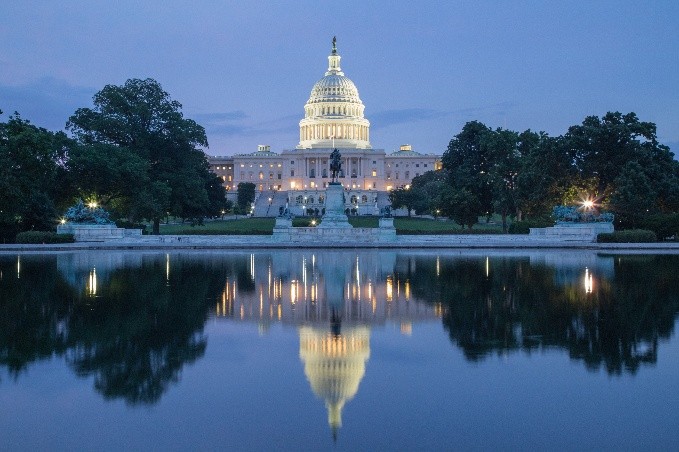
Figure 1: The United States Capitol serves as the seat of Congress, where the “policy whiplash” phenomenon is often reflected in legislators’ priorities.
Over the past decade, the United States has experienced dramatic political shifts that have produced equally dramatic changes in Administration regulatory priorities. At AHRI, we refer to this phenomenon as “policy whiplash.” Each presidential administration brings with it a new governing philosophy, a new cabinet, and new leadership of federal agencies. While changes in policy are expected during significant transitions of power, abrupt reversals of long-established regulatory frameworks create uncertainty that can undermine both environmental progress and economic affordability. The ongoing refrigerant transition provides one of the clearest examples of the ripple effect that results when regulatory stability is challenged.
Industry’s Long Record of Compliance
The global HVACR and water heating industry, of which AHRI is a major part, is – and has always been – a source of energy efficient and affordable solutions to the world’s growing indoor environment needs, whether they be air conditioning in the hotter climates of developing nations or more environmentally friendly cooling and heating solutions in developed nations and regions such as the United States and Europe. We are veterans of regulatory initiatives and have completed two global refrigerant transitions. The industry is adept at working with regulators to identify realistic goals and incorporate them into policy with attainable and affordable compliance.
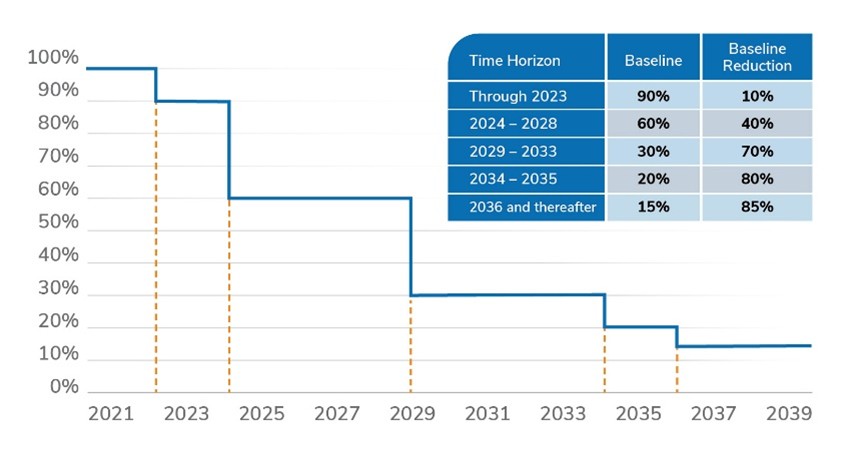
Figure 2: The HFC phasedown timeline found in the AIM Act implements the objectives of the Kigali Amendment to the Montreal Protocol.
There is perhaps no better example of bipartisanship and industry collaboration than the AIM Act. Passed with widespread support in 2020, the legislation established a national framework for the reduction and phasedown of hydrofluorocarbons (HFCs). While it sounds simple, it accomplished the rare feat of satisfying both environmental activists, who wanted to see a shift to more environmentally friendly refrigerants, and industry, which was given a timeline to design and introduce new, innovative products to the market.
As a result, the implementing regulations for the AIM Act enjoyed an extremely high level of compliance. The January 2025 and January 2026 compliance deadlines came and went quietly, largely because much of the industry had started the transition well ahead of time. Today, all new residential and light commercial equipment uses the next-generation refrigerants required by law.
It is important to point out that one of the most significant challenges in AIM Act compliance, the temporary shortage of cylinders to deliver R-454B refrigerant, was solved with patience, not policy. Upon identifying the problem, companies and distributors worked together to find solutions that minimized market disruption without compromising affordability or safety.
The Growing Challenge of Regulatory Instability
The level of compliance described above is the result of confidence in the U.S. refrigerant transition within the manufacturing community. Following passage of the AIM Act, many companies invested millions of dollars in large-scale initiatives to ensure that their people, products, and production facilities would be prepared for the transition, with the understanding that those investments were protected by the long-term regulatory framework.
With the U.S. EPA’s rollback of some commercial refrigeration provisions of the original TT Rule, the industry now faces the challenge of how to restore that confidence. The TT reconsideration final rule injects a significant amount of uncertainty into the market. Production planning, workforce training, and capital expenditures were developed around established compliance deadlines, some of which no longer exist.
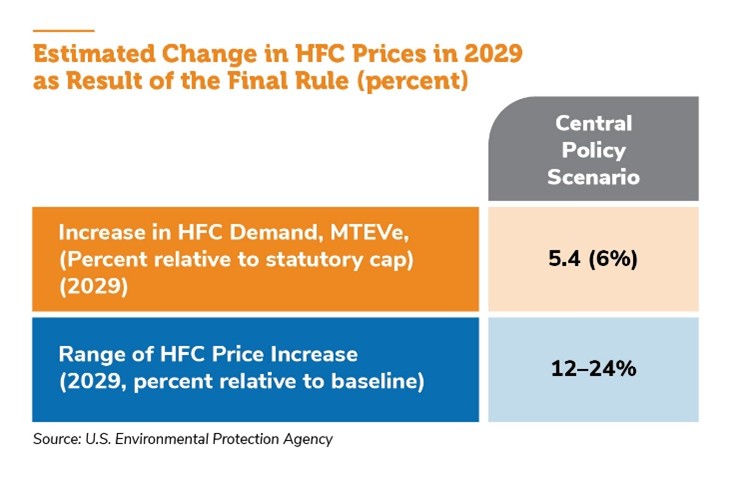
Figure 3: U.S. EPA analysis predicts an increase in refrigerant prices as soon as 2029.
While the U.S. EPA argues that this rollback will reduce costs for working class families by lower prices at the grocery store, the reality is that it will likely continue to see food prices rise due to geopolitical events. The U.S. EPA’s own analysis, released with the rule, acknowledged that delaying the transition could contribute to a 12- to 24-percent increase in refrigerant prices as soon as 2029. This, coupled with the delayed compliance deadline of January 1, 2032, for large commercial refrigeration systems, is likely to create a significant imbalance between the decreasing HFC supply and demand. By extending the commercial refrigeration compliance deadlines to 2032, the U.S. EPA is increasing the length of time that the market will demand these refrigerants, pushing their use well beyond the timeframe that refrigerant suppliers had planned under the AIM Act.
Affordability Depends on Predictability
In the wake of global economic challenges, countries around the world have seen a new policy focus on “affordability.” In the United States, increased inflation spurred by higher gas and food prices has been a major focus of both political parties. Its continued rise in importance as a political issue reflects the fact that consumers, especially those considered middle class, are under a level of economic pressure that they have not experienced for decades.
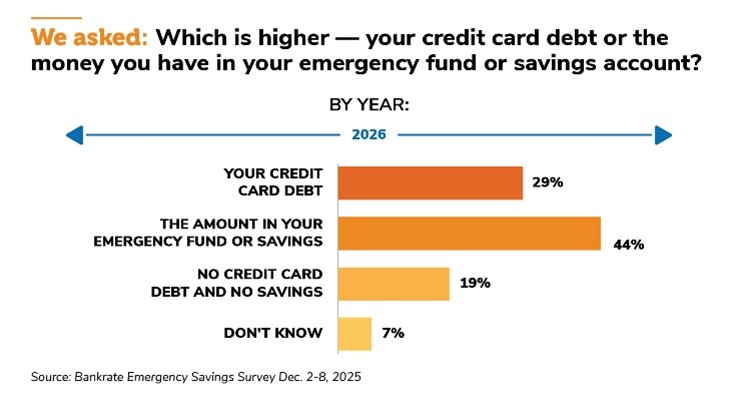
Figure 4: A recent survey from Bankrate found that roughly 3 in 10 Americans have more credit card debt than emergency savings.
Recent analysis from the Brookings Institution found that one third of American middle-class families no longer make enough money to afford basic necessities, such as food, housing, and childcare. The most recent data on personal income from the U.S. Bureau of Economic Analysis shows that, compared to 2025, American households are spending more, specifically on gas and energy, housing, and food, while saving at the lowest rate since 2022. Most concerning, according to Bankrate’s Emergency Savings Report, about three in ten Americans have more credit card debt than emergency savings and more than half of Americans have the same or less money in savings than one year ago.
That means that over time, these households are becoming less prepared for an emergency expense, not more. As we know, heating, cooling, and water heating are not luxuries, they are necessary to ensure human health, safety, productivity, and comfort, and the industry should support measures that make affordable, timely, and efficient repairs and replacements as accessible as possible.
One of the best ways to make that happen is long-term regulatory stability, which allows businesses to confidently invest, early and often, knowing the future requirements of the market. Predictable implementation schedules allow manufacturers to invest in production capacity, address changes in their supply chains, and introduce new technologies at lower costs. This leads to a positive chain of events for both manufacturers and consumers, as regulatory certainty encourages investment, investment drives innovation, innovation lowers costs, and consumers benefit from less expensive, more efficient equipment.
When manufacturers are stymied in doing these things on a predictable schedule, many will be inclined to delay investments and increase contingency planning. These disruptions and their associated costs ultimately flow through distribution and installation chains and are reflected in the prices paid by consumers.
The Path Forward
The solution is not the elimination of existing regulations, which would create sliding goal posts that undermine investments and competition among manufacturers. The focus must instead shift to creating “smart regulation” that has clear objectives and reasonable compliance deadlines. Most important, smart regulations are those that remain in place long enough to allow an appropriate amount of time for the market and other stakeholders to respond.
Smart regulations also recognize that environmental progress and economic growth are not mutually exclusive. The foundation of the current refrigerant transition serves as a promising example of how industry and government can work together to achieve meaningful environmental progress while supporting economic growth. The industry is following a well-established roadmap that involves innovative technology, carefully planned investments, and workforce training. The remaining challenge is preserving the certainty necessary for success.
AHRI’s Commitment to Affordability and Environmental Stewardship
AHRI remains ready to contribute to the needs of the HVACR and water heating industry through the current refrigerant transition.
Figure 5: AHRI is proud to begin the third iteration of the Alternative Refrigerants Evaluation Program (AREP-3).
To help plan for the future, AHRI’s research department recently launched the Lower-GWP Alternative Refrigerants Evaluation Program (AREP), an industry wide collaborative effort to identify and evaluate promising alternative refrigerants for major product types, while avoiding duplicative efforts. This is the third iteration of the program: AHRI successfully managed the original R-22 AREP in the 1990s and oversaw the work of AREP-2 in the 2010s in response to environmental concerns related to high-GWP refrigerants. As with previous efforts, AHRI will provide the leadership to coordinate and manage this industry-driven research and work closely with industry experts from its member companies. It is one of the best examples of the spirit of collaboration within the industry and exemplifies its commitment to innovation and improvement.
AHRI hopes that the data collected from the AREP project will guide future policy decisions by providing a clearer picture of the tangible benefits of new refrigerants and their applications.
The HVACR industry has repeatedly demonstrated that it will meet ambitious policy goals when those policy goals are accompanied by realistic timelines that are economically justified and supported by regulatory certainty.
The AIM Act and Kigali framework have provided that certainty and preserving it will be essential to maintaining momentum toward maximizing the use of lower-GWP refrigerants while protecting consumers. In the years ahead, the question will not be whether the industry can complete the refrigerant transition – we have proven time and again that innovation is well within our comfort zone. The question will instead become whether policymakers will provide the certainty necessary to allow American manufacturers and consumers to succeed.

Stephen R. Yurek