
The European Union marks two important anniversaries in 2026: ten years since the adoption of the Kigali Amendment and twenty years since the first EU fluorinated gas (F-gas) Regulation. Over those two decades, EU policy has evolved from improving the management of fluorinated greenhouse gases to progressively reducing their supply, restricting their use and supporting the uptake of climate-friendly alternatives.
The first F-gas Regulation: improving refrigerant management
The first F-gas Regulation, adopted in 2006, focussed primarily on establishing good refrigerant-management practices for F-gases across all 27 EU Member States. This included the training and certification of some 400,000 technicians (AREA, 2024[1]), alongside mandatory requirements for leak checks, recovery and end-of-life treatment. These measures were designed to prevent emissions from equipment using F-gases.
The 2014 Regulation: reducing HFC supply and transforming markets
The second EU F-gas Regulation, adopted in 2014, broke new ground. In anticipation of a global agreement under the Montreal Protocol, it introduced an ambitious quota system for hydrofluorocarbons (HFCs), triggering a transformation of the EU market. The quota system progressively reduces the quantity of HFCs that can be placed on the EU market, measured in carbon dioxide equivalent (CO2e). This creates an incentive to reduce HFC first in sectors where doing so is most economical and feasible.
Market participants can reduce their demand for HFC quotas by:
(i) using substances with lower global warming potential (GWP) or avoiding fluorinated gases altogether in new equipment,
(ii) reducing refrigerant gas charges through improved equipment design,
(iii) retrofitting existing equipment,
(iv) minimising refrigerant losses through better servicing and regular checks, with associated improvements in energy efficiency and performance,
(v) increasing the recycling and reclamation of used gases.
There are clear indications that all these practices have been adopted in response to the quota system. In particular, the market has shifted away from highly warming F-gases towards gases with a much lower GWP and F-gas free alternatives.
Since 2015, the climate impact of HFCs supplied to the EU market – both in bulk and contained in equipment – has fallen to around one third of its previous level measured in CO2e (Figure 1). Over the same period, the supply of other F-gases not covered by the quota system increased.
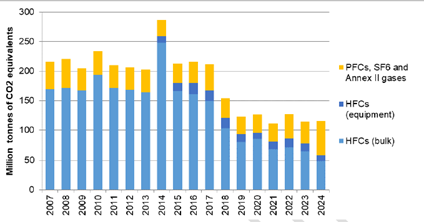
Figure 1. EU supply by type and group of fluorinated gases. Source: European Environmental Agency (2025) – Fluorinated gases 2025.
Ensuring equal treatment of EU and imported equipment
The quota system indirectly covers HFCs contained in imported equipment. It therefore treats equipment importers and EU equipment manufacturers in the same way. The total quantity of HFCs contained in imported equipment has increased significantly over the past ten years. However, the associated climate impact, measured in CO2e, has almost halved (Figure 2). This indicates a substantial shift towards gases with a lower GWP.
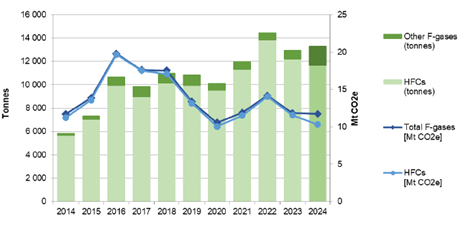
Figure 2. EU imports of fluorinated gases contained in products and equipment. The columns show metric tonnes of F-gases and HFCs according to the left scale, while the blue lines indicate the climate effect (in CO2 equivalents) according to the right. Source: European Environmental Agency (2025) – Fluorinated gases 2025.
How the refrigeration sector responded
The largest reductions in HFC demand have been achieved in the refrigeration sector, where many types of equipment can avoid using fluorinated gases altogether.
Transcritical CO2 technology has become the standard for large supermarket refrigeration systems in the EU. Approximately 100,000 such systems are in operation today compared to fewer than 10,000 a decade ago (Atmosphere, 2025[2]).
For small, self-contained refrigerated cabinets commonly used in smaller shops, hydrocarbons, and particularly propane, have become the preferred choice. Some 20 million units using this technology are now in operation in the EU (Atmosphere, 2025[2]). Ammonia is also frequently used in industrial refrigeration installations, where public access is normally limited.
The quota system is widely regarded as having successfully promoted the uptake of these technologies. However, its operation also creates significant administrative burden. European and national authorities must carry out compliance checks and enforcement, while customs and market-surveillance authorities must devote considerable effort to preventing illegal activities.
Complementing quotas with sectoral prohibitions
Sectoral prohibitions have proven effective restricting the use of high-GWP F-gases where they are no longer needed. One example is the elimination in the EU of R404A (or R507A): highly warming refrigerant blends that offer only mediocre energy efficiency. Alongside restrictions on their use in new equipment, the 2014 Regulation prohibited the use of virgin R404A/R507A to service certain existing equipment from 2020. This measure is commonly known as the “service ban”. Figure 3 shows the resulting decline in the EU supply of R404A
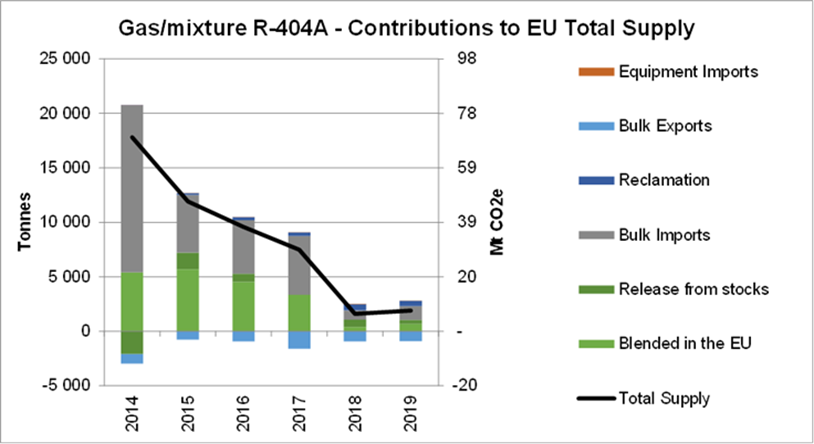
Figure 3. EU supply of R404A Source: European Commission (2022). Impact Assessment.[3]
The 2024 Regulation: Towards an hydrofluorocarbons phase-out
Rapid technological progress across many sectors paved the way for the third EU F-gas Regulation adopted in 2024. The Regulation provides for the complete phase-out of HFCs by 2050 and introduces numerous additional sectoral prohibitions, particularly in the air conditioning sector.
Some of these prohibitions require certain types of equipment, including smaller heat pumps and chillers, to avoid F-gases altogether. In addition to reducing greenhouse gas emissions, moving away from these gases can help address concerns related to per- and polyfluoroalkyl substances (PFAS), commonly known as “forever chemicals”.[4] A broad EU assessment of potential further restrictions on PFAS is ongoing. It may result in additional restrictions where suitable non-PFAS alternatives are available.
The 2024 Regulation also introduced clearer rules to facilitate enforcement. In addition, technicians must now be trained and certified to work with all refrigerants, fluorinated or not, in both stationary and mobile applications. This broader training requirement is crucial for the transition. Many climate-friendly refrigerants have properties, including flammability, that require specialised skills and knowledge to ensure that equipment is installed, serviced and handled safely.
Extending action to mobile equipment
EU market placement bans currently only cover stationary cooling and heat pump equipment as well as air conditioning systems in passenger cars[5]. In 2027, the European Commission will report on the possibilities for replacing F-gases in all mobile equipment that uses refrigeration and/or air-conditioning. This report is likely to provide a key input into the overall review of the F-gas Regulation, which is legally required by 2030.
Atmospheric measurements confirm falling emissions
Recent atmospheric monitoring provides further evidence of the impact of EU F-gas policies. Researchers have observed a steady decline in total HFC emissions over north-western Europe (Figure 4), while global emissions of most HFCs continue to increase.4
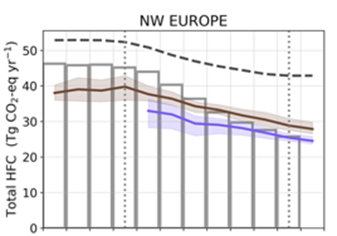
Figure 4. Annual emissions of total HFCs for north-western Europe from 2013 to 2025. While columns represent data reported to the UNFCCC, the black and blue solid lines are derived from inverse modelling based on atmospheric observations. Source: De Longueville et al (2026) [6]
Sharing lessons from EU experience
The EU experience demonstrates the value of combining an ambitious quota system with targeted prohibitions on placing certain F-gas equipment on the market and appropriate flexibilities. This combination of policy tools is particularly important in markets where replacing high-GWP F-gases remains more technically or economically challenging. It has enabled continuous, gradual progress across all sectors of the EU economy.
EU F-gas policies have enabled the Union to meet its obligations under the Kigali Amendment to the Montreal Protocol and now go significantly beyond those requirements. Many countries operating under Article 5 of the Protocol are currently developing their own policies to implement the Amendment.
The transformation of the EU refrigeration and air-conditioning market has resulted in a wide range of new equipment using climate-friendly refrigerants. This should make it easier for other countries to design policies capable of delivering rapid results. For example, targeted bans may be particularly effective where alternatives to F-gases have already become technically mature and widely used.
The EU is working bilaterally with other countries to exchange our experiences of different approaches to implementing the Kigali Amendment.
Overall, the EU experience shows that an effective policy framework must:
- avoid the use of F-gases where suitable alternatives are available;
- minimise emissions where F-gases continue to be used;
- ensure that installers and technicians have the necessary skills;
- and establish effective rules for implementation and enforcement.
[1] The Voice of European Air-Conditioning, Refrigeration and Heat Pumps Contractors:
Training & certification on F-gases and alternative refrigerants. AREA internal survey. https://area-eur.be/sites/default/files/2024-12/Final%20AREA%20survey%20training%20and%20certification%202024.pdf
[2] Refrigeration: Commercial and Industrial Refrigeration with Natural Refrigerants 2025 – ATMOsphere
[3] https://climate.ec.europa.eu/document/download/9013881e-8d5d-429e-9112-c908f127c833_en?filename=f-gases_impact_assessment_en.pdf
[4] Many HFCs and Hydrofluoroolefins (HFOs) break down into TFA. ECHA’s Risk Assessment Committee recommends classifying TFA as toxic to reproduction, as persistent, mobile and toxic (PMT) and very persistent and very mobile (vPvM) substance
[5] MAC Directive (Directive 2006/40/EC). https://eur-lex.europa.eu/legal-content/EN/TXT/?uri=CELEX:32006L0040
[6]De Longueville et al. (2026). European HFC emissions evaluated with multiple atmospheric inverse models and UNFCCC national inventories. Atmospheric Chemistry and Physics 26: 7647-7675. https://acp.copernicus.org/articles/26/7647/2026/

Bente Tranholm-Schwarz

Arno Kaschl