
Abstract
In 2023, the European Innovation Council (EIC) launched the Pathfinder Challenge call “Clean and efficient cooling” aiming to develop a range of breakthrough technology solutions for cooling to improve efficiencies, minimize the use of Critical Raw Materials (CRM), and explore system integration opportunities. The objective of the call was to fund the development of novel technologies in the field of cooling necessary to promote a strong consumption reduction and to avoid the utilization of refrigeration gases with a harmful environmental impact. Out of the EIC Pathfinder Challenge call, 10 projects were selected for funding forming the EIC Cooling Portfolio (referred to herein as “portfolio”). One project was added to the portfolio stemming from the 2022 EIC Pathfinder Open. The thematic areas covered by the projects are several: sorption-based refrigeration, thermo-mechanical refrigeration and solid-state refrigeration (i.e. baro-, elasto-, electro- and magneto-caloric refrigeration). They cover a spectrum of operating temperatures from +29 celsius down to -272 celsius challenging the domains of: data centers, vaccine conservation, residential and mobile air conditioning systems, commercial refrigeration and quantum computing. The present paper describes in detail the scopes of each project and the expected impact on the enlarged cooling sector for a sustainable cooling transition.
Introduction
From a historical perspective, the Montreal Protocol on substances that deplete the Ozone layer, which came into effect in 1989, has deeply shaped the refrigeration and air conditioning (RAC) sectors across building, industrial, and transport applications. By the late 1990s, the dominant vapor-compression technology relied heavily on synthetic refrigerants, mainly chlorofluorocarbons (CFCs). The imperative to halt stratospheric ozone depletion drove a first migration toward hydrochlorofluorocarbons (HCFCs) and, subsequently, hydrofluorocarbons (HFCs). The latter were later targeted by further regulations due to their high Global Warming Potential (GWP) measured over a 100-year horizon. The Kigali Amendment to the Montreal Protocol came into effect in 2019 and established a pathway for the global transition to phase down high-GWP HFCs, fostering the adoption of low-GWP options, including hydrofluoroolefins (HFOs) and, notably, natural refrigerants (CO2, hydrocarbons, ammonia) which offer near-zero direct environmental impact. Europe accelerated this trajectory through the 2024 F-Gas Regulation, imposing stricter reduction thresholds than those mandated by the Kigali Amendment while aligning with emerging environmental frameworks such as potential PFAS restrictions. As vapor-compression systems progressively transition to natural fluids, direct emissions from refrigerant leakage are minimized, shifting the strategic focus toward reducing indirect emissions linked to energy consumption. In line with EU decarbonization and electrification policies —such as the 2026 Electrification Act and the Energy Performance of Buildings Directive (EPBD) — the main challenge becomes lowering energy consumption while meeting required thermal capacities under target ambient and indoor conditions. Within this evolving context, alternative not-in-kind (NIK) technologies—including solid-state caloric systems (magneto-, baro-, electro-, and elastocaloric), sorption, and thermo-mechanical systems do not aim to directly compete with natural refrigerants in standard applications, but represent strategic solutions where vapor compression encounters physical, operational, or safety boundaries. These boundary conditions include ultra-low temperature regimes (below -60 °C down to cryogenic levels, where most conventional refrigerants freeze), high-hazard environments prohibiting flammable or toxic working fluids (e.g., confined spaces, aerospace, or environments with spark risks), and applications operating across narrow temperature spans (<10 K). Furthermore, advanced NIK and sorption paradigms seamlessly integrate with smart energy management architectures, enabling efficient thermal energy storage and the recovery of waste heat, such as in high-performance data centers. This comprehensive landscape of technological opportunities defines the key levers needed to surpass the current state of the art and drive a sustainable cooling transition. Within this framework, the technologies presented in this paper were selected under the EIC Pathfinder Challenge call “Clean and Efficient Cooling”, managed by the European Innovation Council and SMEs Executive Agency (EISMEA). The core objective of the call was to build a direct bridge between cutting-edge European environmental policies[1]—including minimum performance requirements under the Ecodesign for Sustainable Products Regulation, 2050 climate targets (implicitly aligned with Kigali and the 2024 F-Gas Regulation), and the 2023 EPBD. The EIC Pathfinder Challenge aims to unlock breakthrough, high-risk/high-impact technologies, allowing Europe—supported by its strong, high-tech industrial base—to advance its leadership in the deep-tech sector. Beyond individual project developments, the initiative is characterized by a coordinated portfolio approach. Based on a shared vision among the EIC Program Manager, Project Officers, and the scientific-industrial ecosystem formed by the participants, this model fosters mutual reinforcement and maximizes the collective impact of the projects. The following sections provide a detailed overview of these emerging technologies and their underlying physical principles, outline their targeted socio-economic and environmental impacts, and describe the portfolio strategy[2] and joint activities carried out by the Portfolio Working Groups. An overview of the portfolio projects can be found on the portfolio website.
Section 1: Thematic areas and working principles of the different technologies
Cooling systems (and, reversibly, heating systems) transfer thermal energy from a lower-temperature source to a higher-temperature sink. This process cannot occur spontaneously, as heat naturally flows from a hotter to a colder body. Therefore, a working medium (gaseous, liquid, undergoing a liquid-vapor phase transition, or solid) must operate at a temperature lower than the cold source during the heat absorption phase and, conversely, at a temperature higher than the hot sink during the heat rejection phase. Theoretically, this is achieved through ideal thermodynamic cycles with no internal or external irreversibilities: the Carnot cycle for sources with infinite heat capacity, or the Lorenz cycle for sources with finite heat capacity.
Vapor-compression technology approximates these ideal cycles by performing heat exchange through a refrigerant undergoing a liquid-vapor phase change, thus enabling near-isothermal processes. For practical and economic simplicity, real cycles implement expansion via a dissipative throttling process and restrict compression to the vapor phase to avoid liquid-induced compressor damage. Operating with a phase-changing refrigerant provides a large volumetric cooling capacity and exceptional heat transfer performance, significantly reducing equipment size.
Today, vapor-compression technology is extremely mature, mass-manufactured, highly cost-effective, and scaled globally across virtually all cooling capacities. The sector is actively adapting to environmental mandates by transitioning toward non-ozone depleting and ultra-low-GWP natural refrigerants. Further performance enhancements are centered on improving operational resilience over the equipment lifecycle, which is a key objective addressed by one of the Portfolio projects presented herein (BEYOND).
However, as highlighted in the Introduction, specific contextual constraints (e.g., extreme operating temperatures, safety restrictions regarding flammable/toxic fluids, or narrow temperature spans) can render conventional vapor compression less effective or impractical, opening the door for alternative not-in-kind technologies. A brief description of the working principle of each technology is reported below and schematized in Figure 1.
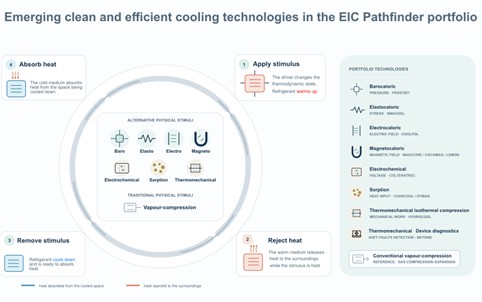
Figure 1. Schematic representation of the traditional and alternative clean and efficient cooling technologies explored within the EIC Pathfinder portfolio, illustrating their alternative physical stimuli and their implementation within a common four-step thermodynamic cooling cycle: stimulus application, heat rejection, stimulus removal, and heat absorption.
Thermomechanical Isothermal Compression (TIC) is a novel concept related to the well-established principle of thermochemical compression, in which the conventional mechanical compressor is replaced by a liquid piston compressor (LPC). Compression is a critical process in vapor-compression systems and can account for a significant fraction of their total energy consumption. Consequently, the development of more energy-efficient compression technologies is becoming increasingly important in response to the growing demand for heating and cooling across a wide range of applications. In conventional rapid gas compression, a significant fraction of the mechanical work supplied to the compressor is converted into an increase in the refrigerant temperature. This temperature rise increases the compression work and may also adversely affect the efficiency and operating conditions of the overall system. From a thermodynamic perspective, isothermal compression represents the theoretical minimum mechanical work required to compress a gas between two specified pressure levels, as heat is continuously rejected from the gas during compression to maintain a constant temperature. Liquid piston compression offers a promising approach to achieving near-isothermal compression. In an LPC, a liquid is used as the compression medium to reduce the gas volume within a fixed compression chamber. Because the liquid piston can provide a large gas–liquid interface and eliminates the need for conventional mechanical sliding seals, this configuration can potentially reduce frictional losses, lubrication requirements, and refrigerant leakage. More importantly, the intimate contact between the gas and the liquid can enhance heat transfer during compression, allowing the compression process to approach the isothermal limit.
The extent to which near-isothermal compression can be achieved in an LPC depends primarily on the ability to remove the heat generated during compression. This can be enhanced through three main strategies: (i) maximizing the heat-transfer area available within the compression chamber, (ii) increasing the time available for heat transfer during the compression process, and (iii) improving the thermophysical and heat-transfer properties of the compression liquid. The Thermomechanical Isothermal Compression concept using liquid piston technology, provides a potential alternative to conventional mechanical compression in vapor-compression systems.
The Thermally Regenerative Electrochemical Cycle (TREC) provides a mechanism for directly coupling heat flows to electrochemical processes. The cycle operates on the principle that certain electrochemical reactions proceed with a significant change in entropy, causing their reversible electrode redox potentials (V) to be highly temperature-dependent. For a single-electron transfer, the temperature coefficient is defined as
, where is the Faraday constant. A complete TREC involves executing an electrochemical forward reaction at a specific temperature, followed by the regeneration of the redox reactants via a reverse reaction at a different temperature. This fundamental voltage-temperature dependency allows the system to either harvest electricity from a temperature differential or pump heat against a temperature gradient. When operated in this heat-pump mode, the cycle absorbs thermal energy from a cold environment during the endothermic reaction and discharges it to a hotter environment during the exothermic phase. This configuration enables TREC to function as a highly efficient cooling technology that approximates an ideal reverse Carnot cycle, entirely eliminating the need for mechanical vapor compression and refrigerant phase-changes.
Sorption cooling exploits the reversible sorption and desorption of a refrigerant onto or into a solid or liquid sorbent material, using low-grade heat rather than mechanical compression as the driving energy. Two main technology families exist: adsorption systems use solid sorbents such as silica gel, zeolite, or activated carbon, to adsorb/desorb water vapor, in intermittently cycled beds; absorption systems, on the other hand, use a liquid sorbent/sorbate pair, most commonly lithium bromide-water or ammonia-water, operating in a continuous cycle. In both cases, an external driving heat source regenerates the sorbent by desorbing the refrigerant, which is then condensed and re-evaporated to produce the useful cooling effect, while the sorbent’s re-uptake of refrigerant vapor releases heat during the sorption phase. Because the cycle is heat-driven rather than electricity-driven, sorption cooling is particularly well suited to valorizing waste heat or solar thermal energy and since water is used as refrigerant, it can operate with zero ozone-depletion potential and zero global warming potential. Current R&D challenges center on improving heat and mass transfer within the sorbent bed to raise cycle frequency and power density, reducing system size and weight to improve compactness, and enabling efficient operation at lower driving temperatures to widen the range of usable waste-heat sources.
Caloric cooling technologies change the paradigm, from the volume change of a gas to the order/disorder of a solid. Depending on the driving force that creates the order and the characteristic of the solid that changes its configuration (or the magnitude that changes its value), we will deal with magneto-, baro-, elasto-, electro-caloric, etc.
The magnetocaloric effect is driven by an adiabatic (fast) application/removal of magnetic field, with the temperature change being associated to the change in magnetization via the order/disorder of magnetic moments. A magnetic refrigeration cycle utilizes alternating magnetization and demagnetization steps, interleaved with heat exchange steps between a cold load (refrigerated space) and a hot sink (ambient environment). To achieve a large magnetocaloric response, the material should exhibit a significant and abrupt change of magnetization with temperature. The material design/selection strategy depends heavily on the operating temperature regime. At cryogenic temperatures, paramagnetic salts are effective due to the divergence of their magnetic susceptibility near absolute zero. Near room temperature, relevant for commercial refrigeration and air conditioning, sharp magnetization changes require phase transitions. These can be second-order thermomagnetic transitions with zero thermal hysteresis (e.g., elemental Gd) or giant first-order magnetostructural/magnetoelastic transitions (e.g., Gd5 (Si,Ge)4, La(Fe,Si)13, or MnFe(P,As) families).
Current R&D challenges center on suppressing thermal hysteresis in first-order materials, designing cost-effective and compact magnetic field application subsystems, optimizing heat transfer inside active magnetic regenerators (AMRs), and achieving seamless system integration for large real-world coefficient of performance (COP).
Electrocaloric materials experience reversible variations of temperature when an external voltage is applied. A rapid change of voltage (blue signal) induces an adiabatic temperature change ΔTad. The latter is generally positive, though some materials can experience an opposite electrocaloric effect, depending on the nature of the phase transition involved. If one keeps voltage on for some time, the generated heat dissipates into the surroundings, which causes the temperature to return to its initial value, provided that the material has negligible leakage current to prevent the Joule heating effect. If voltage is then removed abruptly, the material experiences the opposite variation of temperature, below the initial temperature, which suggests that a cooling device could be prepared out of such materials.
The prototypical electrocaloric materials are 1) perovskite ceramics like lead scandium tantalate or barium titanate and 2) polyvinylidene difluoride (PVDF) and its derivatives. These materials exhibit adiabatic variations of temperature of a few degrees that are generally not large enough to directly address applications.
There are two main devices used to enlarge the overall variation of temperature, namely 1) cascaded devices working under the “pass-the-parcel” principle – a succession of electrocaloric elements that are activated successively after having shared their heat with the next stage and 2) regenerators, in which a heat-transporting fluid is associated with the electrocaloric elements to accumulate the heat and the cold in two different regions of the device.
The best results obtained so far in the literature are a device temperature span of 14.2 K and cooling power of 0.77 W obtained with a cascaded design of six PVDF cooling capacitors and a device temperature span of 21K and a cooling power of 2.1 W obtained with a regenerator design based on lead scandium tantalate.
Mechanocalorics effects lie upon the mechanical response (strain) of a solid to an external stress. The elastocaloric effect is characterized by typically auniaxial stress, while for the barocaloric effect this stress comes equally from all directions (isotropically, meaning hydrostatic pressure).
The barocaloric effect is conceptually the closest to standard vapour compression technology. Indeed, the structural response of barocaloric materials to the external stress (hydrostatic pressure) is characterized by a substantial change of volume, often corresponding to a structural phase transition. This translates into a significant change of entropy (order), which may reach values close to the liquid-gas phase transition phase values of fluids used in HVAC. The technology would thus work through adiabatic (fast) compression of the active material to its more ordered low-volume phase (liquid-like state, step 1 in Figure 1), thermal exchange with the heat sink (step 2), adiabatic decompression to the more disordered high-volume phase (gas-like state, step 3), and thermal exchange with the thermal load (step 4) to complete the refrigeration cycle. To achieve the best performance, an ideal barocaloric material should address the following requirements: 1) large values of isothermal entropy variation (DS) and adiabatic temperature change (DT) upon pressure application; 2) activity over the largest temperature span possible around the temperature of interest (e.g. room temperature for standard refrigeration applications); 3) small or no hysteretic behavior, to avoid unnecessary work to drive the effect; 4) being effective in low pressure ranges, to avoid heavy pressure vessels and allow the use of off-the-shelf compressors; 5) high thermal conductivity, to increase as much as possible the operating frequency; 6) safety (low toxicity and flammability); 7) easy shaping of the material to optimize heat exchange; 8) physical and chemical stability, in particular respective to pressure-transmitting and heat-transfer media, and cyclability over millions of cycles with limited performance degradation due to fatigue; 9) cost competitiveness, scalable and easy synthesis, absence of CRMs.
Barocaloric technology is a young and currently immature technology. Current R&D efforts thus focus on the design of both the barocaloric materials themselves and also on the development of devices. On one hand, investigation into various families of barocaloric materials tries to find or design one with optimum properties. Among the most promising barocaloric materials currently under investigation are polymers, spin-crossover molecular complexes, hybrid organic–inorganic materials, and plastic crystals. In polymers, giant barocaloric effects arise because applied pressure restricts molecular interactions. Spin-crossover molecular complexes exhibit two magnetic states that can be switched by changes in temperature or pressure, producing large entropy changes through molecular vibrations associated with the structural phase transition. In hybrid organic–inorganic materials, the entropy change originates from the restriction of rotational, translational, orientational, and conformational degrees of freedom under applied pressure. In plastic crystals, the entropy change results from the loss of orientational degrees of freedom during the transition between an ordered solid phase and a plastic (liquid crystal-like) mesophase. On the other hand, investigation into practical devices focuses mainly on the design of optimized heat exchangers, and on recovery of the work necessary to apply the required pressure.
Elastocalorics is based on the unusual heating and cooling properties of so-called Shape Memory Alloys (SMA) from, e.g., Nickel-Titanium (NiTi). Simple mechanical loading and unloading of superelastic SMAs releases or absorbs large amounts of latent heat due to a reversible stress-induced, solid-state martensitic transformation in the crystal lattice structure. Even with currently available materials, originally developed for biomedical applications, temperature changes of up to +/-20 K can be generated. The increasing attention of the technology is motivated by promising developments in material Coefficients of Performance, COPmat (i.e., ratio between the material’s latent heat and hysteresis losses) with values of over 30, which potentially could lead at a drastic increase in efficiency compared to recommended target (MEPS) values in reference to split HVAC devices. In the current state of research, several functional devices demonstrated that it is possible to develop a fatigue-resistant ElastoCaloric (EC) cooling/heating device (above 1 million cycles) with a temperature span above 30 K. With thin structures, specific cooling powers of up to 5-10 kW/kg of EC material are possible. Fatigue-resistant operation with more than 10 million loading cycles has been demonstrated without significant degradation of EC effect or failure of EC material [ref]. In summary, over the last decade research has focused on first proofs-of-concept in generic system demonstrators but there have been very few efforts of EC systems for specific commercial applications and the associated requirements. Almost no research at all has looked at the aspect of specific drive technology in EC systems, making all developments today reliant on commercially available electric or even hydraulic drives, which drastically limits the possible fields of applications as the documented specific powers on material level do not translate to system level.
SECTION 2: Innovation targeted by each project with respect to the challenges
BEYOND – Resilient Vapor-Compression Systems through Indirect Fault Detection
Small-capacity vapor-compression systems, such as those used in residential and automotive applications, typically operate over a useful lifetime of 10 to 12 years. Over this period, unaddressed soft faults—most notably minor refrigerant leakages—frequently go unnoticed by end users while causing energy efficiency degradations of up to 20% within just four years. Rather than focusing on conventional predictive maintenance, the BEYOND project aims to enhance operational resilience by accurately identifying and diagnosing these subtle operational faults.
Diagnosing soft faults presents a fundamental reverse-engineering challenge with no direct analytical solution. BEYOND addresses this hurdle by developing a novel diagnostic algorithm that relies exclusively on indirect, cost-effective measurements. To achieve this, rigorous experimental campaigns are combined with validated, high-fidelity physical models to build a comprehensive synthetic dataset for algorithmic training and validation.
As a proof of concept, BEYOND demonstrates the real-world viability of this indirect diagnostic approach. Once validated, this methodology can be deployed across millions of small-scale cooling and heat pump units worldwide. By maintaining optimal energy performance throughout the equipment lifecycle, BEYOND ensures compliance with minimum energy efficiency standards and directly supports global decarbonization targets under the Kigali Amendment framework.
CharCool – Rethinking the future of clean cooling through a revolutionary class of thermally-driven chiller based on a novel bio-based thermochemical material: Europe needs to cut carbon emissions and ensure stable energy supply, particularly in cooling technologies that currently rely heavily on electricity. To tackle these challenges, the EIC-funded CharCool project uses natural energy and nature-based methods to create a sustainable cooling system. It stores excess renewable energy or waste heat for seasonal use, aiming to transform the cooling industry with a flexible, reliable, and eco-friendly alternative to traditional methods. This initiative aims to revolutionise the cooling industry by offering a flexible, reliable, and environmentally friendly alternative to conventional methods. Projected to cut current sorption system volumes and costs by 40 % and 50 %respectively, CharCool enhances cooling efficiency but also promises significant economic and social benefits.
CoCoMag – Multi-property Compositionally Complex Magnets for Advanced Energy Applications: For over a century, technologies such as gas-compression cooling and traditional magnet design have seen incremental improvements. As we transition to a net-zero future, the demand for high-performance magnets in applications like electric vehicles and magnetic refrigeration is skyrocketing. However, these technologies heavily rely on rare and critical materials such as cobalt and rare earths, which are costly and unsustainable. The EIC-funded CoCoMag project plans to use compositionally complex alloys (CCAs) to develop permanent magnets and magnetocaloric materials. Unlike conventional alloys, CCAs avoid the need for critical materials and combine multiple elements in ways that optimise durability and efficiency.
ColteraTREC
The ColteraTREC system advances traditional TREC concepts by utilizing entirely aqueous liquid electrolytes with soluble electroactive reactants, replacing conventional solid electrodes. This liquid-based architecture enables continuous recirculating operation, highly efficient heat transfer, and optimal heat regeneration through counter-flow liquid-to-liquid heat exchangers. The core system functions equivalently to a combination of two Flow Batteries (FBs) operating at different temperatures. It utilizes two distinct electrolytes, EL1 and EL2, characterized by half-cell reactions with significant and opposing temperature coefficients
Specifically, the hexacyanoferrate reaction

exhibits a negative
while the copper reaction

exhibits a positive
By combining these reactions, ColteraTREC achieves a cumulative full-cell
exceeding 3.4 mV/K, which significantly minimizes internal resistance losses and maximizes overall power density. The system employs two isothermal electrode stacks connected electrically in series, allowing the circulating electrolytes to absorb heat in a cold environment and reject it in a hot environment. Furthermore, the architecture is supported by low-cost, self-healing ion-permselective membranes based on hexacyanoferrate coordination polymers. Heat regeneration is managed by lightweight, “breathable” heat exchangers using non-wettable porous polyolefin membranes, which facilitate rapid temperature equilibration via evaporative mass and heat transfer. Technology development and scale-up are closely monitored through prospective environmental life cycle assessment (pLCA) to achieve the targeted sustainable cooling transition.
COOLPOL
The idea of this project is to combine the exclusive assets of electrocaloric polymers in one single device and assess its global efficiency. These assets are (1) excellent electrocaloric properties, (2) the possibility to boost efficiency by recycling electric energy, (3) scale-up possibilities thanks to roll-to-roll technique and (4) intrinsic compactness due to the small size of electric power supply devices.
More specifically, the project aims to make polymer-based electrocaloric multilayers capacitors and introduce them in regenerators. This technique gave excellent results with ceramics and modelling tells us that these results should be even better with such polymers. We will then develop four new innovative technologies, namely 1) enhanced electrocaloric polymers via chemical functionalization, 2) electrocaloric polymer-based multilayer capacitors, 3) fluid-assisted polymer-based electrocaloric regenerators and 4) recycling of the electric energy used to trigger the electrocaloric effect.
DYMAN – DYnamically MANaged self-cooling HPC Data Centers.
DYMAN develops a new generation of adsorption chillers purpose-built for cooling High Performance Computing (HPC) data centres, replacing today’s electrically driven, compression-based cooling with a heat-driven sorption cycle. What sets the technologies developed with the project apart from conventional adsorption chillers (typically bulky, slow-cycling units designed for steady industrial or district-cooling loads) is its dynamic management capability: a Digital Twin combined with AI-based predictive control allows the chiller to anticipate and respond in real time to the data center’s fast, highly variable computational load, rather than operating at the fixed set-point typical of existing sorption cooling installations. The project contributes with novel adsorbent materials and 3D-printed components that shorten cycle times and increase power density and compactness beyond what conventional systems achieve, while enabling efficient operation at the low driving temperatures typical of recovered waste heat from Data Centers, insufficient for most commercial sorption units to exploit. By replacing electrically driven compression cooling systems with this heat-driven, dynamically managed sorption chiller, DYMAN targets a substantial reduction in data center cooling electricity demand.
The FROSTBIT project is developing the world’s first regenerative barocaloric cooling device based on spin crossover materials, which undergo an electronic phase transition. One of the key advantages of spin crossover materials is their versatility. Their barocaloric response can be tailored to operate across an exceptionally wide temperature range: from extreme cryogenic temperatures to well above room temperature. This opens up opportunities beyond conventional refrigeration, enabling the development of alternative, not-in-kind cooling technologies for applications spanning scientific instrumentation, quantum technologies, aerospace, medical systems, electronics cooling, and industrial thermal management. Bringing together eight partners from across the EU and the UK, FROSTBIT combines expertise in materials science, chemistry, physics, engineering, and device development. The consortium is addressing every stage of the technology development process, from the environmentally friendly synthesis and scalable shaping of spin crossover materials to the comprehensive characterization of their phase behaviour, thermodynamic properties, and cooling performance under operating conditions. The project will culminate in the design, construction, and demonstration of a prototype regenerative barocaloric cooling device, laying the foundation for a new class of solid-state cooling solutions across a diverse range of temperature regimes and applications. This prototype will target an initial cooling power of 100 W at room temperatures and will provide a temperature span of at least 20 K with a target COP between 4 and 6 (corresponding to 30% of Carnot efficiency). Scalability is still under investigation, so initial sectors targeted are small-scale refrigeration (household appliances). Interestingly, barocaloric refrigeration is the one technology that could be mixed easily with standard HVAC refrigeration, and a sector of interest where HVAC meets difficulties is very low temperature refrigeration, useful for medicine preservation, biological specimens preservation or CO2 trapping. n-pentane (R601) is currently used as HFC substitute in a variety of refrigeration systems. It is also a very good pressure-transmitting medium down to low temperatures, so the project has started considering mixed systems using solid-state barocaloric refrigeration and pentane.
HYDROCOOL – Novel advanced hydraulic CO2 refrigeration system for multiple sectors: This project aims to develop and demonstrate a novel CO₂ refrigeration technology based on hydraulic compression and expansion energy recovery. The project focuses on the development, characterisation, and experimental assessment of a liquid-piston-based compression and expansion system operating with CO₂ under subcritical and transcritical conditions. The proposed technology combines quasi-isothermal compression with quasi-isentropic recovery of expansion energy, providing a fundamentally different approach to conventional vapour-compression systems. HYDROCOOL addresses the challenges associated with the high operating pressures and limited flexibility of CO₂ refrigeration systems, while also targeting key limitations common to conventional cooling technologies, including insufficient coefficient of performance (COP), high lifecycle costs, reliability constraints, and limited operating temperature and pressure ranges. The proposed approach is expected to substantially increase system efficiency, with the potential to nearly double the COP, while reducing mechanical stresses, extending equipment lifetime, and lowering operating and maintenance costs. The technology is particularly promising for applications with high and continuous cooling demand, including food storage, data centres, and air-conditioning systems. By enabling the use of CO₂ as a natural refrigerant while improving system performance, HYDROCOOL has the potential to significantly reduce the environmental impact of cooling technologies. Following the completion of the initial modelling and system design, the project has entered the pilot implementation and experimental validation phase. Current activities include the assembly and integration of the 17.6 kW pilot system, together with the preparation of experimental testing and the refinement of the project’s environmental and techno-economic assessments.
LEMON – Large-Scale Magnetic Cooling. The LEMON project addresses a fundamental scalability limit in cryogenic cooling that constrains the entire global quantum technology sector, not only Europe. State-of-the-art dilution refrigeration relies on helium-3 and, while individual units can in principle be combined to increase output, doing so is highly inefficient and ultimately not scalable: helium-3 supply is severely limited and depends on a non-scalable supply chain, sourced almost exclusively from military-origin production concentrated outside the EU. This constraint is not specific to Europe — even nations holding larger helium-3 reserves remain limited by the same underlying supply and efficiency bottleneck. As a result, no current cooling technology can economically supply the several hundred microwatts to tens of milliwatts of cooling power that fault-tolerant, large-scale quantum computers will require. LEMON develops a continuous Adiabatic Demagnetization Refrigeration (cADR) process that is inherently modular: individual units can be connected in series or parallel to reach, in principle, arbitrarily high cooling capacities without relying on helium-3 at all. Led by kiutra GmbH (Munich, Germany), the project will design, build, and validate a demonstrator delivering 20 µW of cooling power at 20 mK, directly benchmarked against incumbent dilution technology. By removing this cooling-power ceiling, LEMON aims to unlock the scale-up of quantum computing worldwide, while also eliminating Europe’s dependence on a scarce, geopolitically concentrated resource.
MAGCCINE – Clean and Efficient Cooling in Vaccine Transportation Using Rotating Magnetocaloric Effect.
TheMAGCCINE project leverages magnetocaloric refrigeration to address the critical vulnerabilities of traditional vapor-compression systems in vaccine cold-chain logistics. Failures in temperature control can lead to vaccine degradation and losses. Therefore, this challenge is particularly relevant for mobile, decentralised and resource-constrained cold-chain logistics, where compactness, reliability and environmental sustainability are essential.
Aimed towards portable applications, MAGCCINE replaces the conventional application of a variable magnetic field with the rotational magnetocaloric effect, exploiting the relative rotation of an anisotropic magnetocaloric material within a constant magnetic field. This radically new approach significantly reduces the required mass of permanent magnets, lowering system volume, weight, and production costs while optimizing energy efficiency and reliability, and simplifying system design. To validate this clean and resilient cooling solution, the project combines the development of advanced anisotropic magnetocaloric materials; implementation of specialized bespoke characterisation techniques; comprehensive multiphysics modeling (materials, magnetic field, and fluid flow); heat-transfer optimisation; design optimization of magnetic field sources and functional prototype integration.
SMACool – Shape Memory Alloy based elastocaloric Cooling system
The project SMACool develops a functional air-conditioning device for residential buildings, based on the emerging technology of elastocalorics. The interdisciplinary project consortium consisting of three European Universities from Germany, Italy and Slovenia and one emerging high-tech Company from Ireland, covers several project objectives, including the construction and validation of an application-specific elastocaloric cooling system device, the creation of a versatile validation environment for quantitative validation of future elastocaloric devices, the realization of a multi-physical numerical simulation platform for simulative assistance in elastocaloric device development, the development and characterization of elastocaloric-specific optimized materials, and the development of an efficient electric drive unit suited for the specific needs of elastocaloric system devices. The resulting SMACool system is targeting an efficiency increase by a factor of up to two compared to state-of-the-art HVAC (Heat, Ventilation, and Air-Conditioning) systems and will have high impact on potentially cutting down global energy consumption in the residential building sector and also other cold generation fields.
SECTION 3: Portfolio scope and strategic activities
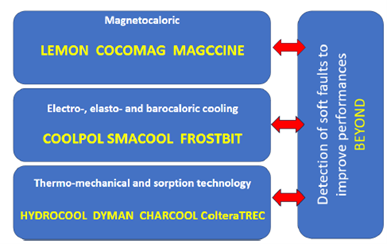
To reach further and go beyond the typical, individual project development, the EIC Clean and Efficient Cooling Portfolio pursues coordinated strategic activities designed to maximize its collective scientific, technological and societal impact. The portfolio brings together eleven EIC Pathfinder projects developing breakthrough cooling solutions with lower energy consumption, reduced environmental impact and limited dependence on CRMs. The projects are organised in complementary thematic areas—magnetocaloric cooling; electro-, elasto- and barocaloric cooling; and thermo-mechanical and sorption technologies—together with a transversal axis on modelling, control, fault detection and maintenance. This structure enables cross-project exchange on common scientific and technological challenges despite differences in physical principles, targeted applications and operating temperatures, which range from cryogenic conditions to near-ambient cooling.
Collaboration is structured through three working groups. The Techno-Scientific Working Group promotes cooperation on shared experimental methods, heat-transfer phenomena, simulation tools, performance indicators, research infrastructure and possible technology hybridisation. The Innovation, Regulation and Standardisation Working Group addresses market positioning, exploitation strategies, intellectual property, stakeholder engagement and common regulatory pathways, including compliance with the F-Gas phase-down and the Kigali Amendment. The Dissemination and Exploitation Working Group coordinates communication, networking, demonstrations and joint outreach. Figure 2 schematizes the main thematic area of each project and the potential interactions.
| Figure 2: Structure of the thematic areas of the projects and potential collaborations. |
SECTION 4: How to follow the development of the projects
Progress across the portfolio can be followed on the joint portfolio website https://eic-cooling.eu/, which provides news and updates on portfolio-wide activities together with links to each individual project’s own website. Additional updates are shared through a portfolio newsletter, the individual projects’ social media channels, and through joint communication and dissemination activities, such as the joint workshop at CLIMA 2025 (Milan) and participation in Thermag XI 2026 (Ljubljana).
Interested readers are encouraged to consult the portfolio website for an overview and contact form, or to reach out to the corresponding Communication Managers directly for updates on specific thematic areas.
[1] E.g. European Green Deal28, the REPowerEU29 plan, Renewable Energy Directive (RED II), and Energy Efficiency Directive (EED)
[2] European Commission: European Innovation Council and SMEs Executive Agency, EIC pathfinder portfolio – Strategic plan clean and efficient cooling – Strategic plan – Brussels, November 2025, 2025, https://data.europa.eu/doi/10.2826/4217925

Alfonso William Mauro
Other authours:
 Christine Minke University of Technology ColteraTREC project |  Adelina Nicolaie European Innovation Coucil Officer and EIC Programme Managers’ office |  Alexander Regnat Kiutra GmbH LEMON project |  Darina Bostova European Innovation Coucil Project Adviser for EIC Pathfinder |
 Emilio Navarro Peris Universitat Politecnica de Valencia – BEYOND project |  Emmanuel-Defay Luxembourg Institute of Science and Technology – COOLPOL project |  Helena Shepherd University of Kent Frostbit project |  Joao Horta Belo Universitade do Porto MAGCCINE project |
 Johannes Bunz European Innovation Coucil Project Officer and EIC Programme Managers’ office |  Krassen Dimitrov Clausthal University of Technology ColteraTREC project |  Paolo Bondavalli European Innovation Coucil EIC Programme Manager for advanced materials for energy |  Patrick Rosa University of Kent Frostbit project |
 Paul Motzki University of Ljubljana – SMACool project |  Steffen Säubert Kiutra GmbH -LEMON project |  Victorino Franco University of Seville – MAGCCINE project |  Walter Mittelbach Sorption Technologies GmbH – DYMAN project |